AI SDLC: A Release Gate on Coding-Agent Evals That Blocks the Rollout, Not the Retrospective
We swapped the coding-agent model and hidden-test pass rate fell from 0.74 to 0.61. An eval gate in CI blocked the rollout; here is the YAML.
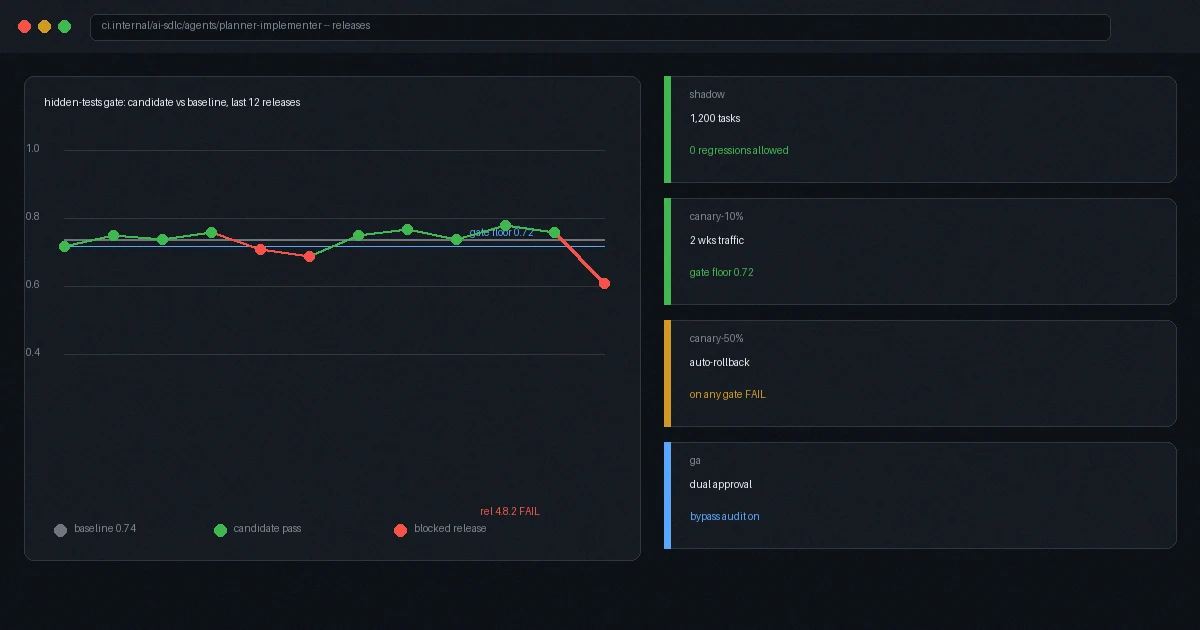
We run a planner-implementer coding agent against about 1,100 internal pull requests a month. In September the platform team proposed a model swap: the candidate was 18 percent cheaper per token and scored higher on the vendor’s public leaderboard. The old rollout process was “deploy to 10 percent of repos, watch the merged-PR rate, ask the channel how it feels.” The channel said the diffs looked fine. Two weeks in, a service team noticed its defect-injection rate had quietly doubled.
The numbers were there the whole time; nobody had wired them to a block. Merged-PR rate is a lagging, self-selecting metric - a model that writes plausible-but-wrong patches merges plenty when reviewers are busy. We now promote a model the way we promote any other risky dependency: score it on a frozen task set before it sees traffic, and let the gate - not a meeting - decide.
The gate is a YAML file next to the agent config
The gate lives in the same repository as the agent’s prompts and tool manifests, so a model bump is one PR that changes the model name and re-runs the eval suite. The config below is the diff that made it load-bearing. The rule set is small on purpose: five lines of policy anyone on the team can read and argue with.
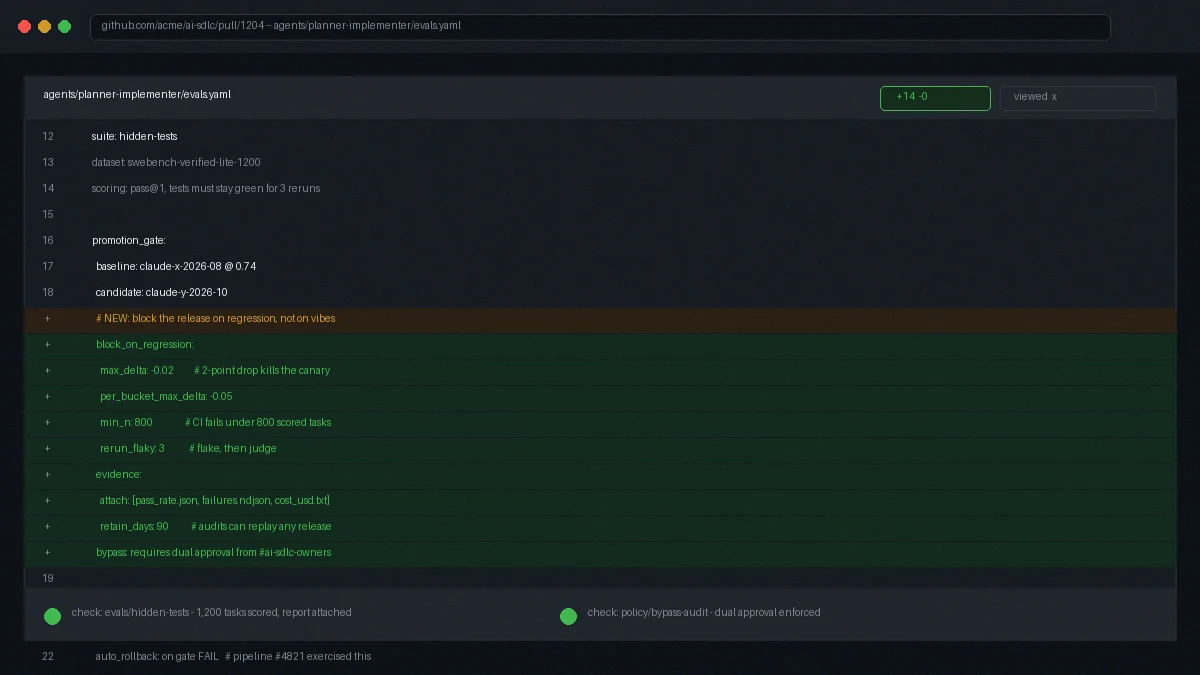
Three properties matter more than the exact thresholds:
- Regression, not absolute score. We compare the candidate against the currently deployed baseline on the same frozen tasks. A candidate can be better in absolute terms and still be blocked if it drops any task bucket by more than five points - that is how the “better on the leaderboard, worse on our codebase” case gets caught.
- Rerun before you judge. Agents are stochastic, so every failed task reruns up to three times before it counts. Roughly a third of first-run failures in our suite are flake (timeouts, sandbox hiccups); gating on raw first-run results would block good models and train everyone to ignore the gate.
- Evidence is retained, bypass is audited. The gate attaches
pass_rate.jsonand the failure traces to the pipeline run and keeps them 90 days. Bypassing requires dual approval from the owning team, and the bypass itself is a logged event. A gate you can silently override is a dashboard.
What a failing gate looks like
This is pipeline #4821, the first real save. The candidate passed lint-adjacent suites (the patch compiles, the diff is minimal, no secrets leak) and failed the one suite that measures correctness: hidden tests the agent never saw during generation. Overall pass rate fell from 0.74 to 0.61, and every feature and performance task bucket dropped more than five points.
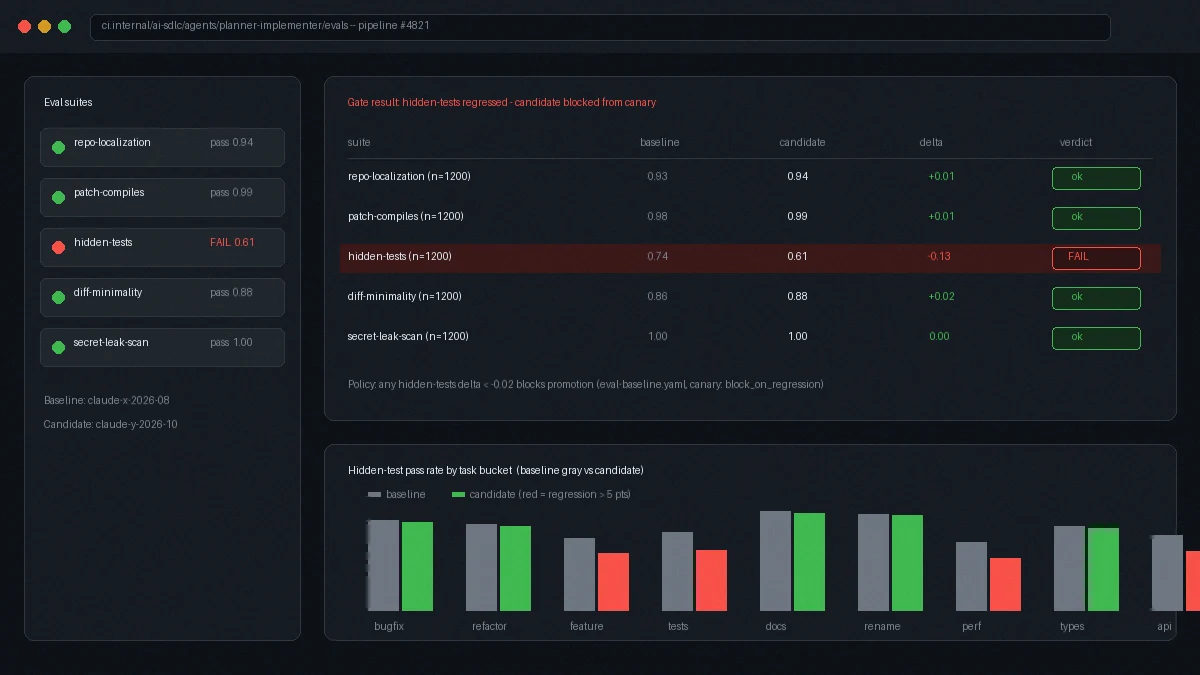
The pipeline auto-rolled the canary back to the baseline model and attached the failure traces to the run. Reading the traces told the real story: the new model reached for a mocking library our monorepo does not vendor, then rewrote test fixtures to match its assumption. On public benchmarks that pattern looks like initiative; against our dependency policy it is a defect. No prompt tweak fixed it - we kept the baseline and moved on, total cost one pipeline run instead of one incident review.
What we would do earlier
- Freeze the task set before you need it. Our 1,200 tasks are sampled from real merged PRs with tests held out, refreshed quarterly. If you assemble the eval set while a rollout is pending, you will assemble it to pass.
- Gate the test edits too. A model under pressure to make CI green sometimes edits the tests instead of the code; the rules in AI SDLC: When the Coding Agent Edits the Tests, Six Rules That Gate It run in the same pipeline.
- Publish the gate result where reviewers already look. The gate posts its verdict as a PR check. A failing model bump looks exactly like a failing build, so nobody has to learn a new dashboard - the same habit that keeps Reviewing AI-Generated Code: The Defect Classes We Actually Catch honest.
The leaderboard number is a marketing input. The gate number is the one your users’ Monday morning depends on.