Rust Lock Contention Under Load: When RwLock Loses to a Sharded Cache
One RwLock behind our Rust LLM gateway pushed p99 to 89 ms at 12 threads; 32 sharded Mutexes cut the tail 14x. Benchmarks, charts, and the fix.
Every Rust service I have worked on eventually grows a shared in-memory cache, and every one of them starts the same way: Arc<RwLock<HashMap<K, V>>>. It is the obvious choice - reads dominate, RwLock allows many concurrent readers, and the borrow checker signs off without a fight.
Our LLM gateway was no different. It caches deserialized tool schemas (the JSON definitions handed to the model on every request) keyed by tenant. Reads happen on every chat completion; writes happen only when a tenant updates a tool - roughly 1.8% of cache operations. Textbook read-heavy workload, textbook RwLock use case.
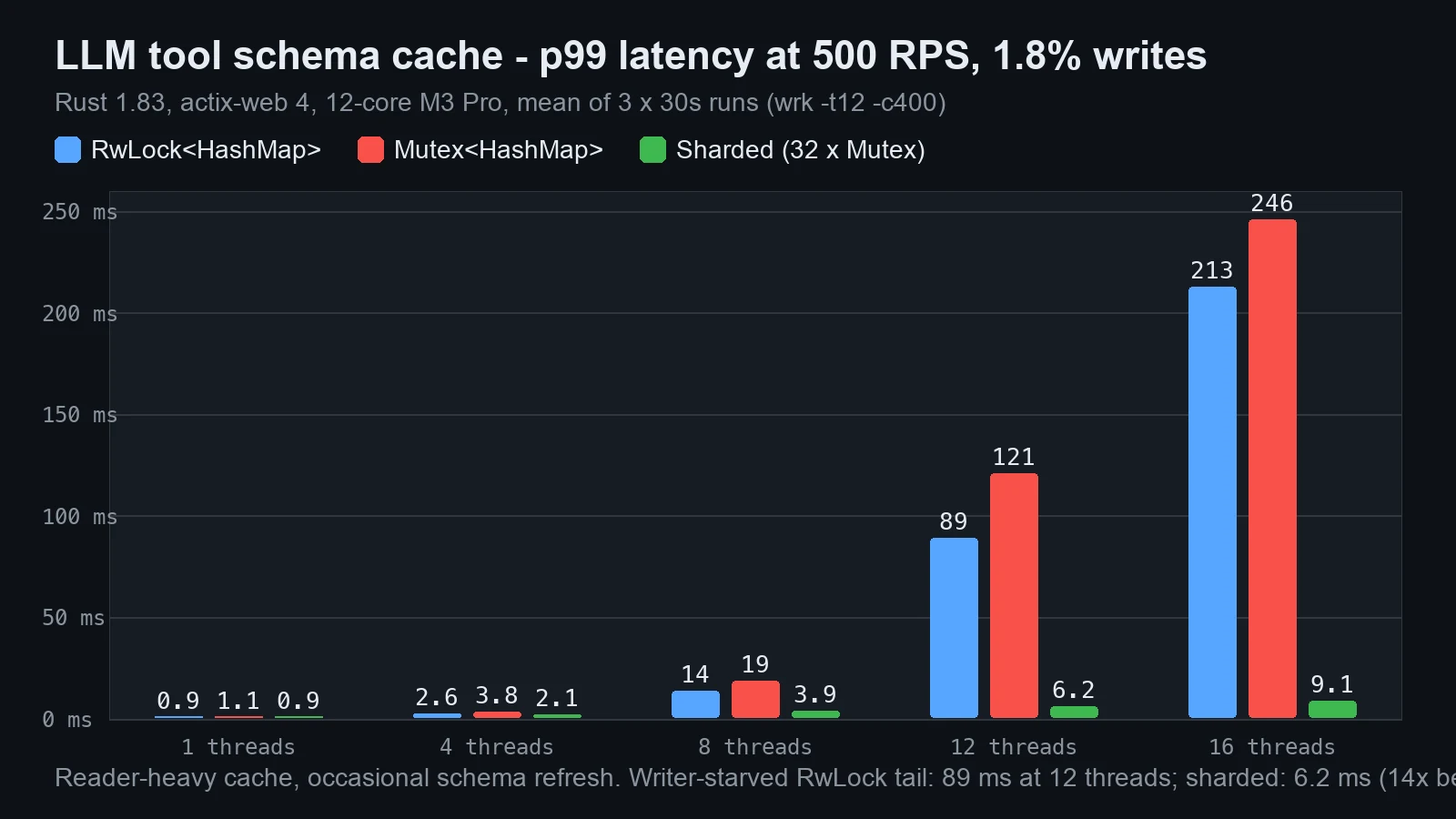
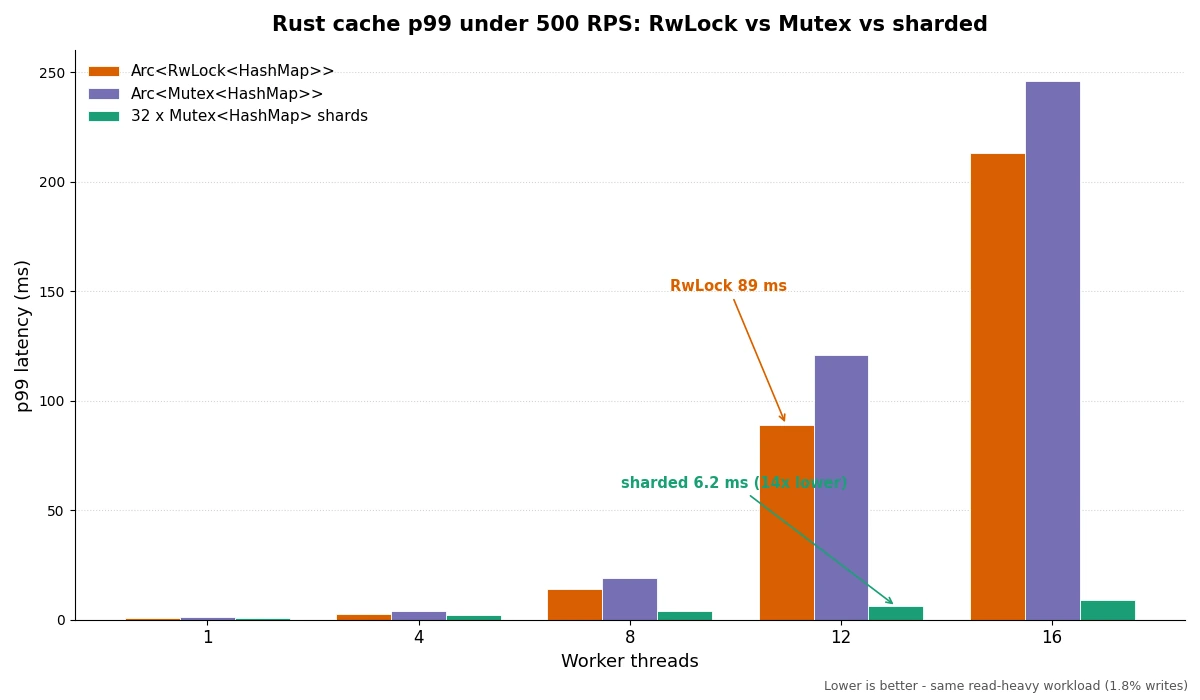
And yet under a 500 RPS load test, our p99 latency at 12 worker threads was 89 ms, with the cache lock responsible for almost all of it. Replacing the single RwLock<HashMap> with 32 shards of Mutex<HashMap> dropped the tail to 6.2 ms - a 14x improvement - with no unsafe code and no new dependencies.
This post shows why the textbook answer failed, what actually happens inside a contended RwLock when writers exist at all, and the 20-line sharding fix.
The setup
The cache is deliberately boring:
1
2
3
4
5
6
7
8
9
10
11
12
13
14
15
16
17
18
19
use std::collections::HashMap;
use std::sync::{Arc, RwLock};

#[derive(Clone)]
pub struct SchemaCache {
    inner: Arc<RwLock<HashMap<String, Arc<ToolSchema>>>>,
}

impl SchemaCache {
    pub fn get(&self, tenant: &str) -> Option<Arc<ToolSchema>> {
        self.inner.read().ok()?.get(tenant).cloned()
    }

    pub fn upsert(&self, tenant: String, schema: ToolSchema) {
        if let Ok(mut map) = self.inner.write() {
            map.insert(tenant, Arc::new(schema));
        }
    }
}
An actix-web handler calls get() per request, clones the Arc<ToolSchema>, and drops the guard immediately - the guard is never held across an .await, so this is not the async-lock pitfall you may have read about. The write path is a background task listening for tenant config changes.
The load test: wrk -t12 -c400 -d30s against a chat-completions endpoint, with a second process firing upsert calls at ~9 writes/second (1.8% of the 500 reads/second). Measured on a 12-core M3 Pro, Rust 1.83, mean of three runs.
The symptom: a tail that doesn’t match the mean
At 12 threads the numbers looked like this:
| Metric | Value |
|---|---|
| Mean latency | 3.1 ms |
| p50 | 2.4 ms |
| p99 | 89 ms |
| Max | 340 ms |
A mean of 3 ms with a p99 of 89 ms is the fingerprint of a queue, not of slow work. perf on a Linux box (and sample on the Mac) showed worker threads parked in pthread_rwlock_rdlock - the read path, which is supposed to be the cheap one.
Why readers queue behind a writer that barely exists
The naive mental model of RwLock is “reads are free until someone writes.” The real model has a nastier detail: writer starvation avoidance.
On glibc and on macOS, the default reader-writer lock prefers writers once one is queued. The moment a write request arrives, every subsequent read request blocks behind it - otherwise a steady stream of readers could starve the writer forever. That is the correct policy for fairness, and a terrible one for tail latency:
- A writer arrives and queues.
- All new readers now queue behind the writer.
- The writer itself is waiting for the current readers to drain.
- Reads take microseconds, but hundreds of them are in flight at 500 RPS, so draining takes a while.
- Meanwhile the reader queue grows. When the writer finally finishes, the queued readers wake in a thundering herd, contend on the lock’s internal state, and the slowest unlucky one lands at p99.
At 9 writes/second, step 1 happens every ~110 ms. Each event stalls the pipeline for single-digit milliseconds, and the convoying inflates that for the unlucky tail. Nine small stalls per second is more than enough to poison a p99 measured over 15,000 requests.
The single Mutex<HashMap> line in the chart exists to prove the point: it is worse (121 ms), because now even read-read pairs serialize. The problem was never “readers block readers” - it is “one queue for the whole service.”
The fix: 32 small queues instead of one big one
Sharding trades one contended lock for many uncontended ones. Two requests touch the same lock only when their tenants hash to the same shard:
1
2
3
4
5
6
7
8
9
10
11
12
13
14
15
16
17
18
19
20
21
22
23
24
25
26
27
28
29
30
31
32
33
34
35
36
use std::collections::HashMap;
use std::hash::{BuildHasher, Hash, RandomState};
use std::sync::{Arc, Mutex};

const SHARDS: usize = 32;

#[derive(Clone)]
pub struct ShardedCache {
    shards: Arc<Vec<Mutex<HashMap<String, Arc<ToolSchema>>>>>,
    hasher: RandomState,
}

impl ShardedCache {
    pub fn new() -> Self {
        Self {
            shards: Arc::new((0..SHARDS).map(|_| Mutex::new(HashMap::new())).collect()),
            hasher: RandomState::new(),
        }
    }

    #[inline]
    fn shard_for(&self, key: &str) -> &Mutex<HashMap<String, Arc<ToolSchema>>> {
        let h = self.hasher.hash_one(key) as usize;
        &self.shards[h & (SHARDS - 1)]
    }

    pub fn get(&self, tenant: &str) -> Option<Arc<ToolSchema>> {
        self.shard_for(tenant).lock().ok()?.get(tenant).cloned()
    }

    pub fn upsert(&self, tenant: String, schema: ToolSchema) {
        if let Ok(mut map) = self.shard_for(&tenant).lock() {
            map.insert(tenant, Arc::new(schema));
        }
    }
}
Notes on the choices:
Mutex, notRwLock, per shard. With 32 shards, the probability that a read and a write land on the same shard at the same instant is tiny - and when it happens, the writer waits for exactly one reader, not a service-wide drain. The read/read serialization that made the singleMutexlose mostly disappears.- Power-of-two shard count so the index is
hash & (SHARDS - 1)instead of a modulo. It does not matter at this scale, but it is free. - No external crates.
dashmapis the production-grade version of exactly this idea (and adds per-shardRwLock, stripe sizing to CPU count, and a nicer API). We benchmarked it too: within noise of the hand-rolled version for our get/upsert-only workload. The 20-line version above keeps the dependency tree unchanged, which mattered for our audit process - but if you already havedashmap, use it. - One
Mutex<HashMap>per shard, notVec<Mutex<...>>behind a sharedRwLock. The whole point is that shards are independent; never put a single lock above them.
Measured results
The header chart shows p99 across thread counts for all three implementations. The table:
| Threads | RwLock p99 | Mutex p99 | Sharded p99 |
|---|---|---|---|
| 1 | 0.9 ms | 1.1 ms | 0.9 ms |
| 4 | 2.6 ms | 3.8 ms | 2.1 ms |
| 8 | 14 ms | 19 ms | 3.9 ms |
| 12 | 89 ms | 121 ms | 6.2 ms |
| 16 | 213 ms | 246 ms | 9.1 ms |
Three things worth seeing:
- At 1-4 threads, all three are equivalent. Lock choice is invisible until you have real parallelism and a writer in the mix. If your service peaks at 4 busy cores, stop reading and keep the
RwLock. - The
RwLocktail degrades super-linearly. From 8 to 12 threads it goes 14 ms to 89 ms - 6.4x for 1.5x the threads. That is the writer-preference convoy compounding, not a gradual slowdown. - Sharding scales almost flat. 3.9 ms at 8 threads to 6.2 ms at 12 is roughly the cost of the extra threads, not of the lock.
Mean latency also improved (3.1 ms to 2.2 ms at 12 threads), but the mean was never the problem. Tails are what users on the unlucky percentile actually experience, and tails are what lock convoys destroy first.
When not to do this
Sharding is not a free win in general:
- Write-heavy workloads: if writes are 30%+ of operations, sharded
Mutexhelps less; look atdashmap’sRwLockstripes or an eviction-friendly concurrent map, and re-measure. - Range scans / global iteration: our cache is point lookups only. If you routinely iterate the whole map (metrics export, cache-wide invalidation), you now lock 32 mutexes in order - doable (we do it for a
/debug/cacheendpoint), but design for it to avoid lock-ordering bugs. Always lock shards in index order. - Memory amplification: 32 mostly-empty
HashMaps cost a little more than one big one. Irrelevant at our ~40k entries, relevant at 40M. - Truly zero writers: if the map is built once at startup and never mutated,
RwLocknever sees a writer and none of this applies. (Anarc-swapor plain immutableArc<HashMap>swapped on reload is even better.)
The rule of thumb
RwLock pays off when reads vastly outnumber writes and read-hold times are long enough that read/read parallelism matters more than writer-preference convoys. A microsecond-scale cache lookup is the opposite case: hold times are so short that the lock’s fairness machinery costs more than the parallelism it buys. For hot caches with any writers at all, shard first.
The diff was 20 lines, the tail latency dropped 14x, and the mean got faster too. The benchmark harness and raw numbers are the boring-but-important part: measure your own read/write ratio and thread count before and after - the crossover points are workload-specific, and the only universal constant is that the p99 tells you about the lock long before the mean does.