AI SDLC: Reviewing AI-Generated Code - The Seven Defect Classes Green Tests Missed and the Checklist That Cut Escapes 65%
Seven defect classes human reviewers found in 312 green coding-agent PRs, and the seven-item checklist that cut post-merge defects from 23 to 8 per 100 PRs.
Every coding-agent pull request we merged last quarter arrived green. The build passed, the unit tests passed, the agent’s own summary said the change was complete. We still logged 184 defects across 312 of those PRs, and 38 of them reached main. This post is about what the human reviewers found, why the automated gates did not find it first, and the short checklist that changed the numbers.
It sits between two earlier posts: gating agent PRs before merge covers the mechanical gates, and human vs agent PR review compares reviewers. Here the question is narrower: when a person opens an AI-written diff, what should they look for?
The data
- 312 pull requests opened by coding agents (GitHub Copilot coding agent and an internal Claude-based agent) across nine .NET 8 and TypeScript services, June to September 2026.
- Every PR passed
dotnet build/tsc, unit tests and the linters before a human saw it. - Reviewers tagged each finding with a defect class in the PR comment. Post-merge defects were tagged from incident and bug tickets linked back to the PR.
- Weeks 1-6 used the team’s ordinary review template. Weeks 7-12 added the seven-item checklist below to the PR template for agent-authored PRs only.
The seven defect classes
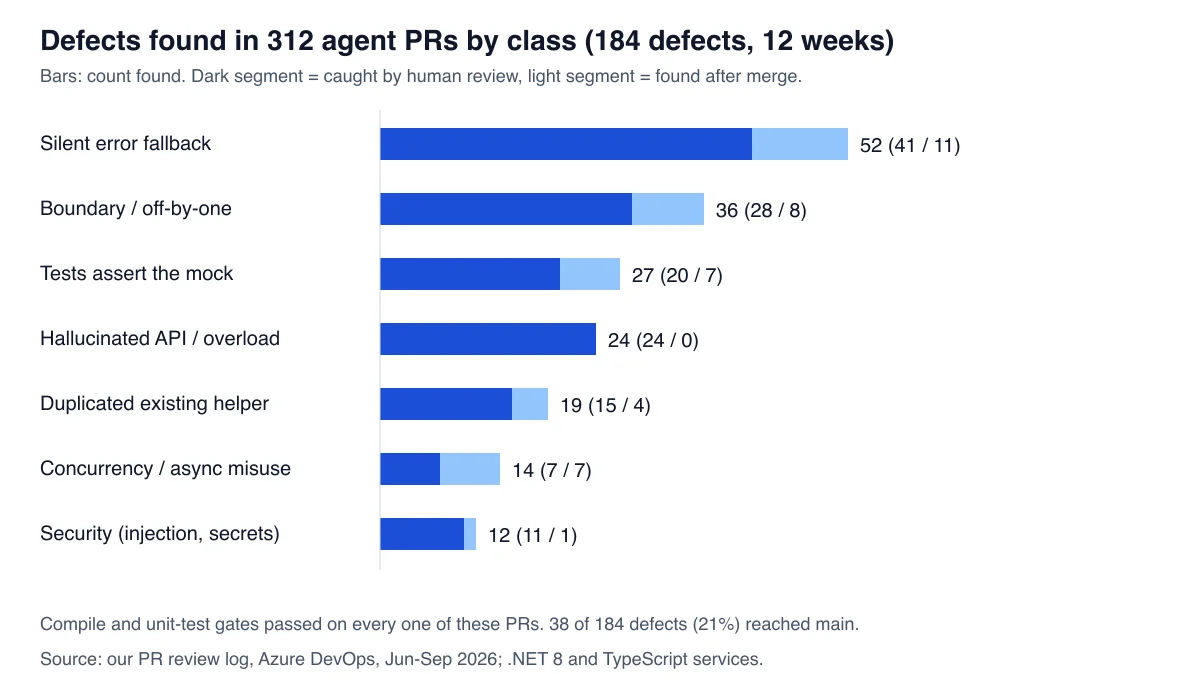
1. Silent error fallback (52)
The single biggest class, and the one that most often escaped. The agent wraps the risky call, catches everything and returns a default so that the happy-path test passes:
1
2
3
4
5
6
7
8
9
10
11
public async Task<Customer?> GetAsync(Guid id)
{
    try
    {
        return await _repo.FindAsync(id);
    }
    catch (Exception)
    {
        return null; // agent added: "handle errors gracefully"
    }
}
Nothing in the test suite exercises a database timeout, so the test stays green while a transient outage turns into “customer not found” for every caller. The TypeScript variant is catch { return [] } or .catch(() => undefined). Eleven of the 52 reached production; three of those became incidents.
2. Boundary and off-by-one (36)
Pagination offsets never checked against the total, Substring on strings shorter than the assumed prefix, date ranges that include the end day in one place and exclude it in another. Agents produce idiomatic-looking loops and slices; they rarely write the test for the empty collection or the last page unless asked.
3. Tests that assert the mock (27)
The PR includes tests, coverage goes up, and the tests prove nothing:
1
2
3
_mock.Setup(r => r.FindAsync(id)).ReturnsAsync(customer);
var result = await sut.GetAsync(id);
Assert.Equal(customer, result); // asserts the mock, not the behaviour
Twenty of 27 were caught in review once reviewers started reading test bodies instead of the coverage delta. This class is why we stopped treating a coverage increase as a positive signal on agent PRs.
4. Hallucinated API or overload (24)
A method that does not exist on that version of the library, or an overload with the parameters in a plausible but wrong order. Every one was caught before merge, because the compiler or a type check failed on the reviewer’s machine when the agent’s run had used a cached or different package. These cost review time rather than production incidents; the fix was pinning the agent’s environment to the lockfile, covered in the dependency upgrades post.
5. Duplicated existing helper (19)
A new ParseIsoDate, NormaliseEmail or retry wrapper next to one that already existed two folders away. Not a bug on day one, but four of these diverged within the quarter and produced inconsistent behaviour between endpoints. An AGENTS.md pointer to the shared utilities folder reduced this class noticeably in weeks 9-12.
6. Concurrency and async misuse (14)
.Result and .Wait() on async calls inside ASP.NET request handling, Task.Run wrapping already-async I/O, a shared Dictionary mutated from Parallel.ForEach. Half of these escaped review - the lowest catch rate of any class - because they look correct and only misbehave under load. These are the ones the checklist moves to a named reviewer.
7. Security (12)
String-concatenated SQL in a reporting query, a connection string pasted into a test fixture, user input reaching a Process.Start argument. Eleven of twelve were caught, mostly by the existing secret scanner and static analysis rather than by eyes. The one that escaped was a log line that included a bearer token.
Why the gates missed them
The pattern across classes 1, 2, 3 and 6 is the same: the defect is in behaviour the test suite does not exercise, and the agent wrote both the code and the tests. An agent optimising for “tests pass” will, quite reasonably, write tests that pass. Compile and unit-test gates verify internal consistency of the PR, not its correctness against the system it lands in. That is what the human review slot is for, and the generic template (“does this look right?”) was not pointing reviewers at the places AI code goes wrong.
The seven-item checklist
This is the block we added to the PR template for agent-authored PRs. It is deliberately short enough to actually be done.
1
2
3
4
5
6
7
8
## AI-authored PR review
- [ ] Every new `catch` either rethrows, logs with context, or is justified in a comment.
- [ ] Empty, single-item and last-page cases have a test or are provably unreachable.
- [ ] At least one new test would fail if the production code were deleted.
- [ ] No new helper duplicates something under `src/Shared` (searched by name and intent).
- [ ] No `.Result`, `.Wait()`, or `Task.Run` around I/O; shared state under parallelism is named.
- [ ] No string-built SQL/shell, no literals that look like credentials, no tokens in logs.
- [ ] I ran it locally, not just read it.
Item three is the one reviewers said changed their habits most: it forces reading a test for what it would catch, not whether it exists.
What changed
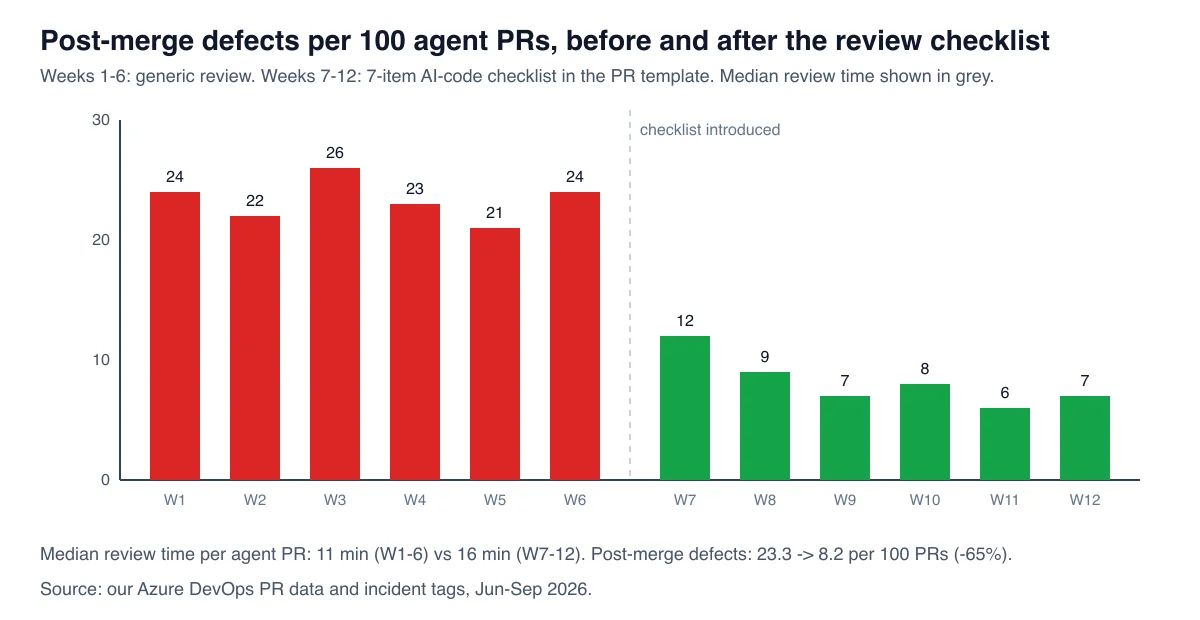
- Post-merge defects per 100 agent PRs: 23.3 (weeks 1-6) to 8.2 (weeks 7-12), a 65% drop.
- Median review time per agent PR: 11 minutes to 16 minutes. Five extra minutes per PR against roughly 15 fewer post-merge defects per 100 PRs; the cheapest fix we made this year.
- Silent-fallback escapes went from 9 to 2. Concurrency escapes went from 5 to 2, and the remaining two were both in PRs where the named reviewer item was skipped.
- Agent PR acceptance rate did not fall. Reviewers requested changes more often, but the changes were small and the agent usually fixed them in one round.
Caveats
This is one organisation’s log, nine services, one quarter, and reviewers knew they were being measured. The checklist also coincided with an AGENTS.md update, so the duplicated-helper drop is not attributable to the checklist alone. Treat the classes as a starting taxonomy and the numbers as a reason to measure your own, as the published-evidence post argues more generally.