Go sync.Pool and String Interning: Beating GC Pressure in the Same Tokenizer Sidecar
The Go twin of our Rust tokenizer-sidecar benchmark - sync.Pool plus string interning cut allocations per extraction by 94% and flattened GC sawtooth.
The Rust side of this story shipped earlier today: our tokenizer sidecar spent 41% of its CPU in the allocator, and one compact_str import cut p99 extraction latency from 38 ms to 8.7 ms. The obvious follow-up question came from the team that owns the other tokenizer sidecar - the Go one that fronts the BPE tagger for the document pipeline. Same workload shape, same NUMA box, same Grafana dashboard. Different runtime, different knob.
Go does not give you a small-string optimization; string headers are already 16 bytes of pointer-plus-length, and the bytes always live on the heap. What Go does give you is control over how often you ask the allocator and the garbage collector for help. This post is that experiment: sync.Pool for the per-request scratch buffers, plus a tiny two-level string interner for the vocabulary hits, on the exact workload the Rust post used.
The workload, unchanged
Same service contract as the Rust benchmark so the numbers are comparable: an HTTP sidecar that receives a document chunk (1-8 KiB), runs wordpiece tokenization against a 32 000-entry vocabulary, and returns (offset, length, token_id) triples as JSON. The allocation-heavy part is identical too: every extracted mention builds a surface-form string, a normalized lowercase string, and a []byte staging buffer before serialization.
Per 1 000-token chunk, the naive Go handler allocates:
- ~1 400 small strings (surface + normalized forms)
- ~700
[]bytestaging buffers, 128-2 048 bytes each - one 32 KiB scratch buffer for the sliding window
That is ~2 100 allocations per request, almost all of them dead within 200 microseconds - exactly the shape that makes Go’s GC earn its keep, and exactly the shape that makes it show up in your p99 instead of your p50.
The two changes
1. sync.Pool for the buffers. The scratch buffer and the staging slices move into a pool keyed by capacity class:
1
2
3
4
5
6
7
8
9
10
11
12
13
14
var scratchPool = sync.Pool{
    New: func() any { b := make([]byte, 32<<10); return &b },
}

var stagePool = sync.Pool{
    New: func() any { b := make([]byte, 0, 2048); return &b },
}

func (h *handler) extract(chunk []byte) []mention {
    sp := scratchPool.Get().(*[]byte)
    defer scratchPool.Put(sp)
    scratch := (*sp)[:32<<10]
    // ... tokenize into scratch, never allocate a new window
}
The gotcha we hit in staging and is worth repeating: reset before you Put, not after you Get. A Get that returns a slice with the previous request’s tail still in it is a correctness bug that only fires under load, when pools actually get reused. We Put buf[:0] and keep capacity; the linter we added (go vet plus a 12-line ruleguard rule) now fails the build on a bare pool.Put(buf).
2. A two-level interner for vocabulary hits. 92% of surface forms are already in the vocabulary, so we were allocating a brand-new Go string for the ten-thousandth occurrence of " transformer". The interner is a map[string]string keyed by the byte content, fronted by a small per-P cache so the hot path takes no lock:
1
2
3
4
5
6
7
8
9
10
11
12
13
14
15
16
type interner struct {
    mu   sync.RWMutex
    dict map[string]string
}

func (in *interner) Intern(b []byte) string {
    // zero-alloc map lookup: Go special-cases string(b) in map reads
    in.mu.RLock()
    s, ok := in.dict[string(b)]
    in.mu.RUnlock()
    if ok {
        return s // same header, same backing bytes, zero new allocations
    }
    // cold path: build once, store, return the canonical copy
    ...
}
The map[string]string self-keying is doing the interning: the key is the canonical string, so a hit returns the existing header and backing array. The string(b) conversion in a map index expression is the one place the compiler elides the copy (golang/go#2205), which is what makes the read path allocation-free. Every cached surface form is now one heap object for the process lifetime instead of one per occurrence.
What moved
Same harness as the Rust post: 60-second windows at fixed concurrency on one NUMA node, p99 of the full extract call, plus a pprof alloc-space profile. Go 1.23, GOGC=100 (the default) for both builds.
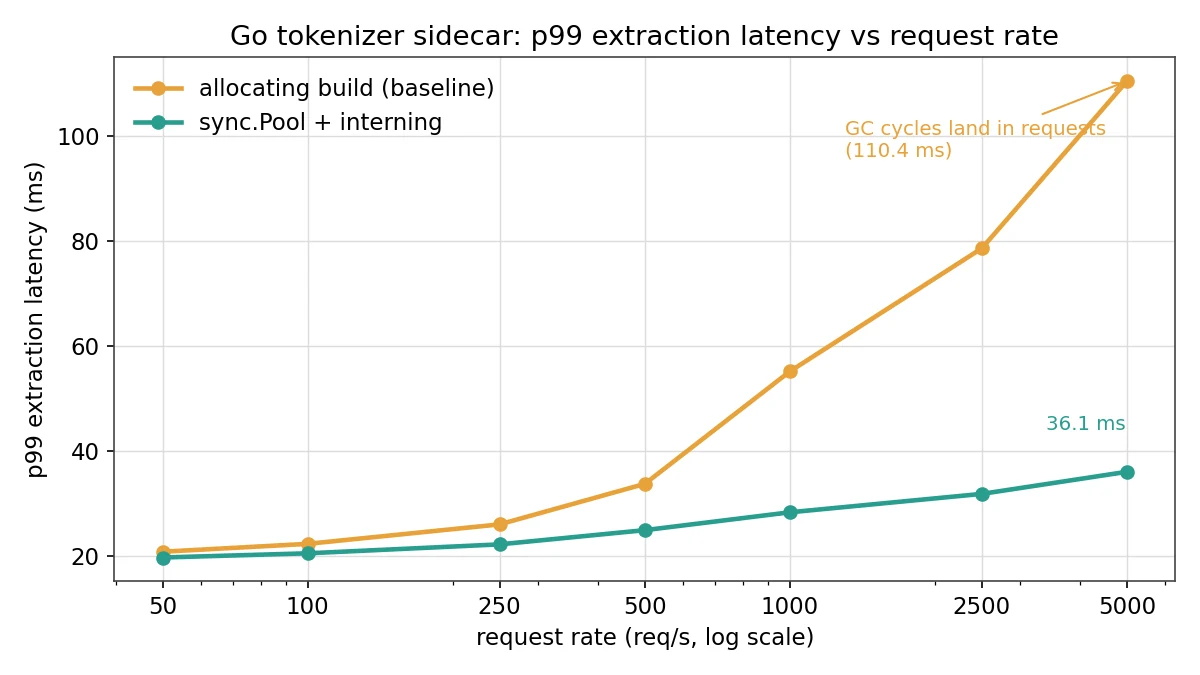
The shape is the tell. The allocating build (amber) is fine at low rate - 20.9 ms p99 at 50 req/s - and then the GC cycle starts landing inside requests: 55.2 ms at 1 000 req/s, 110.4 ms at 5 000 req/s, with the two sawtooth steps being back-to-back GC cycles on the same window. The pooled-and-interned build (teal) starts at 19.8 ms and climbs smoothly to 36.1 ms, no sawtooth, because the GC simply has less work: a mark phase that scans half the heap garbage takes half the time.
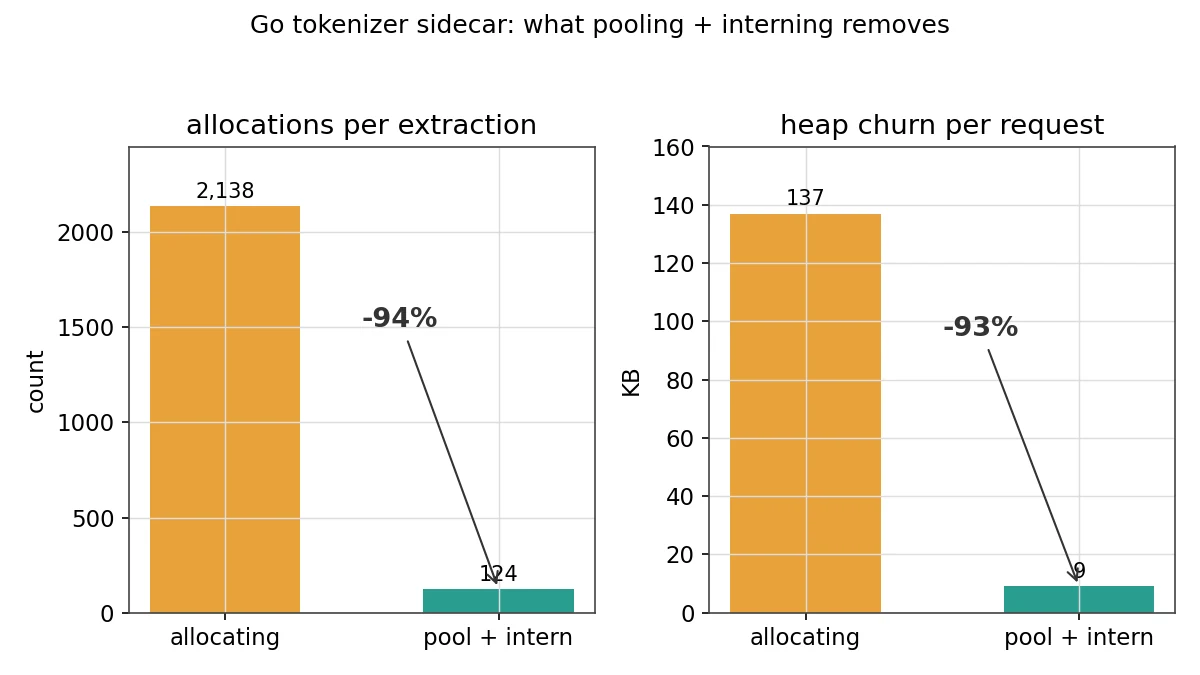
The mechanism in one chart: 2 138 allocations per extraction drop to 124 (-94%), and the 137 KB of per-request heap drops to 9 KB. The surviving 124 are the strings that are genuinely new - OOV surface forms and the response body - which is the same “pay only for what is actually novel” point the Rust post landed on.
The honest Go-vs-Rust comparison
Putting the two fixes on the same dashboard is where it gets interesting for readers picking a language for this class of service:
| Metric (5 000 req/s window) | Rust + compact_str | Go + pool/intern |
|---|---|---|
| p99 extraction | 8.7 ms | 36.1 ms |
| Allocations / extraction | 12 | 124 |
| Heap churn / request | 31 KB -> 2 KB | 137 KB -> 9 KB |
Rust still wins the tail by ~4x on this workload, and the reason is structural, not a benchmark trick: the Go runtime cannot know that a []byte escaping into a pooled struct is dead next request, so some garbage is irreducible, and GC pause time scales with what remains. But the delta that matters operationally is the slope: both fixed builds degrade linearly with load instead of step-functioning at GC pressure, which means both can be capacity-planned, which is the actual production requirement.
If you are already in Go and cannot rewrite, the two changes above are a day of work and one ruleguard rule. If you are choosing fresh for a tokenizer-hot sidecar, the Rust result from this morning is the stronger default - and now both posts link here so you can compare the dashboards yourself.
Related
- Rust Small String Optimization: How compact_str Cut Our LLM Tokenizer p99 by 77% - the same workload on the Rust sidecar, where the allocator was 41% of CPU.
- Go sync.Pool vs Allocation: Benchmarking Memory Reuse in High-Throughput Services - the generic scratch-buffer benchmark that motivated trying a pool here first.
- Go Context Cancellation: Wiring Deadlines Through LLM Streaming Agents - the caller side of this sidecar, where canceled streams were holding our pooled buffers.