Navigating OData APIs with Dotnet 8 and C#: Exploring Options and Drawbacks
Compare ways to call OData REST APIs from .NET 8 and C#: Simple.OData.Client, the OData Connected Service and raw HttpClient, with the drawbacks of each.
TL;DR
OData or Open Data Protocol is a very powerful protocol for REST APIs, if you are working on ERP, CRM, or any enterprise-related integrations you must have come across this. In this post, we are going to talk about how you can interact with OData rest APIs in your dotnet8 c# application.
If you are interested in benchmarking among these, please visit the blog
What is OData
OData (Open Data Protocol) is an open protocol that defines a set of best practices for building and consuming RESTful APIs. It provides a standardized and consistent way to expose and consume data across different platforms and programming languages. OData APIs are widely used in data-centric applications, such as enterprise applications, mobile apps, and web services.
Key Features of OData
RESTful
OData APIs follow RESTful principles, which means they use HTTP methods (GET, POST, PUT, DELETE) to access and manipulate data.
Metadata
OData APIs provide machine-readable metadata that describes the data model and how to interact with it. This metadata can be used by client applications to automatically generate code for accessing and manipulating data.
OData APIs support powerful querying capabilities that allow users to filter, sort, and paginate data.
Here is what that looks like in practice: a single GET with $filter, $select, $orderby and $top on a Customers entity set, and the JSON response the service returns, including the @odata.nextLink you follow to get the next page.
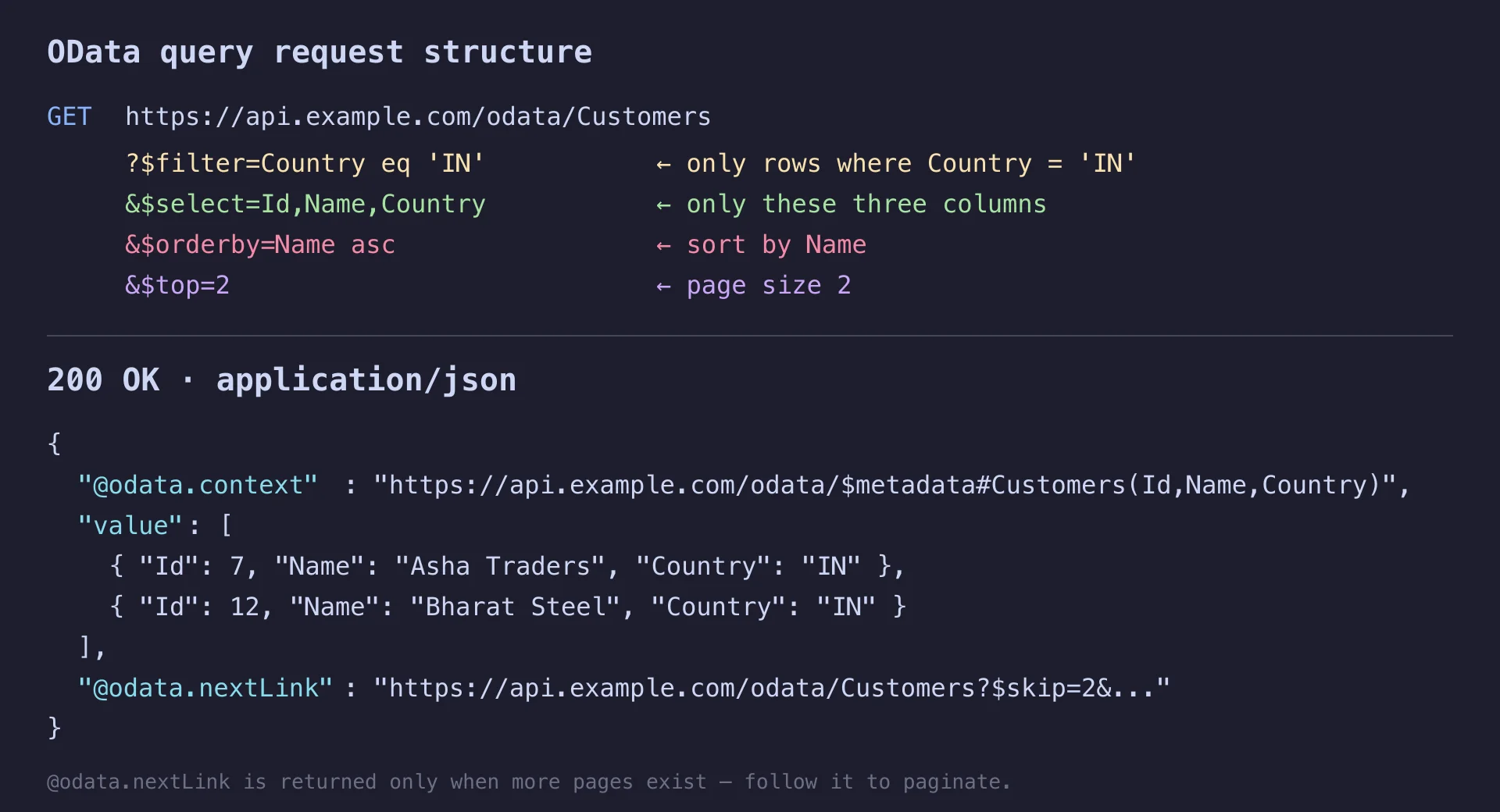 A worked OData query: the URL options on the request and the shape of the paged JSON result.
OData APIs support various data formats, including JSON and XML, to make data accessible to a wide range of applications.
Benefits of Using OData
OData APIs can be consumed by applications developed in different programming languages, making it easier to share data between systems.
OData metadata makes it easy for clients to discover the available data and how to interact with it.
OData APIs provide a consistent way to access and manipulate data, reducing the amount of code that developers need to write.
Common Use Cases for OData:
Exposing data from enterprise applications to web services and mobile apps
Sharing data between different applications and platforms
Enabling data access for external developers and partners
Building data-driven applications and dashboards
How to use it with dotnet 8 and c#
Connecting to an OData-based API in Dotnet 8 and C# can be achieved using various approaches, each with its own set of advantages and disadvantages.
Here’s a breakdown of the common options:
Conclusion
Overall, OData is a powerful and versatile protocol that can be used to build modern data-centric applications. By following OData best practices, developers can create APIs that are easy to use, interoperable, and discoverable.
Other
If you want to explore your OData metadata, you can visit an open-source project created by me (open the site and pick “Explorer” in the top navigation). By using this tool you can get the data types, enum values, and other useful information.