AI Pricing Calculator: Estimating LLM API Costs Before You Ship
How the Lamplit Labs AI Pricing Calculator turns tokens per request and daily volume into a monthly LLM bill and compares models before you commit.
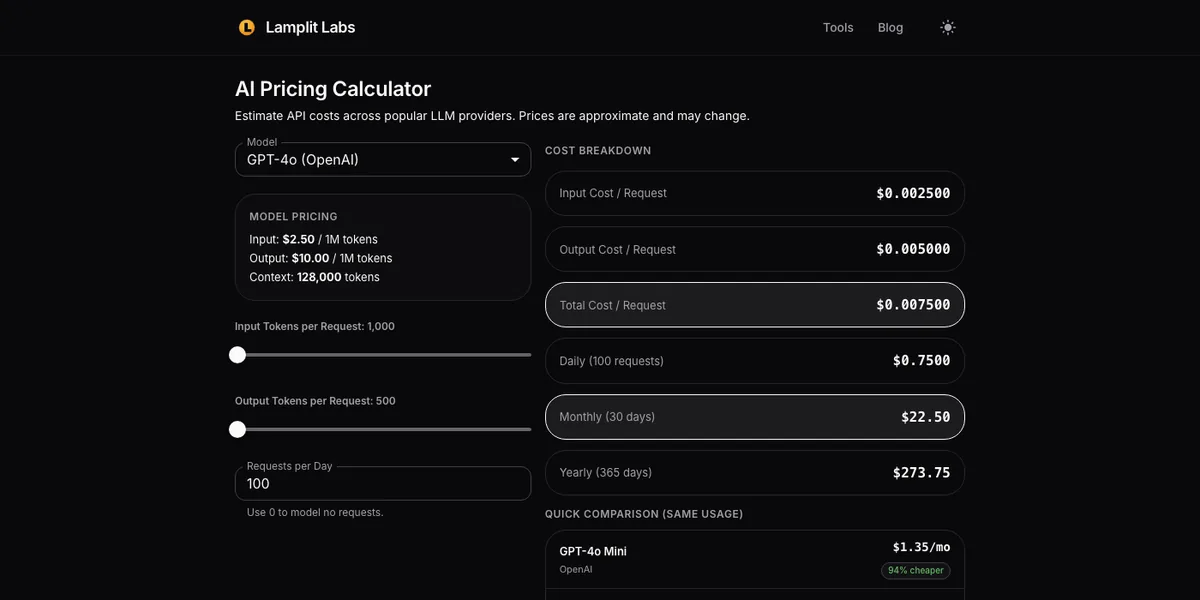
The first question a finance lead asks about an LLM feature is not “does it work” but “what will it cost at volume”. Most teams answer it with a spreadsheet that goes stale the moment a provider changes a price or the prompt grows by a few hundred tokens. We built the AI Pricing Calculator at Lamplit Labs to make that estimate a thirty-second exercise you can repeat every time the prompt, the model or the traffic forecast changes. Like the rest of the tools site, it runs entirely in the browser; nothing you type leaves your machine.
What the calculator takes as input
There are only four knobs, and they map directly onto how providers bill:
- Model. Pick a provider model; the calculator fills in the input and output price per million tokens and the context window.
- Input tokens per request. Your system prompt plus the user message plus any retrieved context. Measure this, do not guess: the token counter on the same site gives you the number for a representative prompt.
- Output tokens per request. The length of the answer. Output is usually billed at three to five times the input rate, so this knob matters more than its size suggests.
- Requests per day. Your traffic forecast. Set it to zero to see per-request cost only.
Reading the breakdown
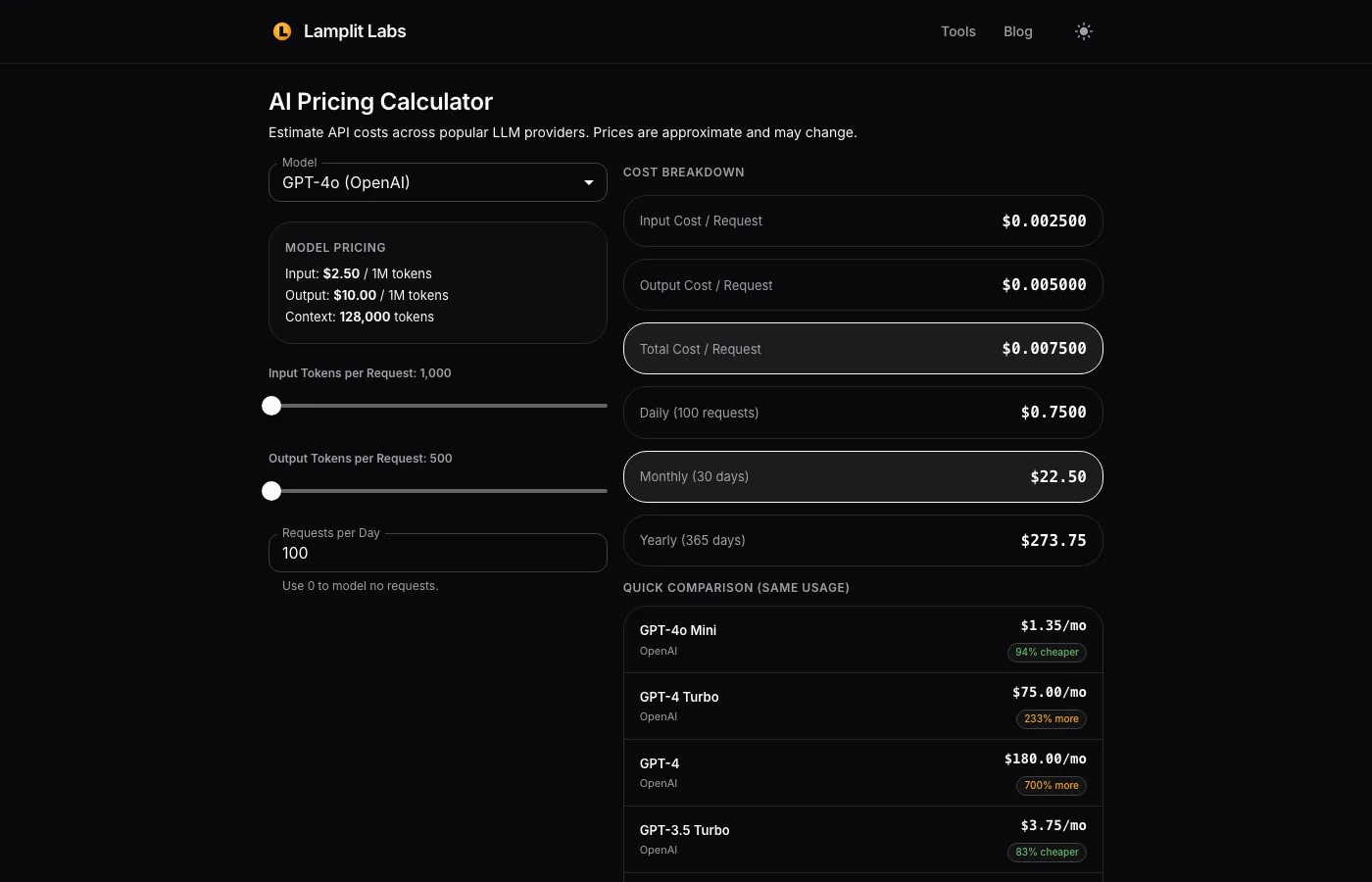
The defaults in the screenshot are deliberately modest: GPT-4o, 1,000 input tokens, 500 output tokens, 100 requests a day. That gives $0.0075 per request, $0.75 a day and $22.50 a month. Two things are worth noticing.
First, the output half of the bill ($0.005) is twice the input half ($0.0025) even though the response is half the length. If you are trying to cut cost, trimming the answer or asking for structured output that stops early pays off faster than shaving the prompt.
Second, the Quick Comparison block reruns the same usage against the provider’s other models. At this usage GPT-4o Mini comes out at $1.35 a month, 94% cheaper, and GPT-4 Turbo at $75, 233% more. That comparison is the real product: it turns “should we use the smaller model” from an argument into a number you can weigh against an eval score.
How we use it in enterprise estimates
When we scope an Enterprise AI engagement we run the calculator three times per candidate model and keep all three numbers in the proposal:
- Pilot volume (tens to hundreds of requests a day) to show the cost of learning.
- Expected production volume from the client’s own traffic data.
- A 5x spike to show what happens if adoption is better than planned.
The spread between the second and third numbers is usually what decides whether the design needs caching, a cheaper routing tier for simple requests or a hard daily budget. Doing that arithmetic in a shared tool, rather than in one engineer’s spreadsheet, means the client can rerun it after we leave. For a worked example of what those costs look like in practice, see the real cost of AI automation.
Limits to keep in mind
The prices are published list prices and are marked as approximate; they change, and negotiated enterprise rates, batch discounts and prompt caching are not modelled. The calculator also assumes every request is the same size. If your traffic is bimodal, run it twice and add the results. It is an estimate for sizing decisions, not an invoice forecast.