AI SDLC: Running an LLM Eval Harness as a CI Quality Gate in .NET - Thresholds, Regression Budgets and the Pipeline That Blocks Prompt Drift
Turn an LLM eval suite into a CI gate in .NET: a harness with four metrics, a diff against main, a regression budget and a GitHub Actions job that fails the PR.
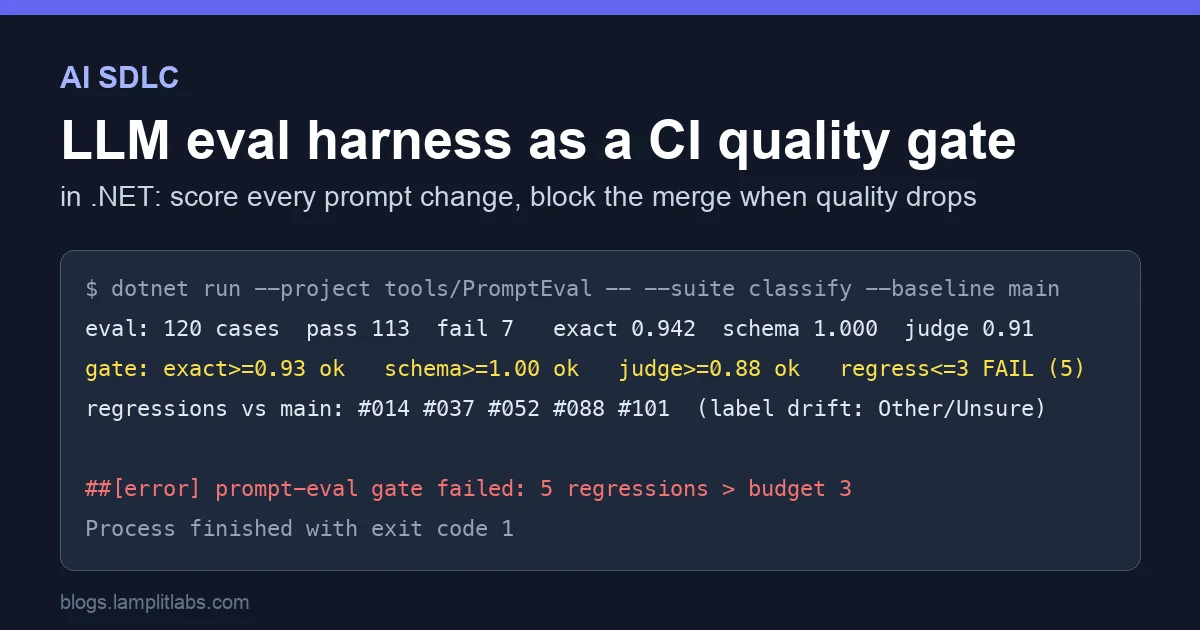
The prompt regression tests post ended with a nightly live run that scored the real model. That caught drift, but it caught it the morning after the prompt change had merged. This post closes the gap: the same eval suite runs on the pull request, compares the branch against main, and fails the check when quality drops. The harness is a small .NET console app, the gate is forty lines of YAML, and everything here is copy-and-adapt.
What a gate needs that a test suite does not
An xUnit test is pass or fail per case. An eval gate has to answer a different question: is this prompt change acceptable? Four things turned out to matter:
- Metrics, not assertions. A single wrong label out of 120 should not block a PR; a 3% drop in exact match should. The harness emits scores, and the gate applies thresholds.
- A baseline from
main. Absolute thresholds catch collapses. Only a diff against the currentmaincatches a prompt that got slightly worse on the cases it used to get right. - A regression budget. The number of individual cases that flipped from pass to fail. This is the metric reviewers actually read, because it comes with case ids they can open.
- Determinism where possible.
temperature = 0, a pinned model deployment, a fixed case order and a recorded-response mode for the cheap first pass.
The harness: tools/PromptEval
One console project, no framework. It reads a JSONL suite, runs the prompt under test, scores each case and writes a JSON report. The data shapes:
1
2
3
4
5
6
7
8
9
10
11
12
13
14
15
16
17
18
19
20
21
22
23
24
25
26
27
28
29
public sealed record EvalCase(
    string Id,
    string Input,
    string Expected,          // expected label or canonical answer
    string[]? MustContain,    // optional substrings for free-text answers
    string? Rubric);          // optional judge rubric for this case

public sealed record CaseResult(
    string Id,
    bool Exact,
    bool Schema,
    double Judge,
    string Actual,
    int PromptTokens,
    int CompletionTokens,
    long Ms);

public sealed record EvalReport(
    string Suite,
    string PromptVersion,
    string Model,
    DateTimeOffset RunAt,
    IReadOnlyList<CaseResult> Cases)
{
    public double ExactRate  => Cases.Average(c => c.Exact ? 1.0 : 0.0);
    public double SchemaRate => Cases.Average(c => c.Schema ? 1.0 : 0.0);
    public double JudgeMean  => Cases.Average(c => c.Judge);
    public double CostUsd    => Cases.Sum(c => c.PromptTokens * 0.15e-6 + c.CompletionTokens * 0.60e-6);
}
The runner is deliberately boring. It uses the same IChatClient abstraction as the production code so the prompt is exercised exactly as it ships:
1
2
3
4
5
6
7
8
9
10
11
12
13
14
15
16
17
18
19
20
21
22
23
24
25
26
27
28
29
30
31
32
33
34
35
36
public sealed class EvalRunner(IChatClient chat, IJudge judge, int concurrency = 8)
{
    public async Task<EvalReport> RunAsync(
        string suite, string promptVersion, string systemPrompt,
        IReadOnlyList<EvalCase> cases, CancellationToken ct)
    {
        var results = new CaseResult[cases.Count];
        using var gate = new SemaphoreSlim(concurrency);

        await Parallel.ForEachAsync(
            Enumerable.Range(0, cases.Count),
            new ParallelOptions { MaxDegreeOfParallelism = concurrency, CancellationToken = ct },
            async (i, token) =>
            {
                var c = cases[i];
                var sw = Stopwatch.StartNew();
                var response = await chat.GetResponseAsync(
                    [new ChatMessage(ChatRole.System, systemPrompt),
                     new ChatMessage(ChatRole.User, c.Input)],
                    new ChatOptions { Temperature = 0, ResponseFormat = ChatResponseFormat.Json },
                    token);

                var text = response.Text;
                var schemaOk = ClassifyOutput.TryParse(text, out var parsed);
                var exact = schemaOk && string.Equals(parsed!.Label, c.Expected, StringComparison.Ordinal);
                var judgeScore = c.Rubric is null ? (exact ? 1.0 : 0.0)
                                                  : await judge.ScoreAsync(c, text, token);

                results[i] = new CaseResult(c.Id, exact, schemaOk, judgeScore, text,
                    response.Usage?.InputTokenCount ?? 0, response.Usage?.OutputTokenCount ?? 0,
                    sw.ElapsedMilliseconds);
            });

        return new EvalReport(suite, promptVersion, chat.Metadata.ModelId ?? "?", DateTimeOffset.UtcNow, results);
    }
}
Two notes on the scoring:
Schemais the parse-and-validate check from the earlier post. It should be 1.000 always; anything less means the prompt started emitting Markdown fences or extra keys, and that is a hard fail regardless of the other metrics.Judgeis an LLM-as-judge score, used only for the cases that carry aRubric. It is the noisiest metric, so it has the loosest threshold and never contributes to the regression count on its own.
Comparing against the baseline
The gate logic lives in one class so it can be unit tested without any model call:
1
2
3
4
5
6
7
8
9
10
11
12
13
14
15
16
17
18
19
20
21
22
23
24
25
26
27
28
29
30
31
32
33
34
35
36
37
38
39
40
41
42
43
44
public sealed record GateConfig(
    double MinExact = 0.93,
    double MinSchema = 1.00,
    double MinJudge = 0.88,
    int MaxRegressions = 3,
    double MaxCostUsd = 0.50);

public sealed record GateOutcome(bool Passed, IReadOnlyList<string> Lines, IReadOnlyList<string> RegressedIds);

public static class Gate
{
    public static GateOutcome Evaluate(EvalReport pr, EvalReport? baseline, GateConfig cfg)
    {
        var lines = new List<string>();
        var passed = true;

        void Check(string name, double main, double value, double threshold, bool higherIsBetter = true)
        {
            var ok = higherIsBetter ? value >= threshold : value <= threshold;
            passed &= ok;
            lines.Add($"{name,-12}{main,6:0.000}{value,8:0.000}{value - main,+8:0.000;-8:0.000}   {(higherIsBetter ? ">=" : "<=")} {threshold:0.000}   {(ok ? "ok" : "FAIL")}");
        }

        Check("exact",  baseline?.ExactRate  ?? double.NaN, pr.ExactRate,  cfg.MinExact);
        Check("schema", baseline?.SchemaRate ?? double.NaN, pr.SchemaRate, cfg.MinSchema);
        Check("judge",  baseline?.JudgeMean  ?? double.NaN, pr.JudgeMean,  cfg.MinJudge);
        Check("cost",   baseline?.CostUsd    ?? double.NaN, pr.CostUsd,    cfg.MaxCostUsd, higherIsBetter: false);

        var regressed = new List<string>();
        if (baseline is not null)
        {
            var before = baseline.Cases.ToDictionary(c => c.Id, c => c.Exact && c.Schema);
            regressed = pr.Cases
                .Where(c => before.TryGetValue(c.Id, out var wasOk) && wasOk && !(c.Exact && c.Schema))
                .Select(c => c.Id)
                .ToList();
            var ok = regressed.Count <= cfg.MaxRegressions;
            passed &= ok;
            lines.Add($"regressions   -  {regressed.Count,6}        -   <= {cfg.MaxRegressions}        {(ok ? "ok" : "FAIL")}");
        }

        return new GateOutcome(passed, lines, regressed);
    }
}
The regression budget is the piece we iterated on most. The first version was MaxRegressions = 0; it blocked almost every prompt change, because any non-trivial rewording moves two or three borderline cases, often in exchange for fixing ten others. A budget of 3 on a 120-case suite, combined with the absolute exact-match floor, let real improvements through while still stopping the “added one helpful sentence, lost the Billing label” class of change. Pick the budget from your own suite size: roughly 2-3% of cases has held up across three suites so far.
Program.cs wires it together and sets the exit code, which is all the CI system needs:
1
2
3
4
5
6
7
8
9
10
11
12
13
var outcome = Gate.Evaluate(report, baseline, cfg);
Console.WriteLine("metric      main    pr      delta   threshold   result");
foreach (var l in outcome.Lines) Console.WriteLine(l);
if (outcome.RegressedIds.Count > 0)
    Console.WriteLine($"regressions vs main: {string.Join(' ', outcome.RegressedIds)}");

await File.WriteAllTextAsync(outPath, JsonSerializer.Serialize(report, JsonOpts));
if (!outcome.Passed)
{
    Console.WriteLine($"##[error] prompt-eval gate failed: {outcome.RegressedIds.Count} regressions > budget {cfg.MaxRegressions}");
    return 1;
}
return 0;
The pipeline
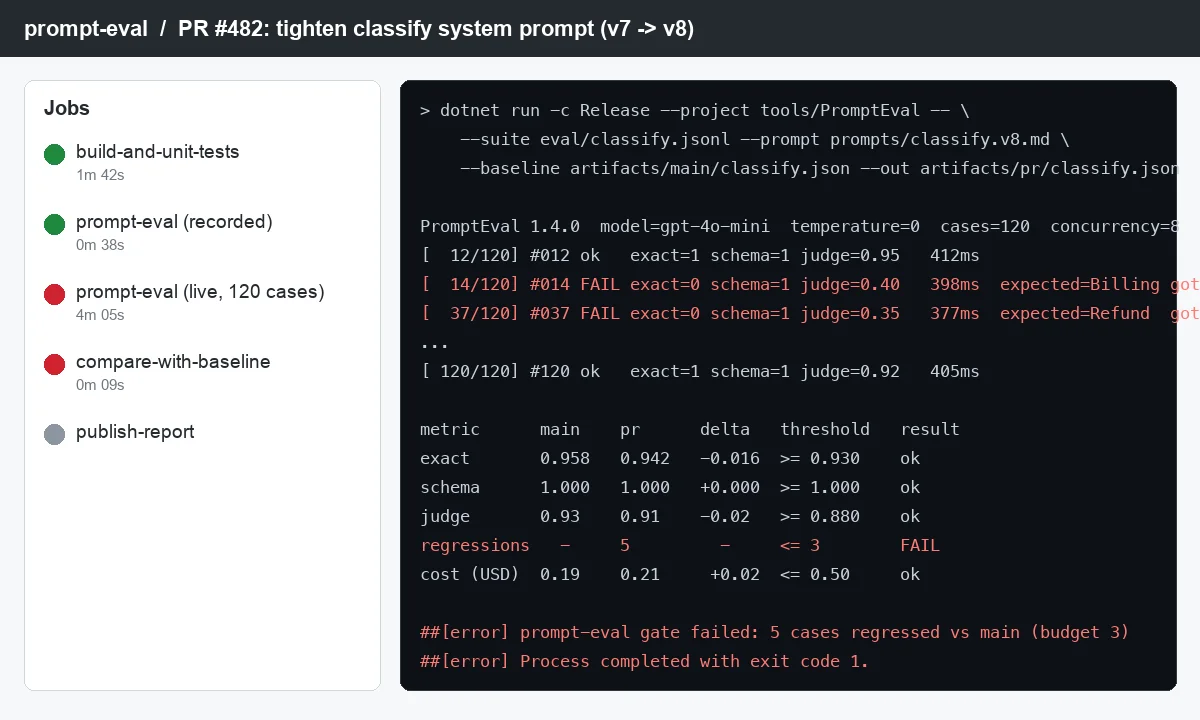
Two eval jobs run on every PR that touches prompts/** or eval/**. The first uses the recorded-response fake from the earlier post and is free; it catches schema and parsing breakage in under a minute. The second runs live against a pinned deployment, downloads the latest main report as the baseline, and applies the gate.
1
2
3
4
5
6
7
8
9
10
11
12
13
14
15
16
17
18
19
20
21
22
23
24
25
26
27
28
29
30
31
32
33
34
35
36
37
38
39
40
41
42
43
44
45
46
47
48
49
50
51
52
53
54
55
56
57
58
59
name: prompt-eval
on:
  pull_request:
    paths: ["prompts/**", "eval/**", "tools/PromptEval/**"]
  push:
    branches: [main]
    paths: ["prompts/**", "eval/**"]

permissions:
  contents: read
  id-token: write
  pull-requests: write

jobs:
  eval-recorded:
    runs-on: ubuntu-latest
    steps:
      - uses: actions/checkout@v4
      - uses: actions/setup-dotnet@v4
        with: { dotnet-version: 8.0.x }
      - run: dotnet run -c Release --project tools/PromptEval -- --suite eval/classify.jsonl --prompt prompts/classify.md --mode recorded

  eval-live:
    needs: eval-recorded
    runs-on: ubuntu-latest
    environment: prompt-eval          # holds the endpoint; keyless via OIDC
    concurrency: { group: prompt-eval-${{ github.ref }}, cancel-in-progress: true }
    steps:
      - uses: actions/checkout@v4
      - uses: actions/setup-dotnet@v4
        with: { dotnet-version: 8.0.x }
      - uses: azure/login@v2
        with:
          client-id: ${{ vars.AZURE_CLIENT_ID }}
          tenant-id: ${{ vars.AZURE_TENANT_ID }}
          subscription-id: ${{ vars.AZURE_SUBSCRIPTION_ID }}
      - name: Download main baseline
        if: github.event_name == 'pull_request'
        uses: dawidd6/action-download-artifact@v6
        with:
          workflow: prompt-eval.yml
          branch: main
          name: eval-report-main
          path: artifacts/main
          if_no_artifact_found: warn
      - name: Run eval and gate
        env:
          AZURE_OPENAI_ENDPOINT: ${{ vars.AZURE_OPENAI_ENDPOINT }}
          AZURE_OPENAI_DEPLOYMENT: gpt-4o-mini-2024-07-18   # pinned, see the retirement gate post
        run: |
          dotnet run -c Release --project tools/PromptEval -- \
            --suite eval/classify.jsonl --prompt prompts/classify.md --mode live \
            --baseline artifacts/main/classify.json --out artifacts/pr/classify.json
      - name: Upload report
        if: always()
        uses: actions/upload-artifact@v4
        with:
          name: ${{ github.ref == 'refs/heads/main' && 'eval-report-main' || 'eval-report-pr' }}
          path: artifacts/pr/classify.json
Three details that saved us debugging time:
- Pinned deployment name. A floating
gpt-4o-minialias means the baseline and the PR can be scored by different model versions and the diff is meaningless. The model retirement gate post covers how to roll the pin forward deliberately. concurrencywithcancel-in-progress. Each live run costs about twenty cents and four minutes; a reviewer pushing three fix-up commits should not triple that.- Baseline refreshed on push to
main. Thepushtrigger runs the same job without a baseline and uploadseval-report-main, so the next PR diffs against the prompt that is actually live.
The report is also posted as a PR comment (the publish-report job in the screenshot, omitted from the YAML above for length): the metric table plus one line per regressed case with expected and actual labels. Reviewers stopped opening the log once that comment existed.
What moved
We enabled the gate in week 2 of a ten-week window on a six-prompt customer-message classification service. The suite grew from 84 to 120 cases over the period as production misclassifications were turned into eval cases.
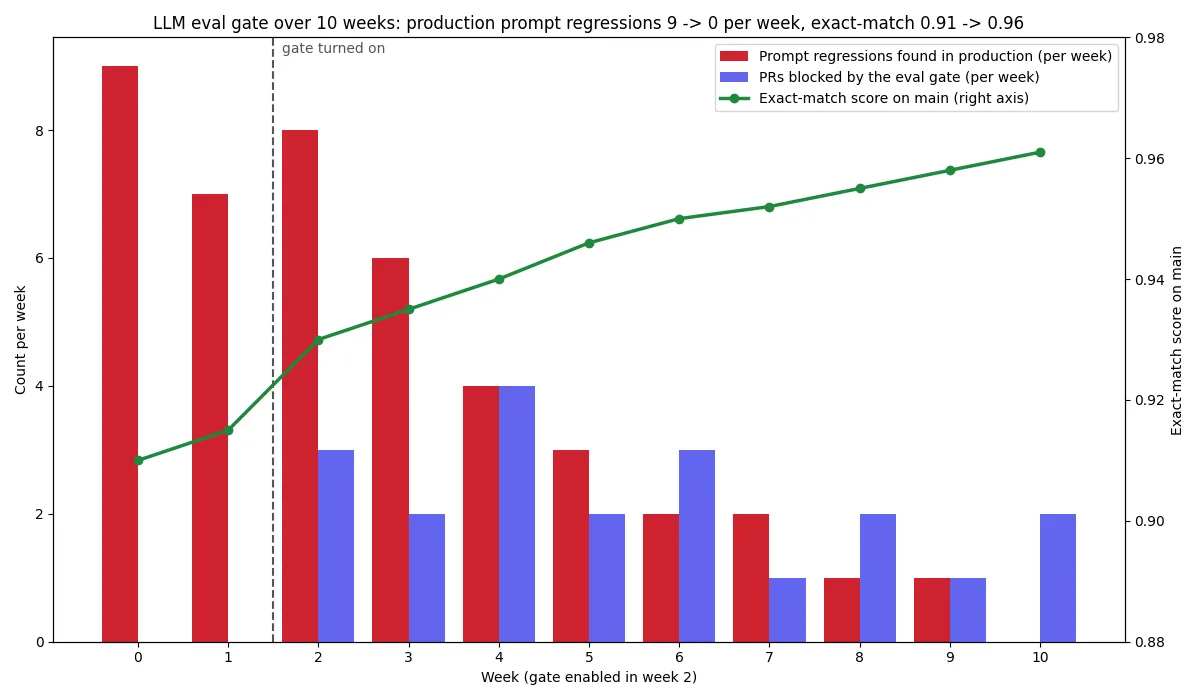
- Production prompt regressions (a misclassification traced back to a prompt change) went from 7-9 per week to 0 in the last week. The remaining ones in weeks 3-6 were cases the suite did not yet contain; each became a new case.
- PRs blocked by the gate: 20 over eight weeks, out of 61 prompt PRs. 14 were fixed in the same PR within a day; 6 were abandoned because the “improvement” did not survive the diff.
- Exact match on
mainrose from 0.91 to 0.96, partly from better prompts and partly because adding failing production cases to the suite forced the prompt to handle them. - Cost: about $0.20 per live run, $31 over the whole window. Cheaper than any one of the week-0 incidents.
Reusing this in your pipeline
- Start from an existing golden-case suite; if you do not have one, the earlier post shows how to build it from production logs.
- Make the harness emit a JSON report and an exit code. Everything else, including the PR comment, hangs off those two.
- Set absolute floors from your current
mainscore minus a small margin, and a regression budget of about 2-3% of the suite. Tighten both as the suite grows. - Pin the model deployment, set temperature to 0, and run the recorded mode first so a broken schema never costs a live run.
- Refresh the baseline on every merge to
main, not nightly; otherwise two prompt PRs merged on the same day diff against a stale baseline.
The eval harness is the same code that produced the nightly numbers; the only new idea is running it where the decision gets made, on the PR, with a diff and a budget. For the broader set of merge gates on AI-authored changes, see gating coding-agent PRs before merge; for the token-counting side of keeping the suite within context limits, the Token Counter tool in Lamplit Tools is what we use before adding a long-document case.