AI Security: Secrets in Agent-Log Hexdumps, Measured - xxd, hexdump and od Against gitleaks and Redaction
405 fake secrets dumped by 9 real xxd, hexdump and od commands into agent logs: gitleaks caught 0, redaction 9. Parsing the dump back to bytes first caught 405.
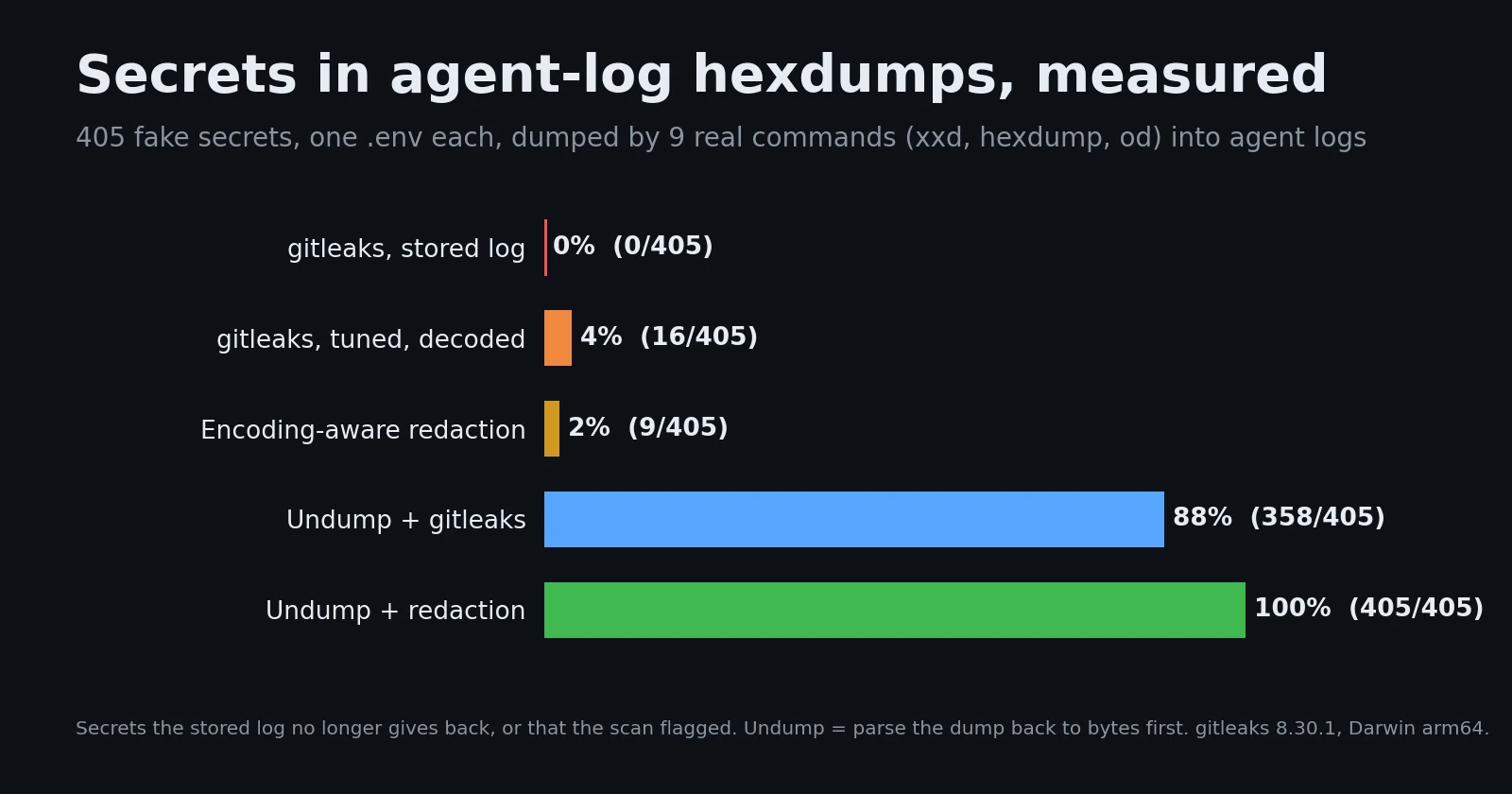
In the secrets in agent logs post one leak shape beat every defence we measured: xxd .env. All 24 hexdumps got through gitleaks and both redactors, and through the two combined. We left it as a one-paragraph warning. This post measures it properly. We used nine real dump commands that agents run when a config file “looks wrong”, and tested one fix: parse the dump back into bytes before the redactor and the scanner see it.
The short version:
- Nine dump formats, 405 fake secrets. gitleaks with default rules flagged 0 of them in the stored log. The same secrets printed by
catwere flagged 40 of 45 times, and printed bybase64also 40 of 45 times. gitleaks decodes base64, but not hexdumps. - Encoding-aware known-value redaction removed 9 of 405 (2%). It already looks for the hex encoding of every secret it knows. It only matched in
xxd -p, and only for secrets short enough to fit on one 60-character row. - Parsing the dump back to bytes (“undump”) and then redacting caught all 405. Undump then the tuned gitleaks scan caught 358 (88%). It missed the same thing as before: passwords with no recognisable prefix.
- The normaliser is cheap and quiet. It ran on 5,000 ordinary agent tool outputs and matched none of them. On 360 dumps of random binary files it rebuilt 356 byte for byte, and it parsed the whole 393 KB corpus in 35 ms.
The setup
Everything comes from scripts/agent-log-hexdumps/bench.py. It reuses the secret generator, redactor, oracle and gitleaks wrapper from the earlier bench, so the numbers are comparable. It uses a fixed seed (20261125), gitleaks 8.30.1, and the stock xxd, hexdump and od on macOS (Darwin arm64).
For each event the script writes a small .env file holding one fake secret. There are 9 secret kinds: AWS key ID and secret, GitHub PAT, Slack bot token, Stripe live key, OpenAI and Anthropic keys, a JWT, and a database password, 5 of each. Then it runs the real command on the file and stores the output as a tool_result record in agent-log JSONL. There are 11 commands with 45 events each: cat and base64 as controls, plus nine dump formats (xxd, xxd -p, xxd -i, xxd -b, hexdump, hexdump -C, od, od -c, od -A x -t x1).
A secret counts as caught when one of two things is true. Either the redactor removed it, so an attacker reading the stored log cannot get it back, or gitleaks reported a finding in that event’s record. The “attacker” is an oracle that tries the raw string, URL decoding, base64, hex, and the same dump parser. It recovered all 495 planted secrets from the unredacted logs, and xxd -r / xxd -r -p rebuilt all 90 xxd and xxd -p files byte for byte. A hexdump is reversible by design.
What one hexdump looks like to the scanner
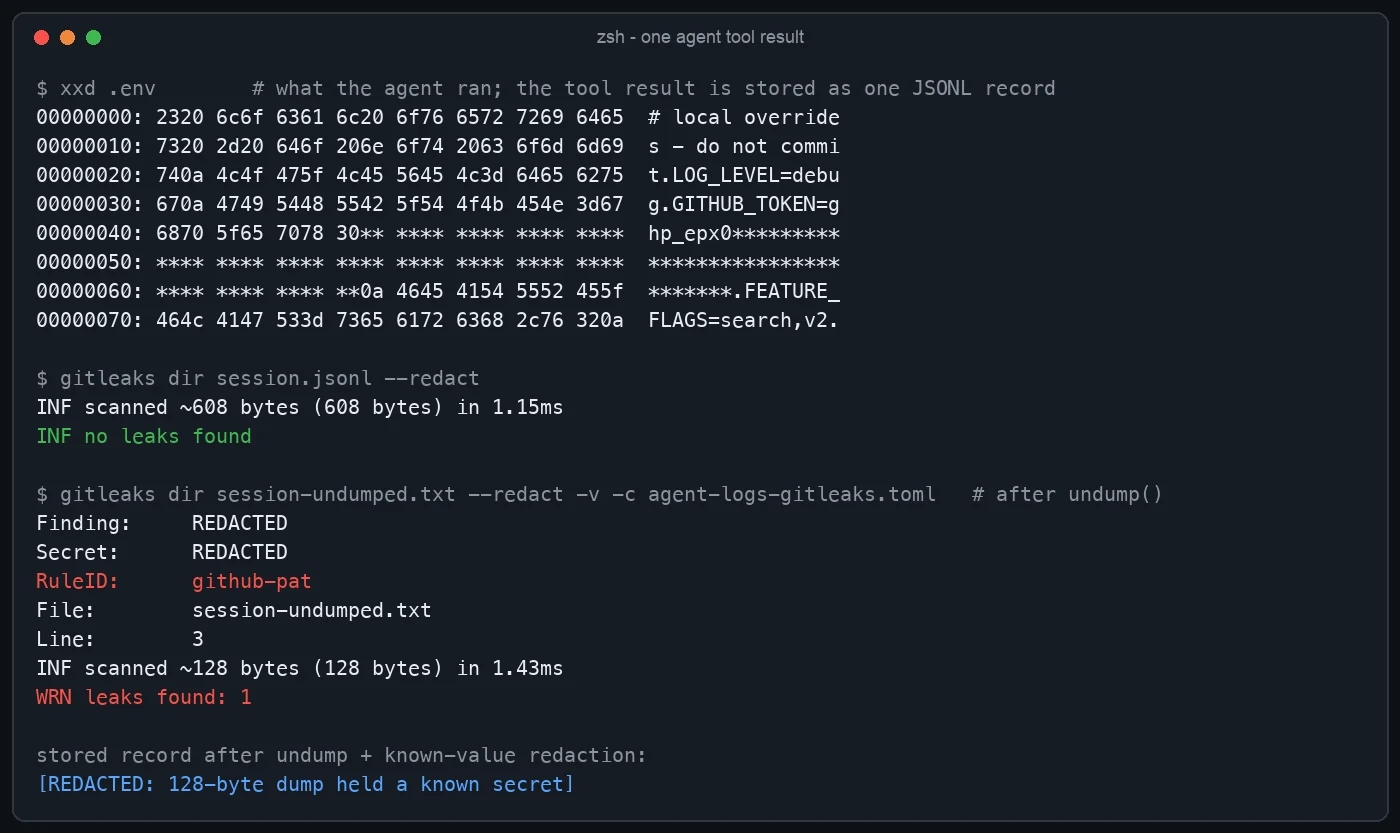 The token is in the stored log twice: as 2-byte hex groups and as 16-character slices of the ASCII column. Neither form matches a rule. (Token masked after 8 characters in this image only.)
The scanner has nothing to match. The hex column splits the value into 4-digit groups separated by spaces, and the ASCII column cuts it into 16-character slices with row offsets in between. A GitHub PAT is ghp_ plus 36 characters, and no single row holds it. The known-value redactor does look for the secret’s hex encoding, but in the stored text that encoding is broken by spaces and line breaks.
Results by command
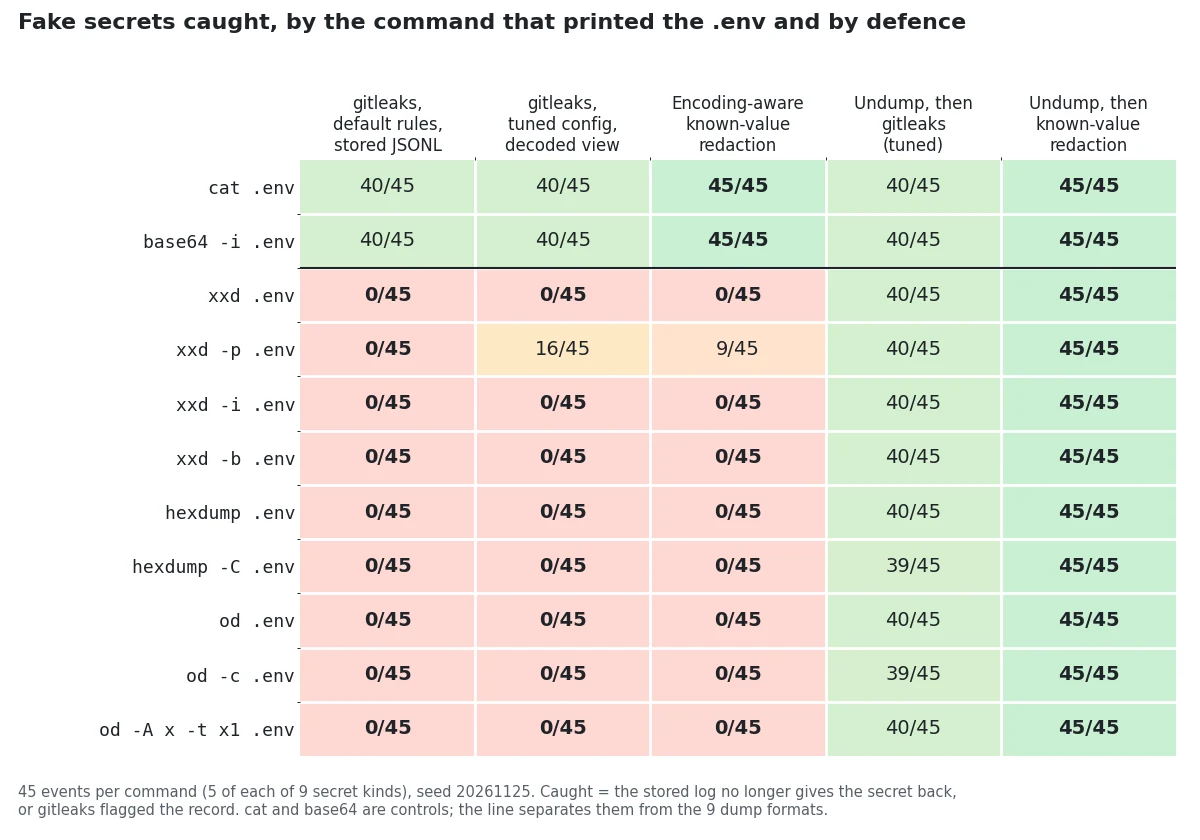 Every cell comes from
scripts/data/agent-log-hexdumps.json. The two rows above the line are controls.
Totals over the 405 dump events:
| Defence | Caught | Share |
|---|---|---|
| gitleaks 8.30.1, default rules, stored JSONL | 0 | 0% |
| gitleaks, tuned config, decoded view | 16 | 4% |
| Encoding-aware known-value redaction | 9 | 2% |
| Undump, then gitleaks (tuned) | 358 | 88% |
| Undump, then known-value redaction | 405 | 100% |
Two cells are worth a closer look:
xxd -pis the only format that half works. It prints plain hex with no spaces, 60 digits per row. On the decoded view, gitleaks’ own hex decoder caught 16 of 45 (taggeddecoded:hex), but only when the key name and value landed on the same row. Redaction caught 9: the 5 database passwords and 4 of the 5 AWS key IDs, the only secrets short enough (19-20 bytes, so 38-40 hex digits) to fit inside one row. Longer secrets wrap, and the newline breaks the match.- Undump plus gitleaks misses 47, and 45 of them are database passwords. This is the same gap as in the first post: no default rule matches
DB_PASSWORD=followed by 19 random characters. Once the dump is back in bytes, the scanner is only as good as its rules. The redactor knows the value, so it catches them.
The fix: undump before you redact or scan
undump() in the bench script is about 240 lines of standard-library Python. It recognises the nine layouts above. A layout only counts if every non-empty line matches it, so a single hex digest or a git log line does not trigger it. The function rebuilds the bytes and expands the * lines that hexdump and od print for repeated rows. When the bytes contain a secret the runtime knows, the log writer stores a placeholder for the whole tool result instead of the dump. A gitleaks pass over the decoded bytes covers secrets the runtime does not know.
How it behaved on things that are not hexdumps:
- 5,000 ordinary tool outputs from the earlier bench’s generator:
git log,pytest, lockfile reads with base64 integrity hashes,docker pulldigests and HTTP JSON. It fired on none of them. - 360 dumps of random binary files (256-2,048 bytes, 40 per format): it rebuilt 356 exactly. The 4 misses are
od -crows where a multibyte character starts in the last column and macOSodprints its trailing byte oddly. gitleaks reported 0 findings on the decoded binary, and the redactor dropped none of the benign dumps. - Cost: 35 ms for 393 KB of dump output, about 11 MB/s in pure Python. That is noise next to the 63 ms gitleaks needed to scan the same records.
One caveat. This only works if the dump is the whole tool result. If an agent pipes xxd through grep or head, you get a fragment of a dump, and it can still hold enough rows to rebuild a short key. The cheaper policy is the one from the first post: an agent that needs to inspect a config file should not hold its secrets in the first place.
A starting sequence
- Don’t let the runtime hand agents real secrets in files they can read. Every event here started with a
.envholding a live-looking key. Inject short-lived credentials at the tool boundary instead, as described in the tool-call permission boundaries post. - Normalise tool output before redaction. Undump hexdumps the same way you would decode base64 or percent-encoding. A redactor that sees the bytes catches everything it knows about.
- Scan the normalised view, not only the stored log. gitleaks over the stored JSONL caught 0 of 405 here. Over the undumped bytes it caught 358.
- Add rules for the secrets your scanner cannot name. Passwords and other prefix-less values need a known-value redactor or a custom rule. The tuned config in
scripts/data/agent-logs-gitleaks.tomlis a start.
Reproduce it
1
2
3
# gitleaks 8.30.1 on PATH; xxd, hexdump and od from the OS. About 5 seconds on an M2 Pro.
python3 scripts/agent-log-hexdumps/bench.py --work /tmp/hexdumps      # -> scripts/data/agent-log-hexdumps.json
python3 scripts/agent-log-hexdumps/gen_images.py --work /tmp/hexdumps # the images in this post
The JSON keeps the per-command counts for every defence, the gitleaks rules that fired, and the timings. It holds no secret values.
Where Pulse fits
Pulse, Lamplit Labs’ multi-project self-improving automation product, is coming soon. Its agents debug real projects without a person watching, and xxd on a config file is exactly the kind of command they run. That is why we test our transcript handling against the odd shapes as well as the common ones. The Pulse introduction has more on what we are building.