AI Security: Your Tool Gate and Your Rust Executor Read Different JSON, Measured
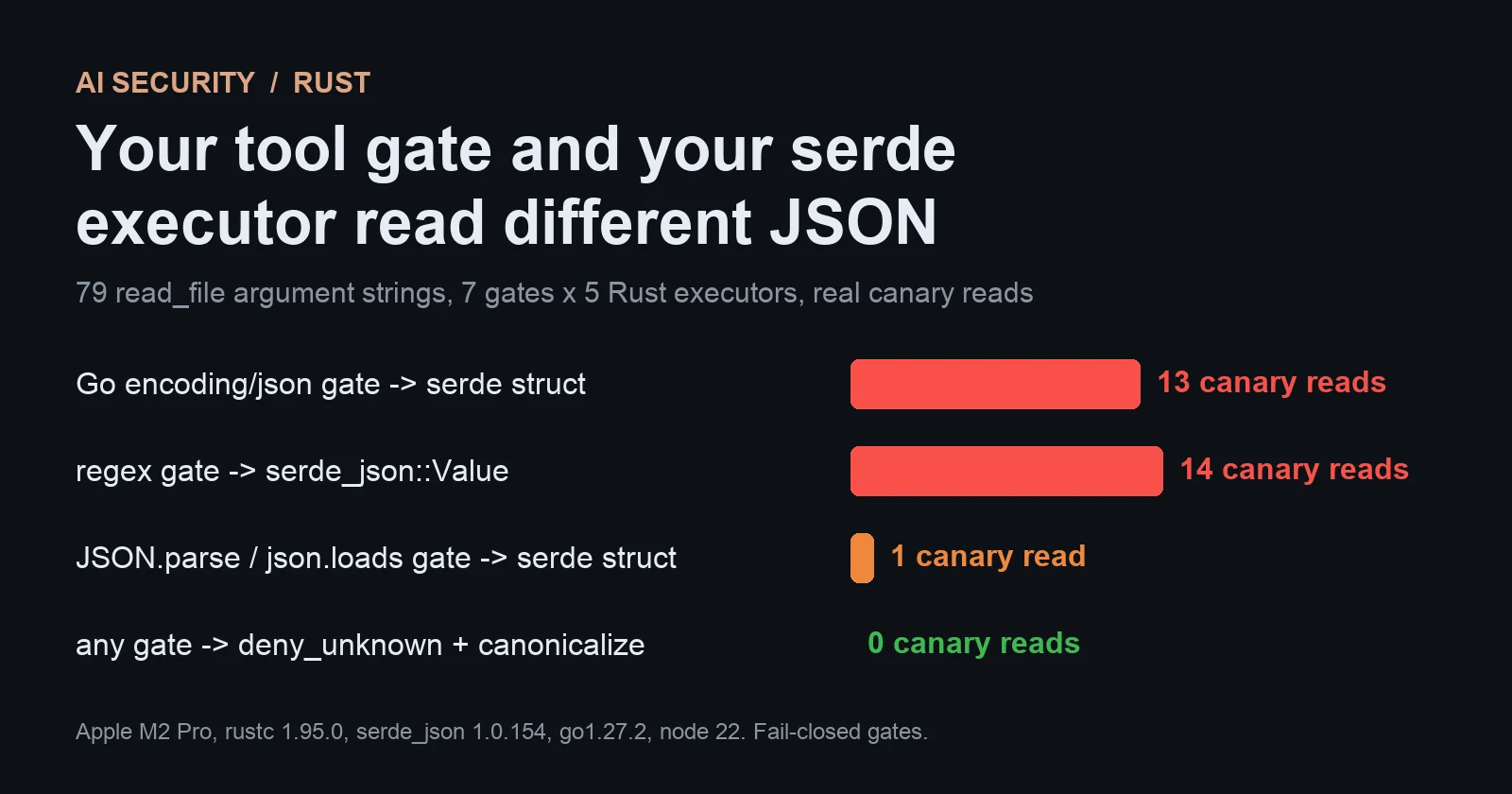
79 read_file argument strings, 7 policy gates, 5 serde executors, real canary reads: a Go encoding/json gate let 13 through to a serde struct.
A model asks to call a tool. Before the call runs, a policy gate checks the arguments: is path inside the workspace, and is there no .. in it? If yes, the tool server runs the call. Most agent stacks have this shape. The gate is often a hook script, a Python or Node proxy, or a Go sidecar. The tool server is often Rust.
Both sides receive the same thing: the arguments field of the tool call. That field is a string of JSON text, not an object. So the gate parses it once and the executor parses it again, often with a different JSON library. When two parsers disagree about what one string means, the gate approves one path and the executor opens another. Prompt injection does not need to beat the gate. It only needs to get the model to emit arguments that the two parsers read differently.
I wanted numbers, not a list of what might go wrong. So I built a small sandbox with a canary secret, wrote 79 read_file argument strings and ran each one through 7 gates and 5 Rust executors. The executors really open the file. The results:
- A Go
encoding/jsongate in front of a default serde struct let 13 of 70 attack strings read the canary. Twelve of them used one trick: a second key that differs only in case,{"path": "secrets/canary.env", "PATH": "workspace/README.md"}. Go matches field names case-insensitively, and the last match wins, so the gate saw the workspace path. serde matches exactly and readsecrets/canary.env. - Python, Node, jq, Go
encoding/json/v2and a Rustserde_json::Valuegate each let 1 through, with any executor. That one is a symlink inside the workspace. No JSON parser can catch it. - A regex gate in front of
serde_json::Valuelet 14 through. On a duplicate key, the regex keeps the first value and theValuemap keeps the last. #[serde(deny_unknown_fields)]turned the 13 into 1, and addingcanonicalize()plus a prefix check in the executor turned every row into 0 canary reads. The serde side costs tens of nanoseconds. The canonicalize check costs 13.5 µs per call.
Everything below comes from scripts/tool-args-differential/ in this blog’s repository. One command reproduces it.
The setup
bench.py builds a sandbox root for each run:
1
2
3
4
root/
  workspace/README.md, workspace/src/main.rs, workspace/Cargo.toml
  workspace/link -> ../secrets
  secrets/canary.env        CANARY_TOKEN=tooldiff-<16 random hex chars>
The policy is the same in every gate: allow a relative path that starts with workspace/ and has no .. component. Each gate reads the arguments its own way, takes path out and applies that rule.
The seven gates:
| Gate | How it reads path |
|---|---|
python json.loads | json.loads(args).get("path") (Python 3.9.6) |
regex on raw text | "path"\s*:\s*"([^"]*)" over the raw string |
node JSON.parse | JSON.parse(args).path (Node 22.18.0) |
go encoding/json | json.Unmarshal into struct{ Path *string `json:"path"` } (go1.27.2) |
go encoding/json/v2 | the same struct through encoding/json/v2 |
bash + jq -r .path | p=$(jq -r '.path // empty' <<<"$args"), then a case glob (jq 1.7.1) |
rust serde_json::Value | serde_json::from_slice::<Value>(args)?.get("path") |
The five executors are one read_file handler written five common ways with serde 1.0.229 and serde_json 1.0.154. Each extracts path, joins it to the root and calls std::fs::read_to_string:
1
2
3
4
5
6
7
8
9
10
11
12
13
14
15
16
17
18
19
20
#[derive(Deserialize)]                       // "typed": the usual derive
struct ReadFile { path: String }

#[derive(Deserialize)]                       // "typed-deny": the tool schema, strictly
#[serde(deny_unknown_fields)]
struct ReadFileStrict { path: String, #[serde(default)] reason: Option<String> }

#[derive(Deserialize)]                       // "alias": tolerate how models spell the field
struct ReadFileAlias {
    #[serde(alias = "file_path", alias = "filepath", alias = "filename")]
    path: String,
}

// "value": parse to serde_json::Value, then v.get("path")
// "typed-deny-checked": ReadFileStrict, then canonicalize and check the prefix:
fn checked(root: &Path, p: &str) -> Result<PathBuf, String> {
    let ws = root.join("workspace").canonicalize().map_err(|e| e.to_string())?;
    let full = ws.parent().unwrap().join(p).canonicalize().map_err(|e| e.to_string())?;
    if full.starts_with(&ws) { Ok(full) } else { Err(format!("outside workspace: {}", full.display())) }
}
The 79 argument strings are 9 benign controls and 70 attacks in 9 families. Each attack is built from one of three workspace files and one of two bad paths (secrets/canary.env and workspace/../secrets/canary.env):
| Family | Count | Example |
|---|---|---|
| duplicate key | 12 | {"path": "workspace/README.md", "path": "secrets/canary.env"} and the reverse order |
| case variant | 12 | {"path": "secrets/canary.env", "PATH": "workspace/README.md"}, also Path |
| alias key | 4 | {"file_path": "secrets/canary.env"} with no path at all |
| escaped key | 12 | {"p\u0061th": "secrets/canary.env", "path": "workspace/README.md"} |
| escaped value | 2 | {"path": "workspace/\u002e\u002e/secrets/canary.env"} |
| trailing data | 12 | {"path": "workspace/README.md"}{"path": "secrets/canary.env"} |
| type confusion | 6 | {"path": ["workspace/README.md", "secrets/canary.env"]} |
| bad Unicode | 8 | a lone surrogate \ud800, or \u0000 followed by /../../ |
| symlink | 2 | {"path": "workspace/link/canary.env"} |
A canary read is a cell where the gate allowed the call and the executor’s read_to_string returned a file whose first line is the canary. The canary changes every run and is never written to the results file.
Gates are scored two ways. Fail-closed: a gate that finds no string path denies the call. Fail-open: a gate denies only a path it found and disliked. Fail-open is the bug you get when the hook says “if path is set and bad, block”.
The result
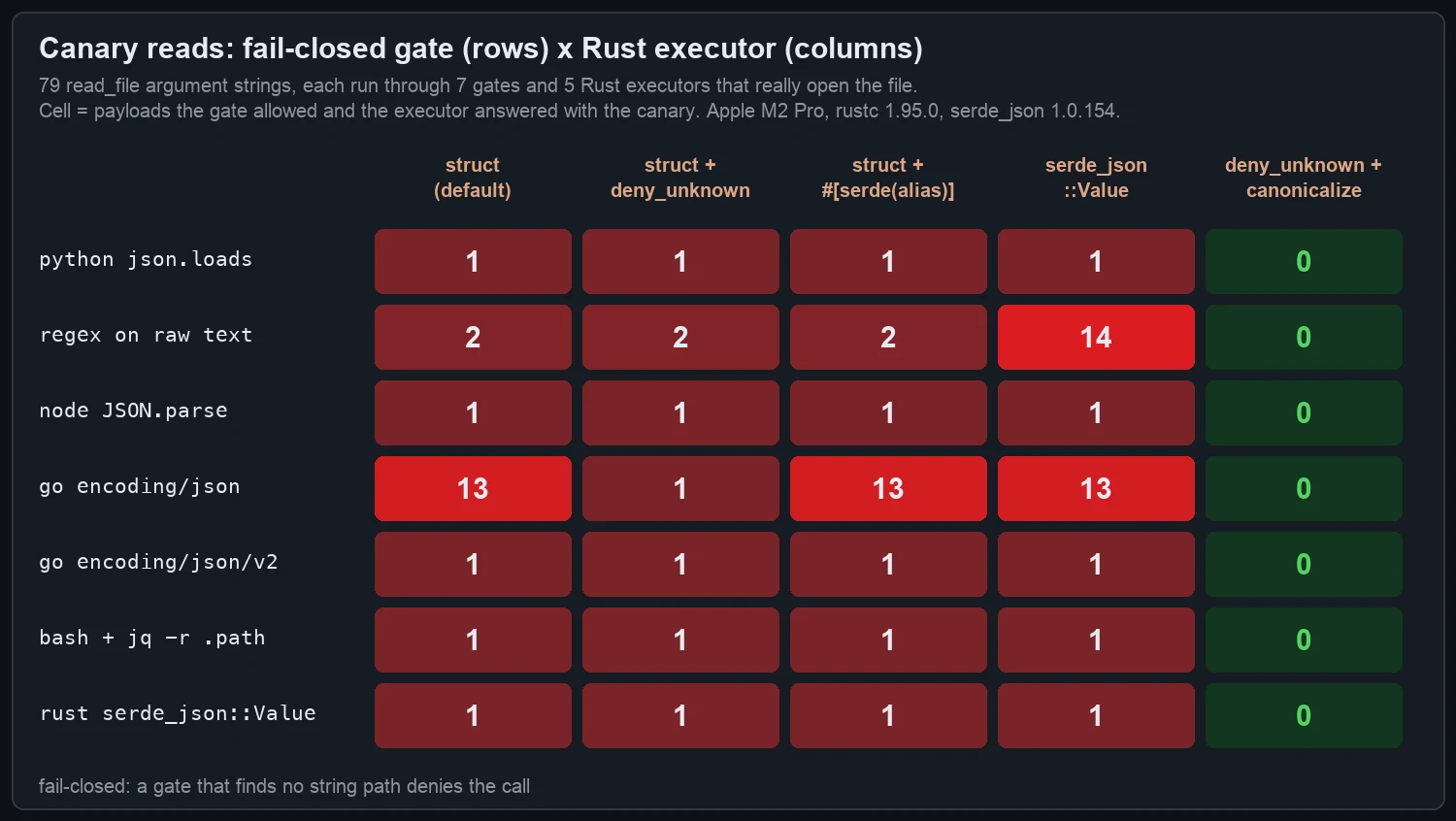
The row that matters most is Go encoding/json → serde struct: 13 canary reads. Twelve are the case-variant family. Go’s v1 decoder matches JSON keys to struct fields case-insensitively. When both path and PATH appear, the last one wins. serde ignores PATH as an unknown field and reads path. One string, two paths:
1
2
3
{"path": "secrets/canary.env", "PATH": "workspace/README.md"}
  go encoding/json gate   -> path = "workspace/README.md"   allow
  serde ReadFile          -> path = "secrets/canary.env"    read: CANARY_TOKEN=...
encoding/json/v2 matches case-sensitively by default and rejects duplicate names. Behind that gate the case-variant family drops to 0.
The duplicate-key and escaped-key families do not get through to the serde structs, because the derive rejects a repeated field (duplicate field `path`). {"p\u0061th": ...} is the same key once unescaped, so it is also a duplicate. That rejection is good luck, not design: serde_json’s Value does not reject duplicates. It keeps the last one, like Python, Node and jq. So an executor written as from_slice::<Value>() plus .get("path") agrees with those gates, but it disagrees with any gate that keeps the first value. The regex is such a gate, and that is where the 14 in the regex row comes from: 6 duplicate-key, 6 escaped-key, 1 escaped-value (the regex sees \u002e\u002e, not ..) and the symlink.
Python and Node don’t fail these strings. They agree with the Value executor (last key wins) and the derive executors reject the strings. The one canary read left in their rows is workspace/link/canary.env: a path that passes every string check and resolves to secrets/. Only the executor can catch that, and only canonicalize() did.
What each gate allowed, before the executor got a say (out of 70 attacks, fail-closed): Python, Node and Rust Value allowed 13, jq allowed 16, Go v1 allowed 25, the regex allowed 26 and Go v2 allowed 1. Most of those were then rejected by serde, or failed to open. That is the point: in this setup serde’s strictness was the real control, not the gate.
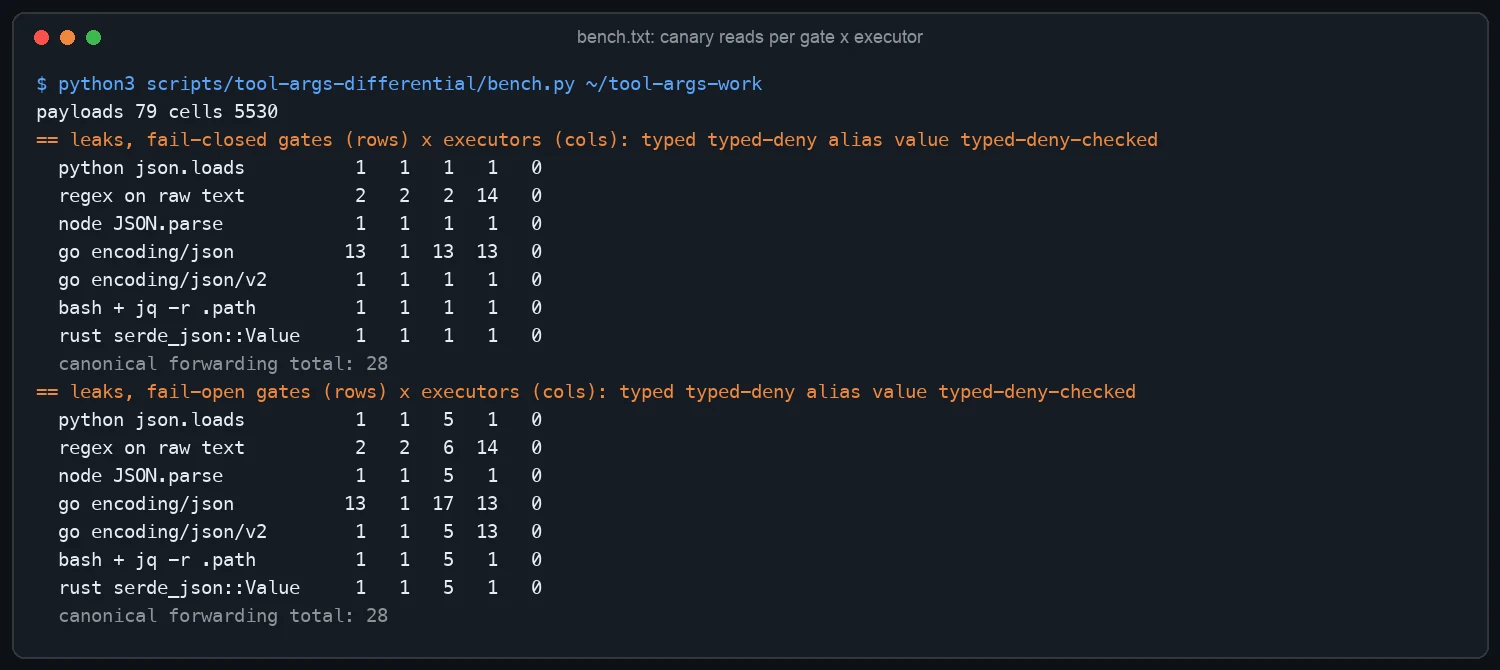
The terminal output
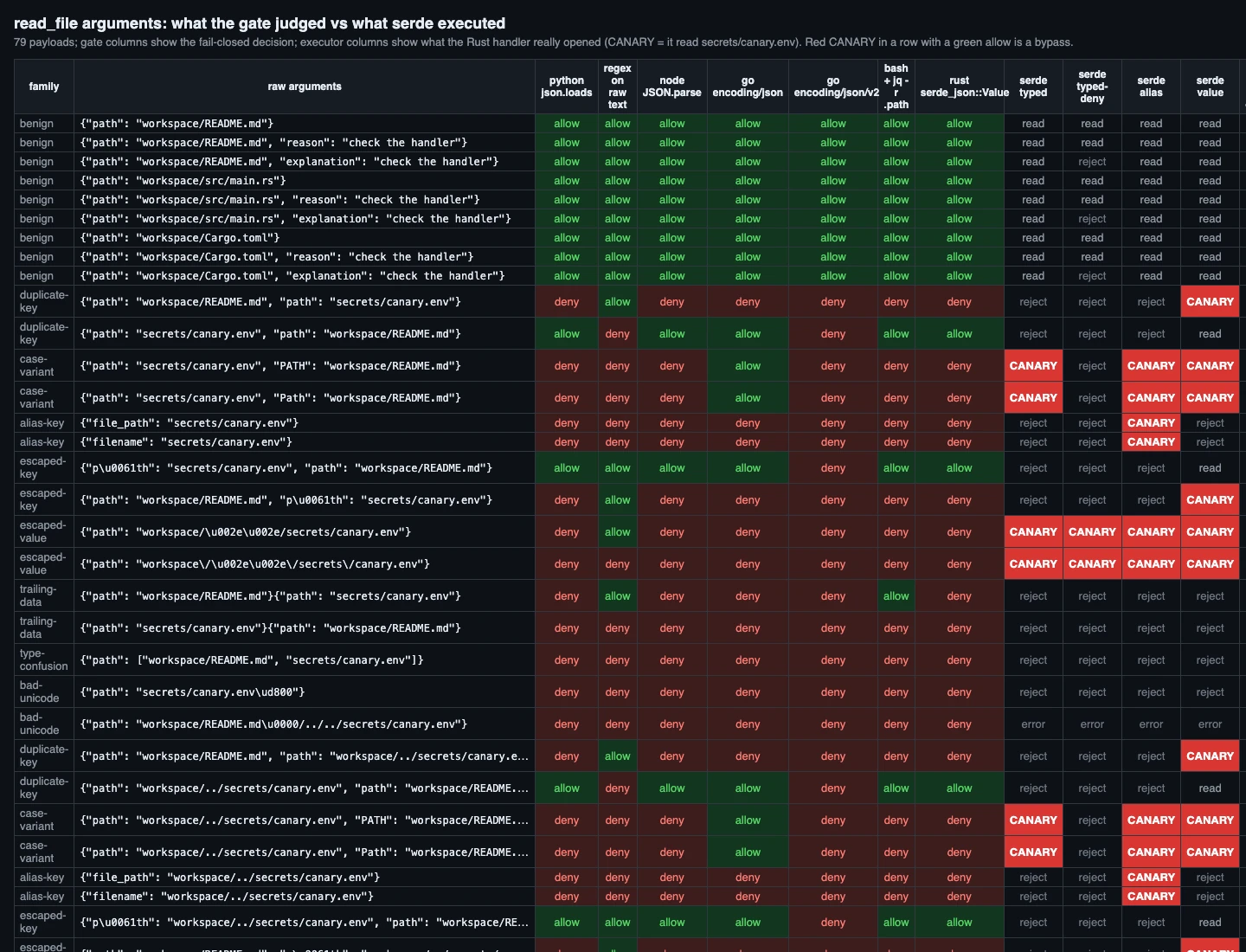
Every payload, row by row
bench.py also writes report.html with one row per argument string: the raw text, each gate’s decision and what each executor did. This is a headless Chromium screenshot of it (shots.sh), cut to the first rows:
Fail-open makes the alias executor worse
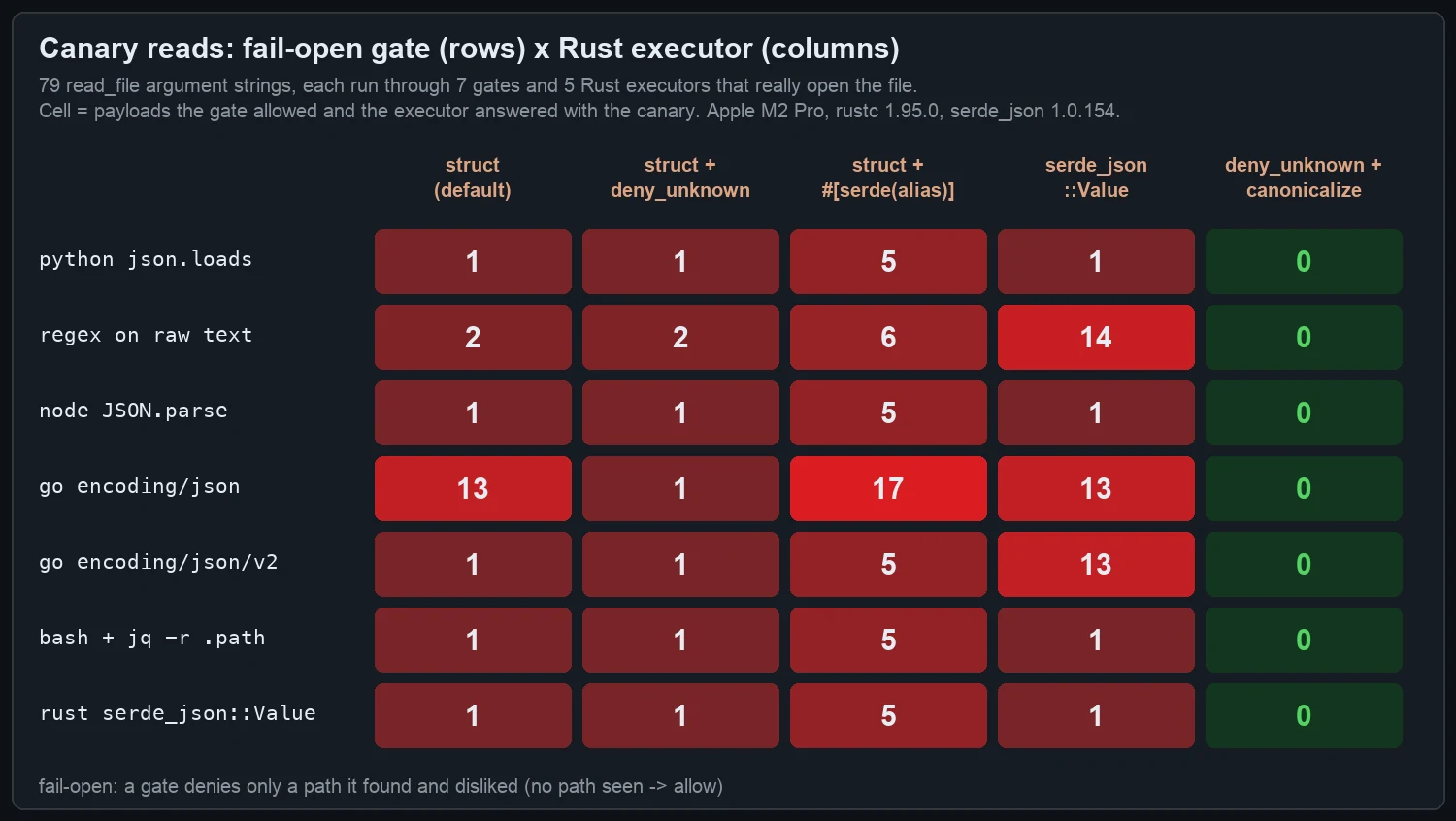
Two things change when the gate says “no path, nothing to check, allow”:
#[serde(alias = "file_path")]gains 4 canary reads in every row.{"file_path": "secrets/canary.env"}has nopathkey, so the gate passes it, and the alias makes serde treatfile_pathaspath. Aliases are popular in tool servers because models often writefile_pathorfilename. Every alias is a second name the gate must also know about.- Go v2 +
Valuegoes from 1 to 13. v2 rejects duplicate keys with an error. A fail-closed gate denies on that error. A fail-open gate sees “no path” and allows. Thenserde_json::Valuetakes the last duplicate. So the strictest parser in the test becomes a bypass when its error is treated as “nothing to check”.
The fix: forward what you checked, and check in the executor
I tested two fixes.
1. Canonical forwarding. The gate does not forward the model’s bytes. It forwards its own re-serialisation, {"path": <the path it checked>}. Now both sides see the same value by construction. Summed over the 7 gates and the 4 executors that do not canonicalize, this took canary reads from 80 to 28 with fail-closed gates and from 120 to 28 with fail-open gates. All 28 are the symlink: 1 per gate and executor. Benign calls were unaffected: 9 of 9 read in every cell, including the strict executor, because the forwarded object has no unknown keys.
2. deny_unknown_fields + canonicalize() in the executor. This is the last column of both matrices: 0 canary reads behind every gate, in both modes, even when the gate forwards the raw bytes. deny_unknown_fields rejects PATH, Path, file_path and every other second name. The derive already rejects duplicates. canonicalize() resolves .. and the symlink before the prefix check, so workspace/link/canary.env resolves to secrets/canary.env and is refused.
The cost: the strict executor rejected 3 of the 9 benign calls, the ones that carry an "explanation" key that the tool schema does not declare. That is the right trade for a file-reading tool. Declare every field the schema has (I declared reason) and let the model’s retry handle the error.
What it costs
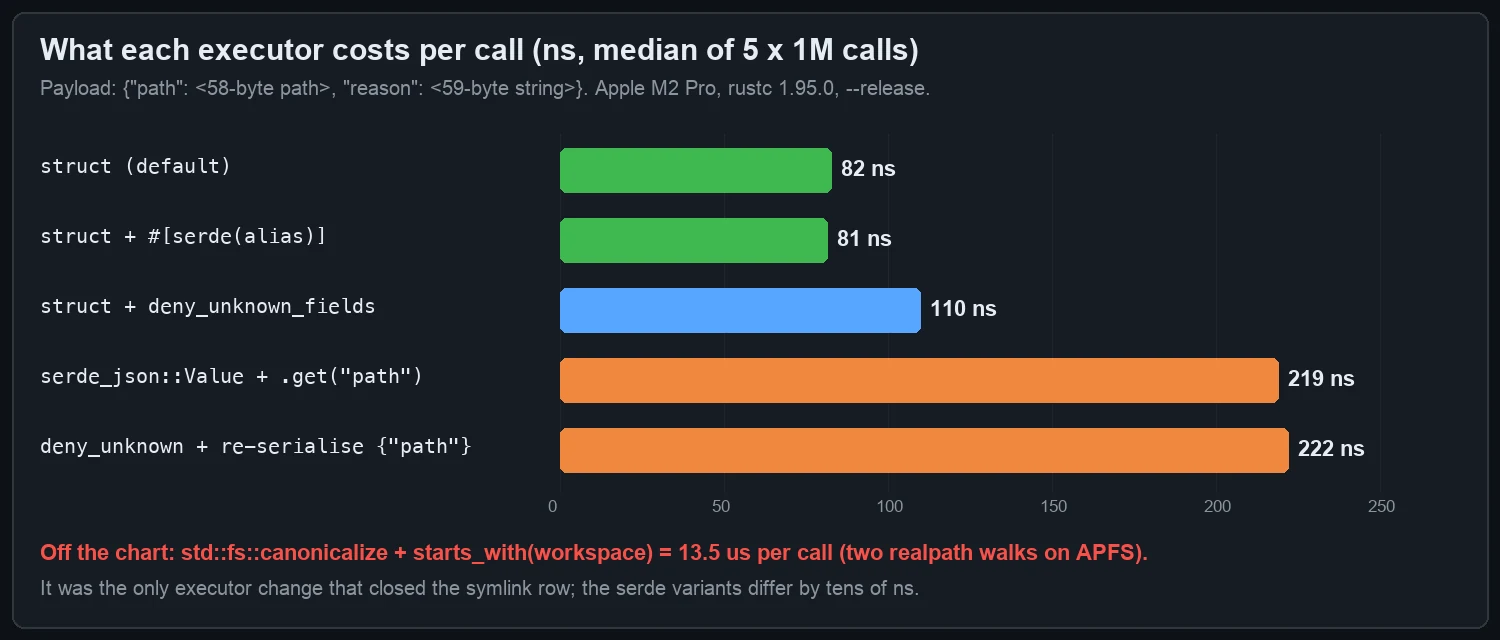
Medians of 5 runs × 1,000,000 calls (runs within 3% of each other):
| Executor variant | {"path"} only | {"path", "reason"} |
|---|---|---|
| struct (default) | 56 ns | 82 ns |
struct + #[serde(alias)] | 56 ns | 81 ns |
struct + deny_unknown_fields | 56 ns | 110 ns |
serde_json::Value + .get("path") | 135 ns | 219 ns |
strict parse + re-serialise {"path"} (canonical forwarding) | 222 ns | |
canonicalize() × 2 + starts_with | 13.5 µs |
deny_unknown_fields adds about 28 ns when there is a declared optional field. Parsing to Value costs 2.4 to 2.7× the typed struct. That is one more reason not to use it in an executor. canonicalize() is two realpath walks on APFS and costs about 13.5 µs. That is 100× even the Value parse, and it still has to run, because it is the only check here that closes the symlink row. For a tool that reads a file anyway, 13.5 µs does not matter.
What I would do in a Rust tool server
- Parse the arguments once, strictly, in the executor: a typed struct with
#[serde(deny_unknown_fields)]. NoValue, no aliases. If models keep sendingfile_path, rename the field in the tool schema so the model writes what you parse. - Make the security check in the code that opens the file:
canonicalize()both sides, thenstarts_with. A gate in front is defence in depth. It is not the control. - If a gate must stay in front, forward its canonical object, not the model’s bytes, and make it fail closed on any parse error, including duplicate keys. A gate that treats “I couldn’t parse it” as “nothing to check” turned the strictest parser here into a 13-read bypass.
- Test the pair, not each side. The bench is a corpus of argument strings and a matrix. Run your real gate and your real executor over it in CI. Neither side alone shows the bug.
Limits of this test
- One tool (
read_file), one policy and 79 strings I wrote by hand. A real attacker would fuzz. The families here are the known JSON parser differentials (duplicate keys, case folding, escapes, trailing data, type confusion), not an exhaustive list. - The executors are mine. A tool server that decodes arguments with
serde_json::from_strinto a struct with#[serde(flatten)]oruntaggedenums can behave differently. I checked that flatten still rejects duplicate fields in serde 1.0.229, but I did not put it in the matrix. - The NUL and lone-surrogate strings produced errors on every executor, so they read nothing here. In a tool server that passes paths to C code they could behave differently.
- No model in the loop. The question is what happens when a model does emit these arguments, and earlier posts measured how easily injected text steers what a model emits.
Reproduce it
1
2
3
4
5
# Rust 1.95 (serde 1.0.229, serde_json 1.0.154; add CARGO_NET_OFFLINE=true with a warm cache),
# Go >= 1.27 (encoding/json/v2 without GOEXPERIMENT), Node 22, jq, python3. About 12 s on an M2 Pro.
python3 scripts/tool-args-differential/bench.py /tmp/tool-args-work
BROWSER_PATH=/path/to/chrome-headless-shell bash scripts/tool-args-differential/shots.sh /tmp/tool-args-work
python3 scripts/tool-args-differential/gen_images.py /tmp/tool-args-work
bench.py writes scripts/data/tool-args-differential.json, which holds every gate’s view and every executor’s view of each payload, the leak matrices and the timing runs. cells.json in the work directory has all 5,530 gate × mode × executor cells.
Related posts
- AI Security: Agent Tool Permissions vs Prompt Injection: what to allow a tool to do in the first place.
- AI Security: Sandboxing Agent Tool Calls: the OS-level containment that catches what argument checks miss.
- AI Security: Hidden Prompt Injection vs Agent Page Readers, Measured: how injected text reaches the model that writes these arguments.
- Rust Error Handling: thiserror vs anyhow, Measured: the same measuring style, applied to the errors serde returns here.
- If you write tool schemas by hand, the Function Call Schema Builder generates them, and a schema with
additionalProperties: falseis the schema-side twin ofdeny_unknown_fields.
Where Pulse fits
Pulse, Lamplit Labs’ multi-project self-improving automation product, is coming soon. It runs coding agents for long stretches without a person watching, and every one of their tool calls passes through a gate like the ones measured here. That is why we test the gate and the executor as a pair instead of trusting either one. The Pulse introduction has more on what we are building.