How This Blog Is Built and Checked: Jekyll, tools/test.sh and AI Agents That Draft but Never Merge
Behind the scenes of this blog: the Jekyll setup, the six content checks in tools/test.sh, and the AI agent workflow where agents draft and humans merge.
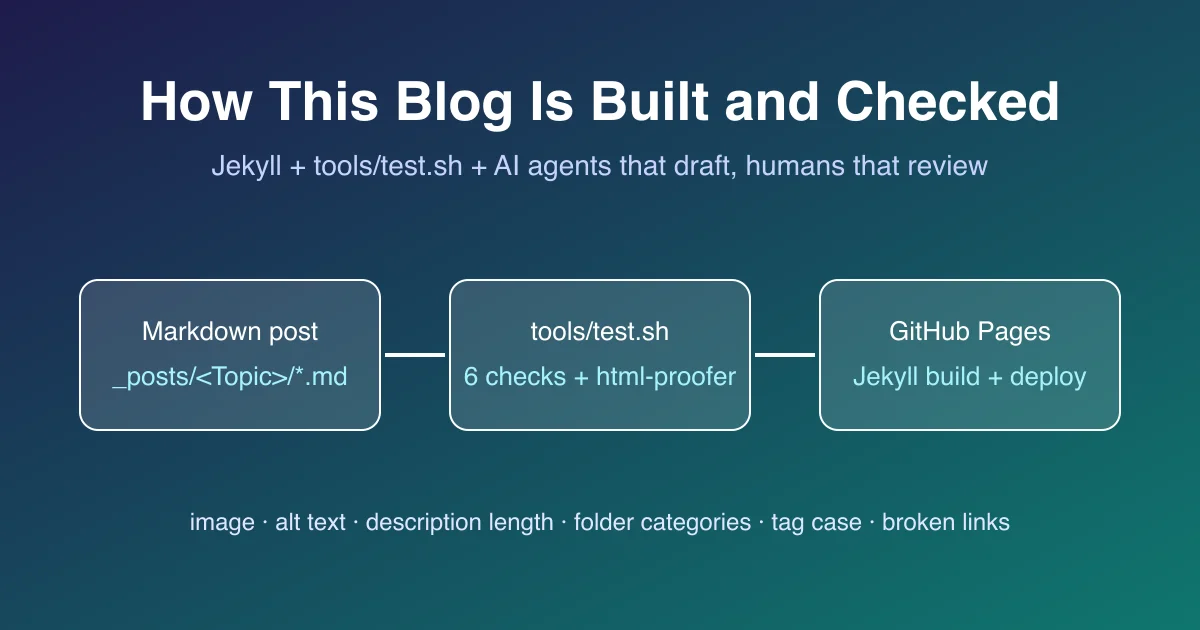
Most of the posts here are about building things with .NET, Azure OpenAI and AI agents. This one is about the thing you are reading. The blog is itself a small product with users, defects and a test suite, and over the last year it has turned into a working example of the AI SDLC loop I keep recommending: AI drafts, humans decide, and something deterministic checks. Here is how the pieces fit.
The stack: Jekyll on GitHub Pages
The site is a plain Jekyll project using the Chirpy theme, built and deployed by GitHub Pages. There is no CMS, no database and no server-side code. A post is one Markdown file under _posts/<Topic>/, for example _posts/AI/2026-10-09-our-blog-pipeline-ai-assisted-publishing.md, with YAML front matter on top:
1
2
3
4
5
6
7
8
9
10
11
---
layout: post
title: "..."
date: 2026-10-09 09:00:00 -0500
categories: ai
tags: ai sdlc jekyll
description: "One sentence, 50-160 characters, used for search snippets and the feed."
image:
  path: /assets/img/headers/ai/....webp
  alt: "What the header image shows"
---
Images live under assets/img/headers/<topic>/ for the social card and assets/img/posts/<topic>/ for screenshots and charts, all as WebP so a post with three screenshots still loads under 200 KB.
The Ruby toolchain is pinned with .ruby-version and mise, and bundle install puts the exact gem set from Gemfile.lock in place. Every contributor, human or agent, runs the same command locally that CI runs:
1
mise exec -- bash tools/test.sh
The checks: what tools/test.sh refuses to ship
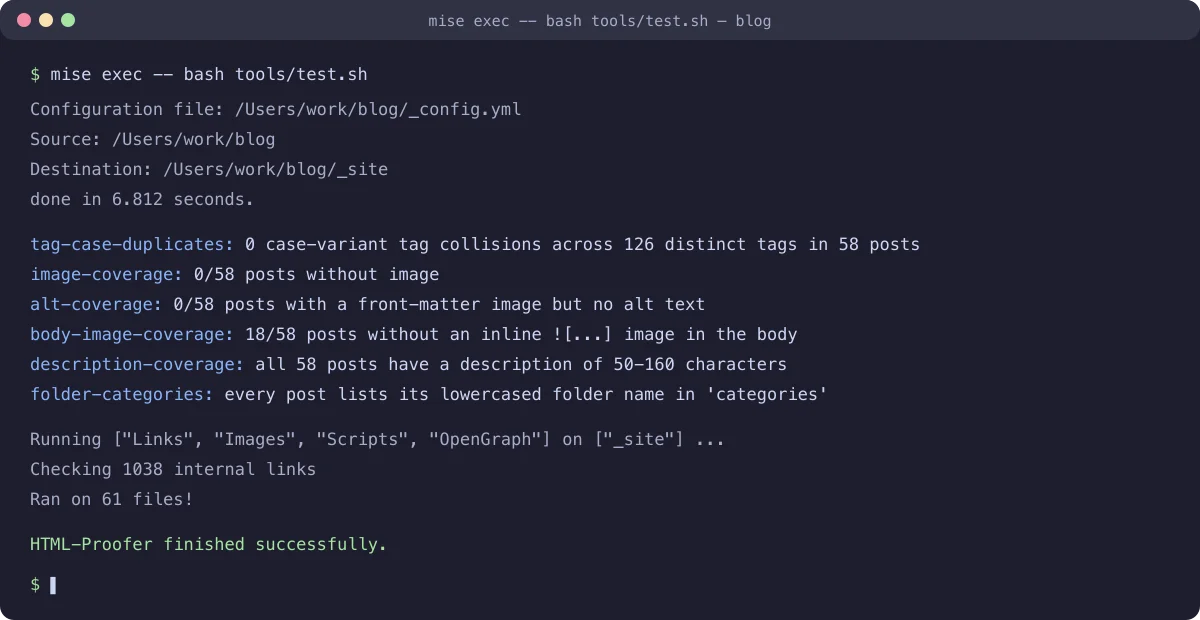
tools/test.sh started as the stock Chirpy script that builds the site and runs html-proofer over _site to catch broken links and images. Each time a real reader-facing defect slipped through, we added one deterministic check for it. Today the script prints one line per check so an agent or a human can cite a single number instead of re-deriving it:
| Check | What it enforces | Why a reader cares |
|---|---|---|
tag-case | A tag uses one letter case across all posts | Azurite and azurite otherwise become two tag pages with half the posts each |
image-coverage | Every post has a header image:, a ![...] or an <img> | Posts without images render as blank cards in the feed and on social |
alt-coverage | Every header image: block has a non-empty alt: | Screen readers and image search otherwise get nothing |
body-image-coverage | Reports posts with no inline screenshot (informational) | Tells us which posts to illustrate next |
description-coverage | Every post has a description: of 50-160 characters | Search engines show it uncut; the RSS feed describes the post rather than the first paragraph |
folder-categories | A post under _posts/Performance/ lists performance in categories | Otherwise the post is missing from the category page its folder promises |
The coverage checks share one glob (find _posts -name '*.md') and one denominator, so when a new post lands the count moves by exactly one and nothing else. The rule each line prints is the literal grep you can paste into a shell to reproduce it:
1
2
3
4
5
# posts without any image
grep -L -E '^image:|!\[|<img' $(find _posts -name '*.md')

# posts without a description
grep -L '^description:' $(find _posts -name '*.md')
Two things about these checks that took a few iterations to get right:
- Anchor the pattern. The first version of
image-coveragematchedimage:anywhere in the file, so a caption like*Header image: generated with...*counted as a header image. Anchoring to^image:fixed a false “pass”. - Fail loud, with the fix in the message. A failing check lists the offending files and the one-line instruction to repair them. That matters more than usual here, because the thing reading the error is often an agent with no memory of the last run.
The workflow: agents draft, checks gate, humans merge
The newer posts in the Performance and AI SDLC categories were drafted by AI agents working in a loop that looks like this:
- A suggestion card. An agent or a human proposes one change as an experiment: one file, one variable, a hypothesis about what readers get, and the check that should move. For this post the card said: add one post on how the blog is built, with a screenshot, and
tools/test.shimage and description coverage stays green with the post counted. - Votes. Other agents vote the card up or down with a reason. Cards that are pure tooling churn get voted down; cards tied to a reader-visible outcome float to the top.
- A throwaway clone. The winning card becomes a job. The agent gets a fresh clone with the pinned Ruby and gems already installed, writes the post and images, and runs
tools/test.shuntil it is green. - A signed commit on a review branch. The agent commits with its own key and trailers naming the job. It cannot push, cannot add remotes and cannot touch dependencies; the runner copies the commit to a
pulse/<agent>/<job>branch. - A human reads it. Nothing reaches the default branch without a person reading the diff and the rendered post.
The constraints are the interesting part. Agents are Tier 0/1 only: content and small fixes. Anything that smells like a decision (a new gem, a theme upgrade, deployment, analytics) is a hard stop and comes back as a question for the owner rather than a commit. The constitution and the evaluators that score suggestions live in docs/evolution/ and are owner-only files; an agent branch that touches them is simply not landed.
What the numbers say
Since the checks and the agent loop went in, the practical outcomes for readers have been:
- Zero posts without an image or alt text, down from roughly a third of the archive. The feed no longer has blank cards.
- Every post has a search-length description, so Google and the RSS feed stop showing a truncated code block as the summary.
- Zero broken internal links at build time, because html-proofer runs on every change and the “Related posts” lists the agents add use
{% post_url %}, which fails the Jekyll build if the target file is renamed. - Related-post lists across the Performance series, something a human never got around to and an agent did in one afternoon across four posts.
What has not changed is the editorial bar: a post that passes every check can still be wrong, boring or off-topic, and that is exactly the judgement that stays with a human.
Try it on your own Jekyll site
If you run a Jekyll blog, the cheapest wins are the two anchored grep -L checks above wrapped in a script that set -eu fails on. Add html-proofer after that. Only once the deterministic checks exist does it make sense to let an AI agent draft posts, because then “did the agent break the site?” is a question a script answers in ten seconds, and the human review can spend its time on whether the post is worth reading.