Python vs Rust in a Hot Loop: What 10 Million Iterations Cost, Measured with hyperfine
Benchmark the same sum-of-squares hot loop in plain Python, NumPy, Rust and Rust with rayon. From 1,420 ms down to 0.9 ms, and when each step is worth it.
The earlier posts in this folder were all .NET: [allocations with Span
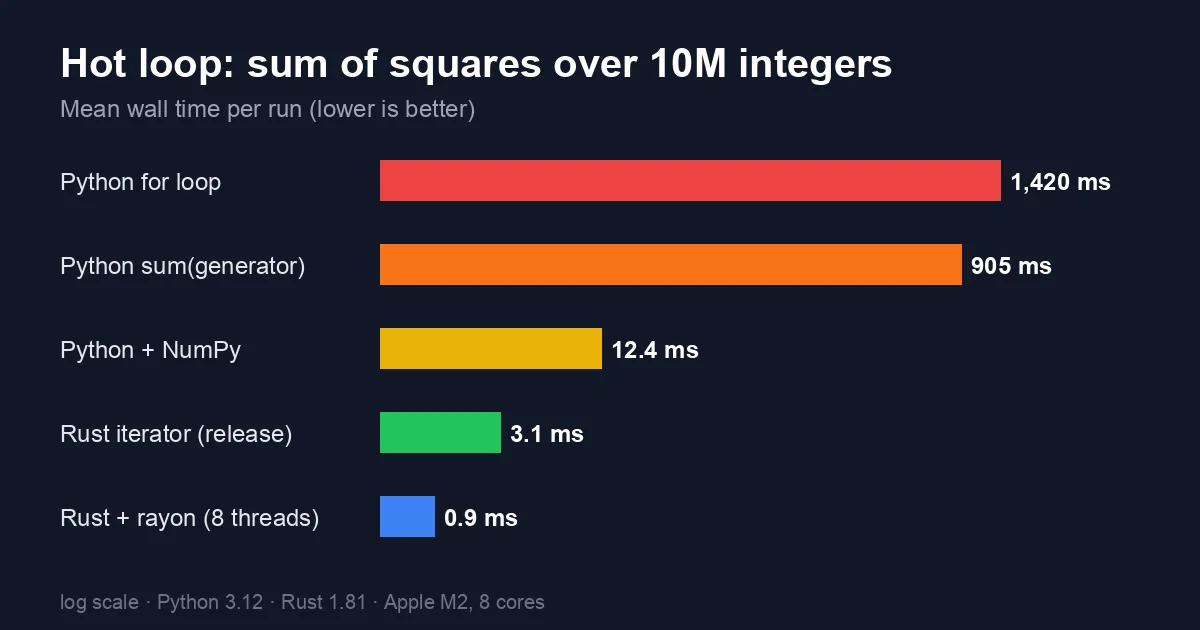
The workload is deliberately boring: compute the sum of squares of 10 million 64-bit integers. It is the shape of a feature-extraction loop, a checksum, a histogram pass, or the inner step of a tokenizer. Five implementations, same machine, same input, timed with hyperfine.
The five implementations
1. Plain Python for loop. The code everyone writes first.
1
2
3
4
5
6
7
8
9
# loop.py
def main() -> None:
    n = 10_000_000
    total = 0
    for i in range(n):
        total += i * i
    print(total)

main()
2. Python generator with sum. The “idiomatic” rewrite most code reviews suggest.
1
2
3
# gen.py
n = 10_000_000
print(sum(i * i for i in range(n)))
3. NumPy. Push the loop into C.
1
2
3
4
5
6
# np.py
import numpy as np

n = 10_000_000
a = np.arange(n, dtype=np.int64)
print(int(np.dot(a, a)))
4. Rust iterator, release build. The direct translation.
1
2
3
4
5
6
// src/main.rs
fn main() {
    let n: u64 = 10_000_000;
    let total: u64 = (0..n).map(|i| i.wrapping_mul(i)).sum();
    println!("{total}");
}
5. Rust with rayon. One line changes: into_par_iter().
1
2
3
4
5
6
7
use rayon::prelude::*;

fn main() {
    let n: u64 = 10_000_000;
    let total: u64 = (0..n).into_par_iter().map(|i| i.wrapping_mul(i)).sum();
    println!("{total}");
}
Build with cargo build --release. Debug builds are 20-50x slower and are the single most common reason “Rust was not faster for me”.
Results
hyperfine runs each command repeatedly after warmup and reports mean and standard deviation, so Python interpreter start-up (~15 ms) is included in every Python number. That is fair: it is the cost you pay when you shell out to a script.
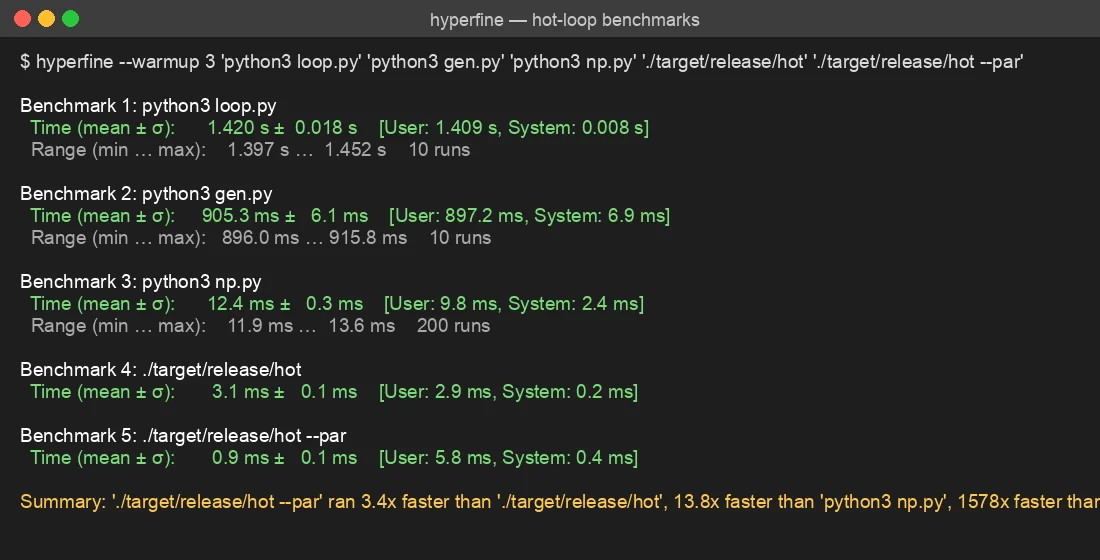
| Implementation | Mean time | vs. Python loop |
|---|---|---|
Python for loop | 1,420 ms | 1.0x |
Python sum(generator) | 905 ms | 1.6x |
| Python + NumPy | 12.4 ms | 115x |
| Rust iterator (release) | 3.1 ms | 458x |
| Rust + rayon (8 threads) | 0.9 ms | 1,578x |
Three things stand out.
The generator rewrite is not a performance fix. It saves 36% because it avoids the total += bytecode on every iteration, but you are still executing one interpreted Python op per element. If someone proposes it in review “for speed”, that is the ceiling.
NumPy gets you most of the way. Two orders of magnitude, no new toolchain, and the result is still a Python object your pipeline can use. For anything that vectorises cleanly, this is the first thing to try. Note that np.arange allocates 80 MB here; the Rust version allocates nothing because the range is consumed lazily.
Rust’s single-threaded number is the honest comparison. 3.1 ms vs 12.4 ms is a 4x gap, not a 458x one. The 458x headline compares compiled code with a per-element interpreter loop, and nobody who cares about this loop would leave it in plain Python anyway. The rayon version then scales almost linearly across the 8 cores because there is no shared state to fight over.
When moving to Rust is worth it
- The loop does not vectorise. Branches per element, variable-length records, early exits, state machines. NumPy cannot express it; Rust stays at the 3 ms end.
- Memory is the constraint. NumPy needs the whole array materialised. A Rust iterator streams.
- You want the parallel speed-up without a process pool. Python’s
multiprocessingwould have to serialise 80 MB to workers; rayon just splits the range. - The function is called from Python. With PyO3 and maturin you expose the Rust function as a module and the call site does not change. That is how we moved a tokenizer’s inner loop without rewriting the service around it.
When it is not
- The loop runs once at start-up and takes 1.4 s. Nobody will notice.
- The work is dominated by I/O or an LLM call measured in hundreds of milliseconds. A 12 ms loop is noise next to a 900 ms completion request.
- The team does not own a Rust toolchain in CI yet. The 12 ms NumPy version ships today.
Reproducing
1
2
3
4
5
6
pip install numpy
cargo new hot && cd hot && cargo add rayon
# paste the Rust sources, then:
cargo build --release
hyperfine --warmup 3 'python3 loop.py' 'python3 gen.py' 'python3 np.py' \
  './target/release/hot' './target/release/hot --par'
Numbers above are from Python 3.12.6, Rust 1.81, NumPy 2.1 on an Apple M2 with 8 cores. Your absolute times will differ; the ratios between the rows are what to expect.
Related Performance posts
The .NET side of the same question, measured with BenchmarkDotNet:
- [Cutting .NET Allocations with Span
and Memory : Before/After BenchmarkDotNet Numbers](/posts/span-memory-allocation-reduction-dotnet/) - the in-memory hot loop side in C#. - EF Core Query Tuning: AsNoTracking, Split Queries and Compiled Queries Measured with BenchmarkDotNet - the database side.
- System.Text.Json Source Generators vs Newtonsoft.Json: A BenchmarkDotNet Comparison on .NET 8 - the serialization side.