AI Code Review Gates in CI, Measured: 26 Seeded Agent Defects Against a Go Pipeline
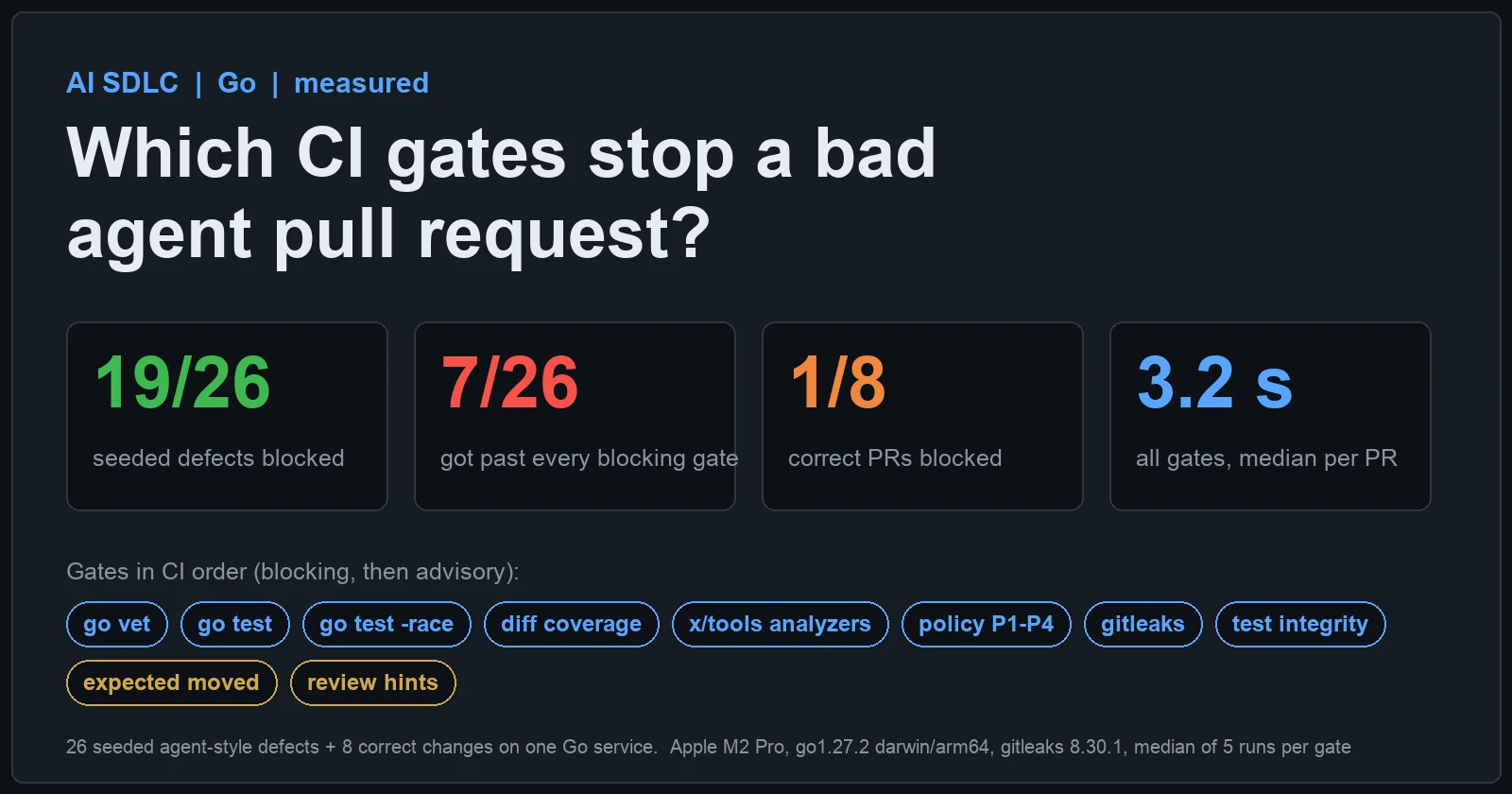
26 agent-style defects and 8 correct changes run through 8 blocking CI gates on a Go service: 19 blocked, 7 got through, 1 correct PR blocked, 3.2 s per PR.
Most teams that let coding agents open pull requests already have a CI pipeline. The usual question is which gates to add before an agent PR can merge without a human reading every line. The usual answers are opinions: “turn on the race detector”, “add a secret scanner”, “require coverage on the diff”. I wanted numbers, so I measured the gates.
I took one small Go service, wrote 26 agent-style defects and 8 correct changes as patches against it, and ran every patch through ten CI gates: eight that can block a merge and two that only leave a note for the reviewer. Every gate is a real tool or a short script in this blog’s repository (scripts/ai-review-gates/), and one command reproduces the whole table.
The results:
- The eight blocking gates stopped 19 of 26 defects. 7 got through. All seven compile, pass every test and pass every analyzer.
- No single gate is enough. Eight of the 19 blocked defects were caught by exactly one gate. Drop that gate and they merge.
- The race detector added no new catches over plain
go test, at 3x the time (1.65 s against 0.54 s per PR). What it did add was certainty: plaingo testcaught the two race defects on only 2 and 3 of 5 runs, and-racecaught them on every run. Each gate was timed on its own, as CI would run it. - The test-integrity rules caught two defects nothing else saw, but they also blocked 1 of the 8 correct PRs (a test refactor).
- All ten gates together cost a median 3.2 s per PR on an M2 Pro. CI time is not a reason to skip any of them.
The service and the seeded PRs
The base tree is a token-budget service for an LLM gateway, 282 lines of Go: a Ledger that charges tokens per tenant behind a mutex, a generic Page helper, config loading, a tenant store interface, an upstream HTTP client and one handler. It has 18 tests. The base tree passes every gate. The runner checks this before it counts anything.
Each seeded PR is a list of exact text edits in corpus.py. I modelled the 26 defects on the seven classes from our review checklist of AI-generated code defects, with the same kind of plausible mistake an agent makes when it is told to “make CI green” or “handle errors gracefully”:
| Class | PRs | Example |
|---|---|---|
| Silent error fallback | D01-D04 | DisplayName returns "tenant <id>" instead of the store error |
| Boundary / off-by-one | D05-D08 | > became >= in the budget check |
| Tests that prove nothing | D09-D12 | the code broke and the test’s expected value moved to match |
| Hallucinated API / argument order | D13-D14 | time.ParseDurationStrict, which does not exist |
| Duplicated helper | D15 | a second pagination helper with different end-of-list behaviour |
| Concurrency and resources | D16-D21 | ok++ without the mutex, a lock released between check and write |
| Security | D22-D26 | SQL built by concatenation, InsecureSkipVerify: true, a key in the code |
The eight correct changes (B01-B08) are the everyday edits an agent also makes: a rename, a new test case, min() in place of an if, a new method with its test, an intended default change with its test update, a table-test refactor, an extra log line, errors.New in place of an argument-free fmt.Errorf. A gate that blocks these costs review time on every PR, so false positives count as much as catches.
To be clear about the limits: I wrote these patches by hand. They are not sampled from a model, and 26 defects is a small sample. The point is not a catch rate you can quote for your codebase. The point is which gate catches which kind of defect, and which kinds no gate catches.
The gates
The eight blocking gates run in CI order. Each one runs on a fresh copy of the patched tree:
go vetwith the default analyzers. It also fails if the tree does not compile.go test: the service’s own tests.go test -race: the same tests under the race detector.- Diff coverage:
go test -coverprofile, then the gate fails if any added non-test line sits in a block that no test ran. - Extra analyzers:
nilness,shadowandunusedwritefromgolang.org/x/tools.go vetdoes not run these by default. They are built into one-vettoolbinary. - Policy rules P1-P4: four house rules written as a
go/analysisanalyzer in 140 lines. They flagInsecureSkipVerify: true, a SQL string literal concatenated with a non-constant value, anAuthorization/Cookie/X-Api-Keyheader value passed to a logger, andjson.NewDecoder(r.Body)on an*http.Requestwithouthttp.MaxBytesReader. - gitleaks 8.30.1 on the added lines only, through
gitleaks stdin. - Test integrity: the Go version of the rules from our test-integrity gate post. The gate blocks when a test function disappears (T01), a
t.Skipis added (T02), or a test losest.Fatal/t.Errorcalls (T03).
The two advisory gates never block a merge. They leave notes for the reviewer, who can be a human or a review agent:
- Expected moved (T05): a comparison literal in a test changed in the same PR as production code.
- Review hints H1-H4: four diff-only patterns. A net error return removed from non-test code (H1). Lock calls added or removed (H2). A
defer ... Close()moved (H3). A comparison flipped between<and<=, or>and>=(H4).
I would have added staticcheck too, but the newest staticcheck in my module cache was built against an x/tools that cannot read go1.27 export data. Every package failed with export data version 5 is greater than maximum supported version 4. If you pin your Go toolchain ahead of your linters, this is the failure you get. It is worth a CI step that runs the linter on an empty package and fails loudly.
Every PR against every gate
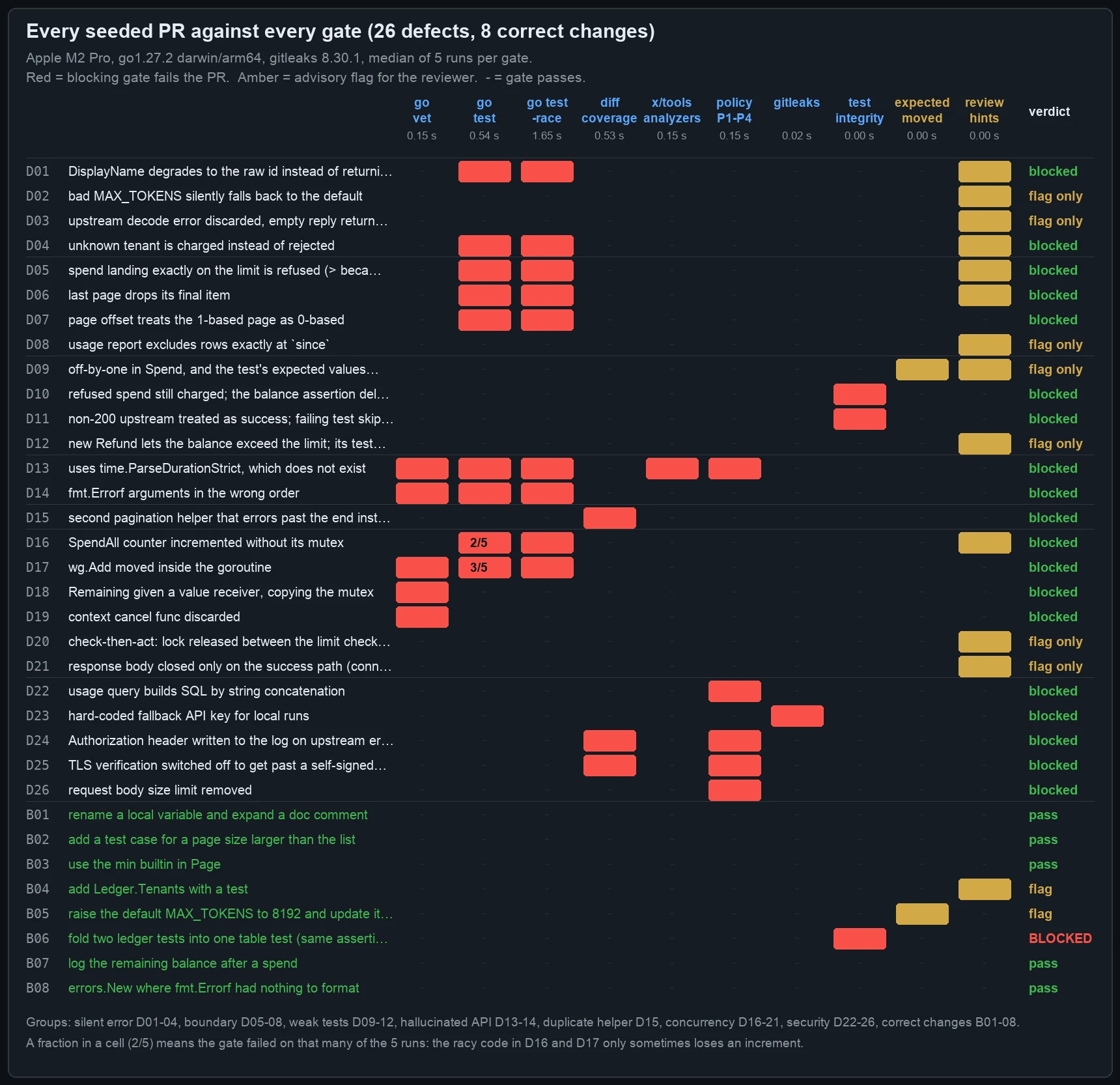
Read it one column at a time:
go vet caught 5, two of them alone. D18 gave Remaining a value receiver, so every call copies the sync.Mutex. D19 dropped the cancel from context.WithTimeout. No test noticed either one, because both bugs only matter under load. vet also caught D14 (fmt.Errorf("%w", ErrOverBudget, tenant) with the arguments swapped) and D17 (wg.Add inside the goroutine), and both of those also failed go test. D14 failed it because go test runs a small subset of vet (including printf) before the tests, and D17 because the lost wg.Add lets SpendAll return early (on 3 of 5 runs). D13’s hallucinated time.ParseDurationStrict fails at compile time, so every gate that builds the tree failed it. That matches the checklist post: hallucinated APIs cost review time, not incidents.
go test caught 9. The three boundary defects in Go code (D05-D07) failed it, and so did D01 and D04, where an error became a default value. These are the defects a good existing suite stops, because it tests the edges: the exact-limit spend, the last page, page 1. The fourth boundary defect, D08, is inside a SQL string, and no test runs that query.
go test -race caught 9, the same 9 as go test. In this corpus the race detector added no new defect. The two race defects (D16, unlocked ok++, and D17, wg.Add in the goroutine) make TestSpendAll count fewer than 50 successes on some runs, so plain go test already catches them sometimes. The race detector made that failure certain on every run, where plain go test caught D16 on 2 of 5 runs and D17 on 3 of 5. So the race detector’s real value here was a reliable verdict. Under a flaky verdict, an agent that retries CI until it goes green merges the race.
Diff coverage caught 3, one alone. D15 is the duplicated pagination helper. Nothing calls it and no test covers it, so 13 added lines never run. That is the only signal any gate gave about a duplicated helper. Diff coverage also hit D24 and D25, because the new log call and the new TLS client were never run by a test either.
The extra analyzers caught nothing that was not already caught. nilness, shadow and unusedwrite only failed on D13, which does not compile, so the failure is the compile error and not an analyzer finding. None of the 26 defects is a nil dereference or a shadowed err, so this is a fact about the corpus, not about the analyzers. I kept the gate because it costs 0.16 s.
The policy rules caught 4 security defects, two alone (the fifth hit in the column is D13’s compile error). These four rules did most of the security work. D22 (SQL concatenation) and D26 (body size limit removed) were seen by no other gate. D24 (the Authorization header in a slog.Warn) and D25 (InsecureSkipVerify) were also caught by diff coverage, but only by luck: if the agent had added a test that exercised the new code, coverage would pass and the policy rule would still fire.
gitleaks caught the hard-coded key (D23), and nothing else did, as expected. It also made no false positive on 34 diffs.
Test integrity caught 2 alone and blocked 1 correct PR. D11 turned non-200 upstream replies into successes and added t.Skip("flaky on CI, see #412") to the test that would have failed. D10 charged refused spends and deleted the balance assertion that proved it. No other gate caught either one, because the tests that would have caught them were gone. The cost is B06: a refactor that folds two tests into one table test with the same three assertions. T01 sees two test functions disappear and blocks it. That false positive is the price of the rule, and the fix is a reviewer override, not a weaker rule.
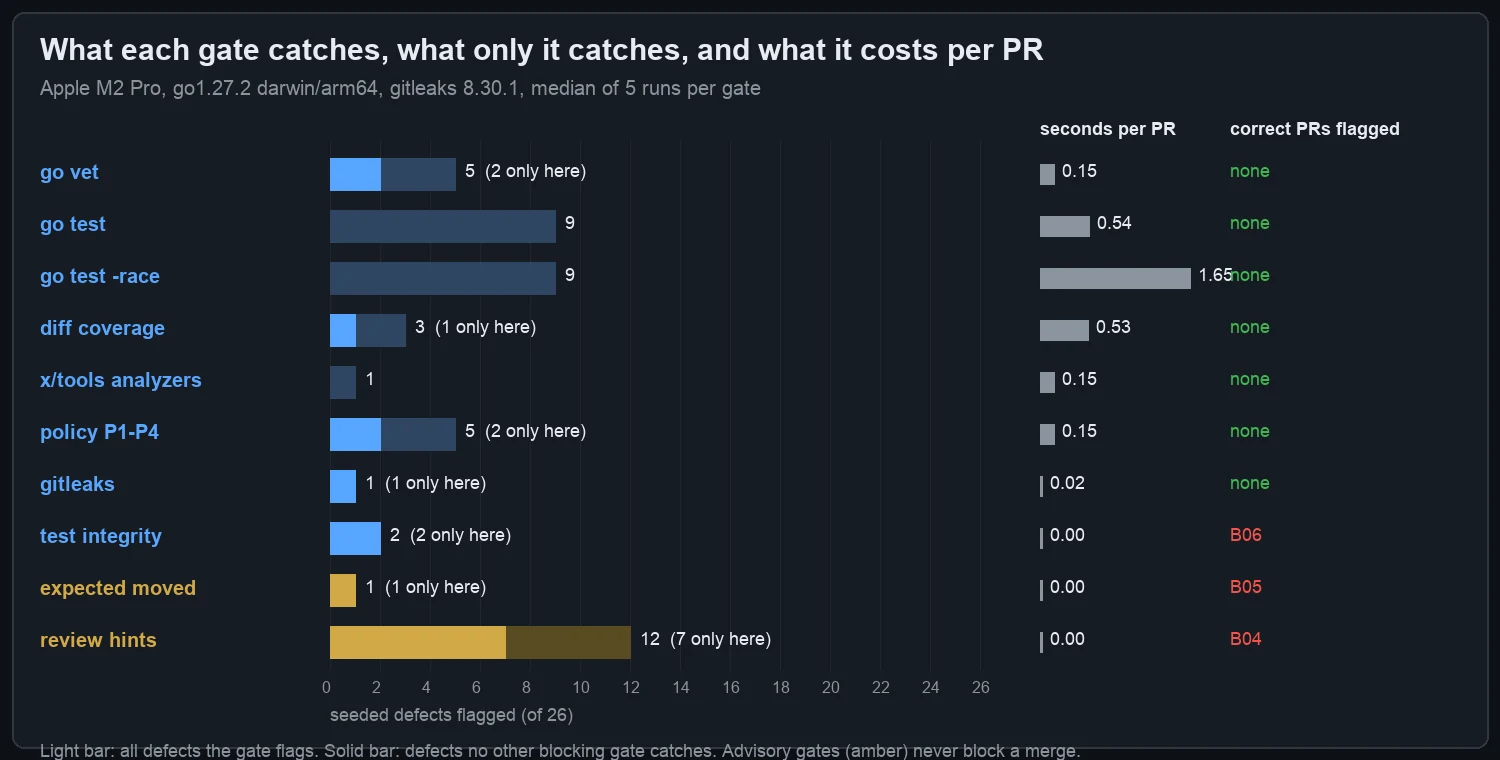
The cumulative count shows the same thing. In CI order the blocking gates reach 5, 11, 11, 14, 14, 16, 17 and 19 blocked defects. Two gates added no new defect on this corpus (the race detector, which only made two verdicts reliable, and the extra analyzers). Every other gate added defects that no earlier gate had caught.
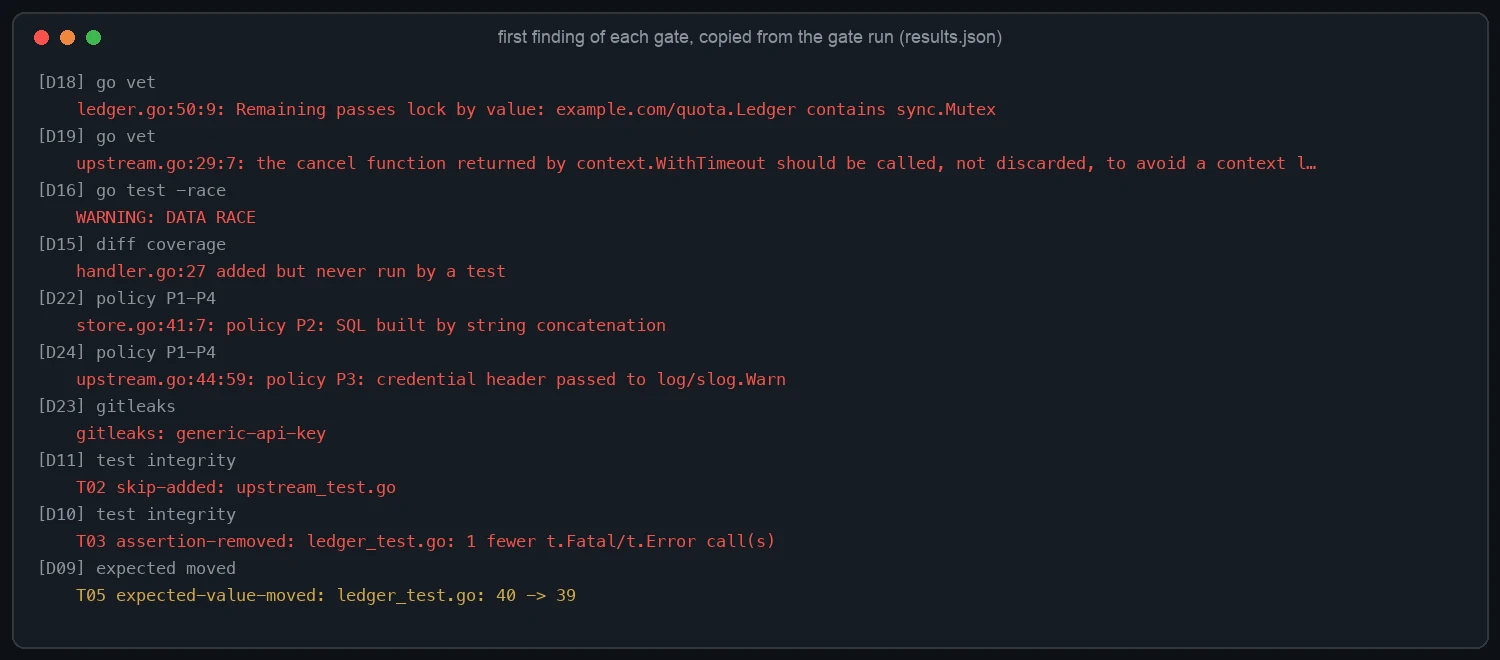
These are the first findings each gate printed, copied from the run’s results.json:
The seven that got through
These seven defects passed all eight blocking gates. They are where review time should go, from a human or from an AI reviewer.
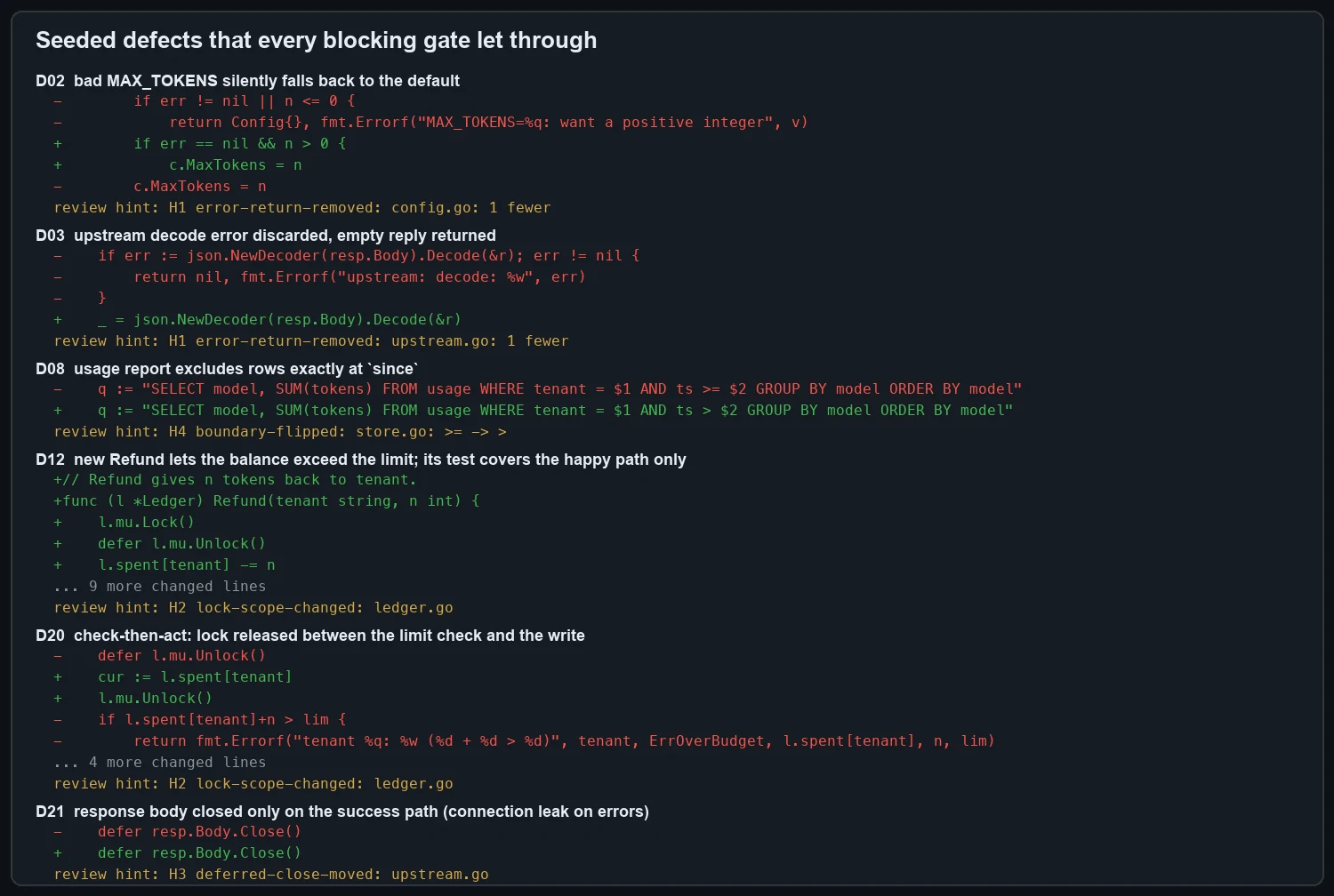
- D02 and D03 are silent error fallbacks: a bad
MAX_TOKENSquietly becomes 4096, and a broken upstream reply becomes an empty one. No test feeds bad input, and the lines that remain are still run by the happy-path tests. Diff coverage cannot see a branch that was deleted. - D08 moved
ts >= $2tots > $2inside a SQL string. Go’s tooling cannot see inside a string, and the test only checks the arguments. D09 is the agent’s favourite: it broke the exact-limit spend with
>=, and then “fixed” the test by spending 39 instead of 40 and expecting 1 token left instead of 0. Every test passes. Only the advisory T05 rule noticed that40 -> 39moved in the same PR asledger.go.1 2 3 4 5
- if l.spent[tenant]+n > lim { + if l.spent[tenant]+n >= lim { ... - if err := l.Spend("acme", 40); err != nil { + if err := l.Spend("acme", 39); err != nil {
- D12 adds a
Refundthat can push the balance above the tenant’s limit, with a test that only covers the happy path. Coverage is 100% on the new lines. - D20 is a check-then-act race. The lock is released after reading the balance and taken again to write it. Every individual access is locked, so the race detector is silent.
TestSpendAlluses a budget large enough that the lost check never matters. - D21 moves
defer resp.Body.Close()below the status check, so every non-200 reply leaks a connection. The test still gets its 503 error.
None of these is exotic, and two of them (D09, D20) are exactly what an agent produces when it optimises for a green check. More blocking gates would not catch them. They need a reviewer who knows what to look at.
Advisory gates: pointing review at the right lines
This is where an AI reviewer, or a tired human, gets the most help. The four review hints are diff-only regexes with no build step. They flagged all 7 of the defects that got through, plus 5 that were already blocked. They also flagged one correct change, B04, because its new Tenants() method takes the lock. On a real team that is one extra look at a lock in a PR that adds locking, which is fair.
An honest caveat: I wrote the hints after I saw which defects got through. Their 7-of-7 is fitted to this corpus and is not a prediction. What carries over is the shape. Each hint names a change that is cheap to detect and expensive to miss: an error return removed, lock scope changed, a deferred Close moved, a boundary flipped. That is also where we point our review agent first, as in the code review agent workflow. The deterministic gates do the blocking. The reviewer, human or model, gets a short list of lines with a reason attached, not a 300-line diff and “please review”.
What I would run on agent PRs
From this run, for a Go service:
go vetandgo test -racetogether. Drop plaingo test. On this corpus-racemade the same catches with a reliable verdict, and the extra 1.1 s is cheaper than a race that merges after a retry.- Diff coverage, blocking. It is the only gate here that noticed dead code and an unused helper.
- Four to six narrow policy analyzers for the security rules your incidents taught you. Each rule should be narrow enough to fire on zero correct changes. Ours fired on 0 of 8.
- gitleaks on the added lines (0.02 s).
- Test-integrity rules, blocking, with a reviewer override for refactors like B06.
- Expected-moved and the review hints, advisory, posted as the first comments on the PR so the human or the review agent starts there.
That set adds up to about 2.5 s per PR in this setup (all ten gates: 3.2 s median, 4.0 s worst). For the merge policy around these gates (who may override what, and when an agent PR still needs a human), see how we gate AI coding-agent pull requests before merge.
We run gates like these on the agent PRs behind Lamplit Labs’ products. Measuring each change against a baseline before it lands is also the core of Pulse, Lamplit Labs’ self-improving automation product, coming soon.
Reproduce it
1
2
3
4
# needs Go 1.24+ and gitleaks 8.x on PATH; Pillow only for the images
python3 scripts/ai-review-gates/run_gates.py /tmp/gates-work 5     # about 10 minutes for 5 runs
python3 scripts/ai-review-gates/summarise.py /tmp/gates-work       # -> scripts/data/ai-review-gates-go.json
python3 scripts/ai-review-gates/gen_images.py                      # the four figures and the header
run_gates.py builds the analyzer binary from scripts/ai-review-gates/gatecheck/. It copies svc/ once per patch, applies the edits (each edit must match exactly once, or the run stops), runs all ten gates and records each verdict on every run. A gate that fails on some runs and passes on others is kept as flaky (2/5), not averaged away. summarise.py refuses to write anything if the unpatched base tree fails a gate. Gate times will differ on your machine. The verdicts should not, except for the two races.
Related
- AI SDLC: Reviewing AI-Generated Code - The Seven Defect Classes Green Tests Missed: the seven defect classes this corpus is modelled on.
- AI SDLC: When the Coding Agent Edits the Tests, Six Rules That Gate It: the test-integrity rules ported to Go here.
- AI SDLC: How We Evaluate and Gate AI Coding-Agent Pull Requests Before Merge: the merge policy around these gates.
- AI SDLC: A Code-Review Agent Workflow That Reviewers Actually Trust: where advisory findings go in the review.
- AI Security: Secrets in Agent Logs, Measured - What gitleaks and Redaction Actually Catch: what gitleaks misses when the secret is not in a diff.
- Go pprof Profiling Guide: the same kind of service, measured for speed instead of defects.
- Pulse: Lamplit Labs’ self-improving automation product, coming soon: the product mentioned above.