Sandboxing Agent Tool Calls: Keep the Secrets Out of the Blast Radius
Sandbox every AI agent tool call: per-call sandbox schemas, isolated execution, environments with no secrets, and output scanning before results come back.
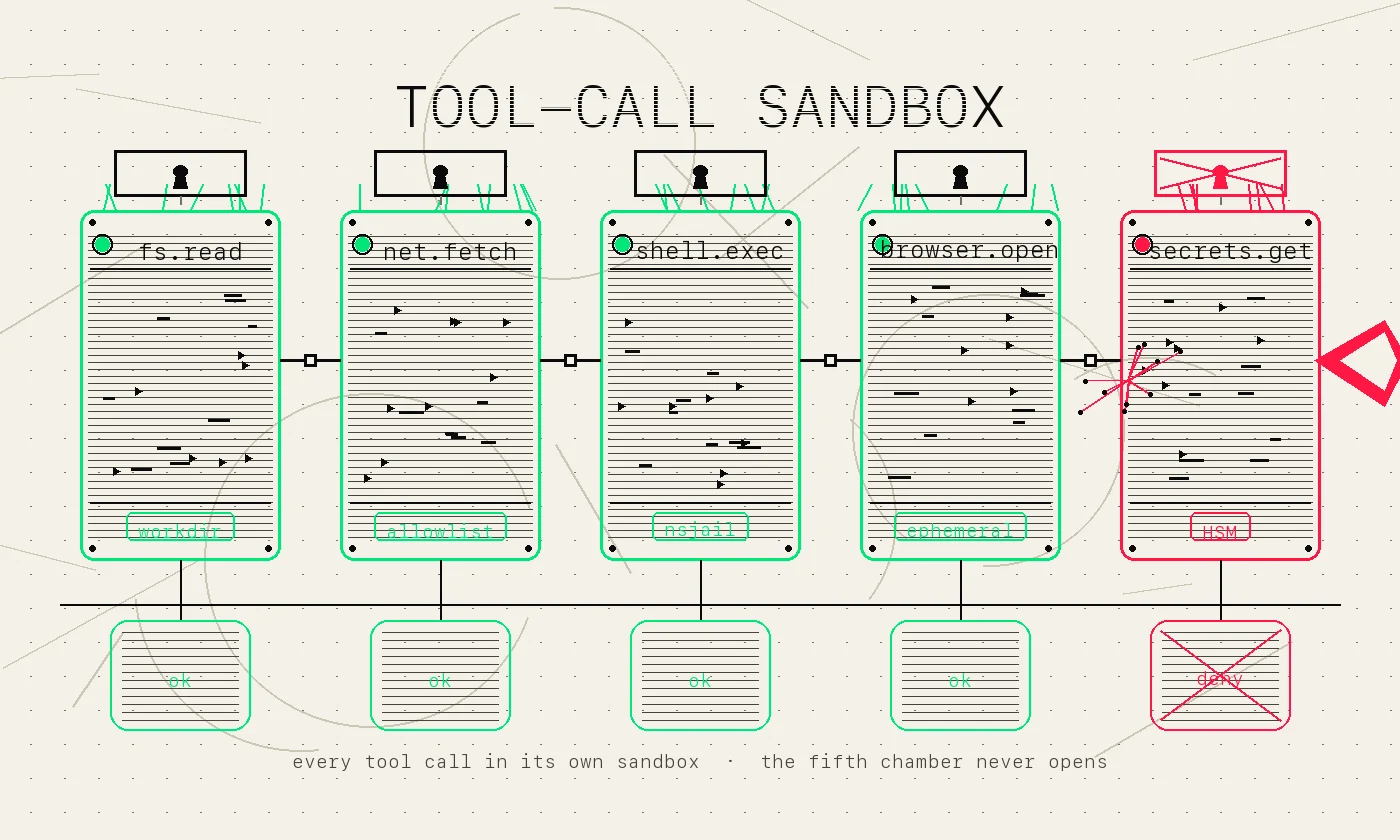
Your coding agent decides to “debug” a failing test by printing os.environ. Your support agent, asked to summarize a ticket, helpfully includes the API key the customer pasted into it. Nobody wrote an attack; the model just reached for whatever was in reach. In the previous post on prompt injection defenses we covered how to stop an attacker from talking your agent into misbehaving. This post is about the layer underneath: when the agent - tricked, confused, or simply wrong - does try to call a tool, what stops that call from touching your secrets? The answer is sandboxing, and it works even when every defense above it has failed.
Why least privilege is not enough
The standard advice is “give the agent only the tools it needs.” That is necessary and wildly insufficient, for three reasons:
- Tools are ambient. If the agent process can read
~/.aws/credentials, then every tool it has - even an innocentfs.read- is one path traversal away from your AWS keys. The permission you granted is on the tool; the exposure lives in the environment. - Capabilities compose.
net.fetchalone is fine.fs.readalone is fine.fs.readplusnet.fetchis an exfiltration channel: read a file, POST it somewhere. No single tool policy sees the composition. - The decider is probabilistic. The model decides which tool to call and with what arguments, and it can be steered by the content it reads (the injection post) or simply by a bad day in the weights. Static permission lists assume a rational operator. You do not have one.
The fix is to stop treating tool calls as function invocations and start treating them as untrusted processes: each call gets its own sandbox, its own filesystem view, its own network policy, and - critically - an environment that contains no secrets at all.
A per-call sandbox decision flow
Every tool call should pass through the same pipeline, regardless of which tool it is:
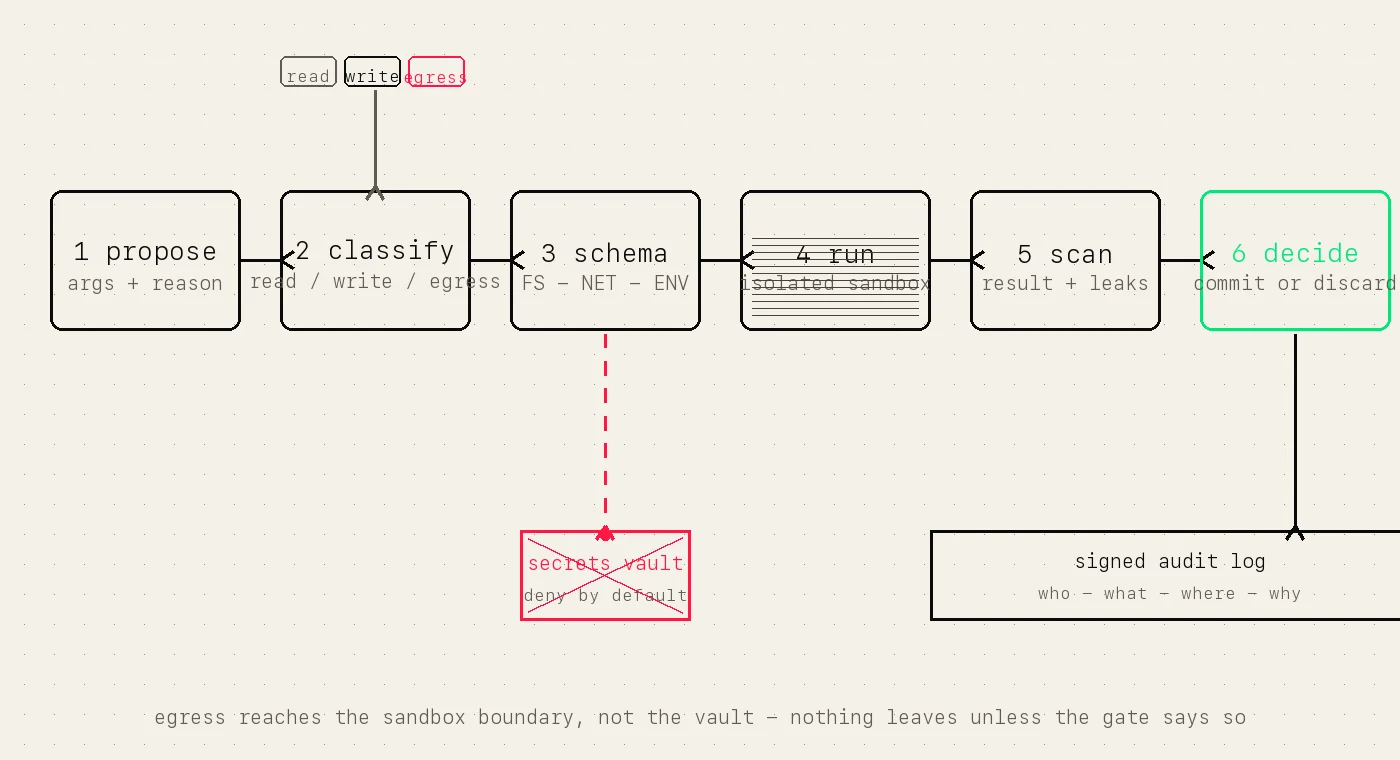
- Propose. The model emits a tool call: name, arguments, and (in a disciplined runtime) a reason. Treat all of it as untrusted input.
- Classify. Map the call to a risk band - read, write, or egress - based on the tool and the arguments.
fs.readof./src/main.rsis a read;fs.readof~/.ssh/id_rsais an egress attempt, because its only plausible use is to move that data somewhere. - Build the sandbox schema. From the band, derive the three boundary policies: which filesystem paths are visible, which network destinations are reachable, and what the environment contains (almost always: nothing).
- Run isolated. Execute in a fresh sandbox - a namespace jail, a microVM, a container with a read-only root - that lives for exactly this call. No shared state with other calls, no writable persistence unless the schema grants it.
- Scan the result. Before the tool output goes back to the model, scan it for secrets and exfil-shaped payloads. A
git diffthat accidentally includes.envgets redacted here, not after the model has memorized it. - Decide and log. Commit the result to the conversation or discard it, and record the whole decision - tool, arguments, classification, policy, outcome - in a signed audit log.
The important property is that steps 2 through 6 are deterministic code, not model judgment. The model proposes; the sandbox disposes. A prompt injection can make the model ask for secrets.get; it cannot make the sandbox’s environment contain a secret that was never put there.
The three layers that keep secrets out
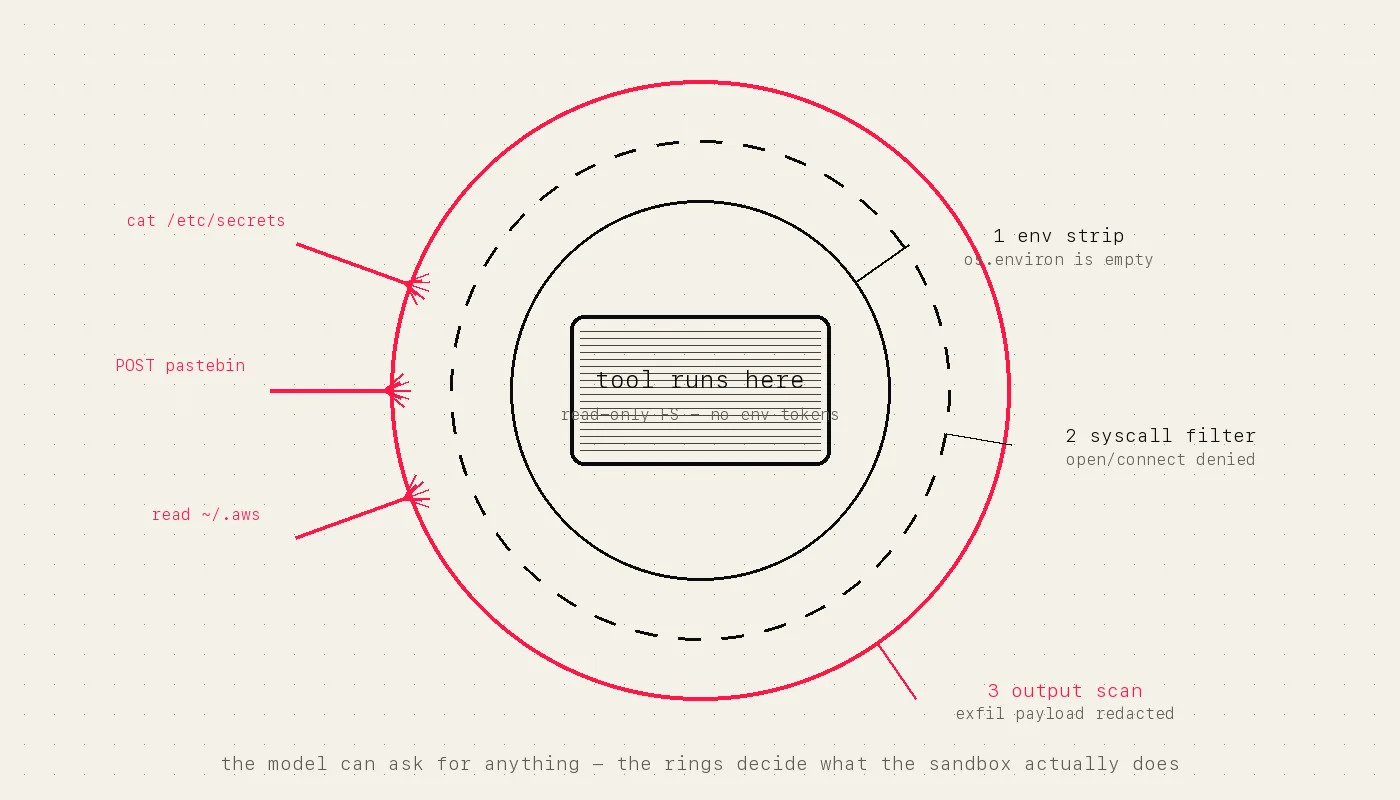
Layer 1: Environment stripping
The single highest-yield control. Most secret leaks in agent systems are not exotic: the agent runs env, or reads a file that sources a profile, or the tool SDK helpfully passes os.environ into a subprocess. The sandbox starts with an empty environment and adds back only the variables the schema names - PATH, HOME pointing at a scratch directory, maybe LANG. API keys, cloud credentials, and session tokens never enter. If the task genuinely needs a credential, the sandbox calls a broker outside the jail that holds it, uses it, and returns a result - the key itself never crosses the boundary.
Layer 2: Syscall and network filtering
Environment stripping removes the data; this layer removes the moves. A seccomp-style syscall filter denies open outside the mounted paths and connect to anything not on the egress allowlist. This is what stops the composition attack from the tool egress post: fs.read inside the jail can read only what was mounted in, and net.fetch can reach only the allowlisted hosts, so the read-then-POST channel has no second leg.
Layer 3: Output scanning
Defense in depth for the failure mode where the first two layers are misconfigured. Scan tool output for secret patterns, tokens, and suspiciously large base64 blobs before it reaches the model context. This layer is a scanner, not a boundary - it will have false positives - but it turns a silent leak into a logged event, and a logged event into a policy fix.
No single layer is trusted to hold. That is the point of calling it a shield: you assume each ring has holes and you overlap them.
A sandbox schema in practice
The schema is where policy becomes concrete. Keep it data, not code, so it can be reviewed, versioned, and diffed:
1
2
3
4
5
6
7
8
9
10
11
12
13
14
15
16
17
tool: shell.exec
risk: write
sandbox:
  image: ghcr.io/example/agent-exec:1.4
  fs:
    mount_ro: ["/repo"]
    mount_rw: ["/tmp/work"]
  net:
    allow: ["github.com:443"]
    deny_all_others: true
  env:
    allow: ["PATH", "HOME", "LANG"]
  limits:
    cpu_seconds: 30
    memory_mb: 512
    max_output_kb: 64
  secrets: deny          # no broker access from this sandbox
Two things to notice. First, deny_all_others: true - egress is opt-in per destination, which is the same posture the egress post recommends at the gateway, pushed down into the sandbox itself. Second, secrets: deny is explicit. Every schema should answer the question “can this call reach a secret?” with a word you can grep for, not with an absence you have to infer.
Failure modes worth planning for
- Sandbox escape through the tool itself. If your
shell.execsandbox runs a container with a shared kernel, a kernel exploit is a sandbox escape. For high-risk tools, use a microVM (Firecracker-style) so the blast radius stops at a VM boundary, not a cgroup. - Legitimate work that looks like exfiltration. A test suite that reads fixtures from
$HOMEwill break under environment stripping, and the team’s first instinct will be to loosen the sandbox globally. Resist this: mount the fixtures into/tmp/workin the schema for that tool, and keep the global posture. - Secret-shaped non-secrets. Output scanning will flag UUIDs, hashes, and minified blobs. Tune the scanner on your own corpus before you let it block results, or people will route around it.
- The audit log nobody reads. A signed log of every decision is only useful if someone - or something - replays it. Alert on the crossing of budgets and deny counts, not on the breach.
A starting sequence
- Inventory the tools your agents can call today, and classify each as read, write, or egress by arguments, not by name.
- Strip the environment for every execution path. This is usually one afternoon and removes the most common leak vector outright.
- Jail the high-risk tools first -
shell.execand anything with network access - with read-only roots and per-destination egress. - Add output scanning for the two or three secret classes you actually hold.
- Log every decision and verify you can answer “which sandbox saw which file at 03:12 on Tuesday?” before you need to.
Where Pulse fits
We are building Pulse, Lamplit Labs’ multi-project self-improving automation product, and its agents run under exactly this discipline: every tool call is classified, sandboxed, and scanned before the result re-enters the conversation, and every decision lands in a signed audit log. Autonomous agents that can reach your secrets are not automation; they are an incident report with a scheduler. Pulse is coming soon - if agent governance is on your 2027 roadmap, that is the problem we are building it to solve. We wrote about how Pulse improves this very blog last week.