LoRA vs QLoRA vs full fine-tuning: the GPU memory, cost, and eval-score tradeoffs
LoRA and QLoRA cut GPU memory 3-5x and training cost 3-6x versus full fine-tuning. See where their eval scores match and how to pick per task.
When a team decides a base model is not enough, the default answer used to be full fine-tuning: update every weight. For a 7B model that was painful; for a 13B or 70B model it is a budget line of its own. Low-rank adapters changed the arithmetic. LoRA (Low-Rank Adaptation) and QLoRA (its quantized sibling) let you specialize a large model on one GPU instead of a cluster - but they are not free. This post lays out the three tradeoffs that decide which method to use: GPU memory, training cost, and eval-score quality.
What each method actually updates
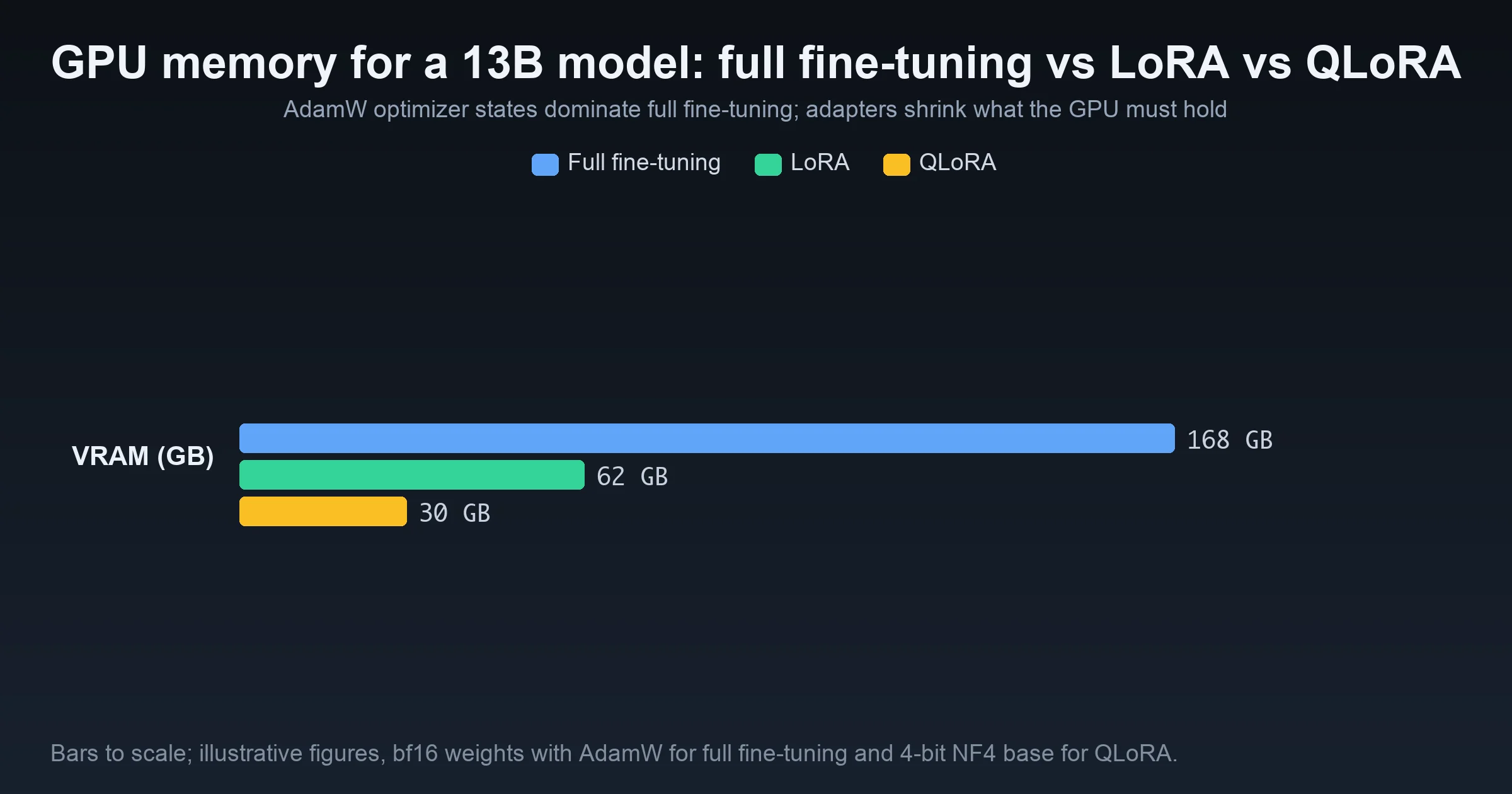
Full fine-tuning updates all model weights. In mixed precision with AdamW, the optimizer alone dominates memory: each parameter needs the bf16 weight, an fp32 master copy, and two fp32 optimizer moments - roughly 14-16 bytes per parameter before gradients and activations. A 13B model lands near 170 GB of VRAM: three A100 80GB cards or a sharded setup.
LoRA freezes the base weights and trains small low-rank matrices (typically rank 8-64) injected into the attention and MLP projections. Trainable parameters drop from 13 billion to roughly 40-160 million - about 0.3-1% of the model. You still load the base weights, but the optimizer state shrinks by two orders of magnitude: the same 13B model fits in about 60 GB, one A100 80GB.
QLoRA goes one step further: the frozen base weights are stored in 4-bit NormalFloat (NF4) quantization and only dequantized during the forward pass. The base model now takes about a quarter of its bf16 footprint, and a 13B model trains in roughly 30 GB - a single A100 40GB or a high-end workstation card.
The memory picture in one glance: full fine-tuning at ~168 GB, LoRA at ~62 GB, QLoRA at ~30 GB for the same 13B model.
GPU memory: where the wall actually is
The optimizer, not the weights, is what kills full fine-tuning. AdamW keeps two fp32 moments per parameter, so memory scales linearly with parameter count and there is no batch-size knob that fixes it. Gradient checkpointing and smaller micro-batches trim activation memory but leave the 13-bytes-per-parameter optimizer-plus-master-weight block untouched.
LoRA’s memory floor is the base model itself: bf16 weights (26 GB at 13B) plus activations and the small adapter optimizer. QLoRA lowers that floor to the 4-bit weights (~7-8 GB at 13B) plus the quantization overhead, paged optimizer states, and activations. This is why QLoRA made fine-tuning a 65B model on a single 48 GB GPU feasible in the original paper’s experiments.
The header chart shows the practical consequence: full fine-tuning is a multi-GPU scheduling problem, LoRA is a one-GPU job, and QLoRA is a one-modest-GPU job.
Training cost: the same bars, in dollars
Memory maps almost directly to money because it decides how many GPUs you rent and how scarce those GPUs are.
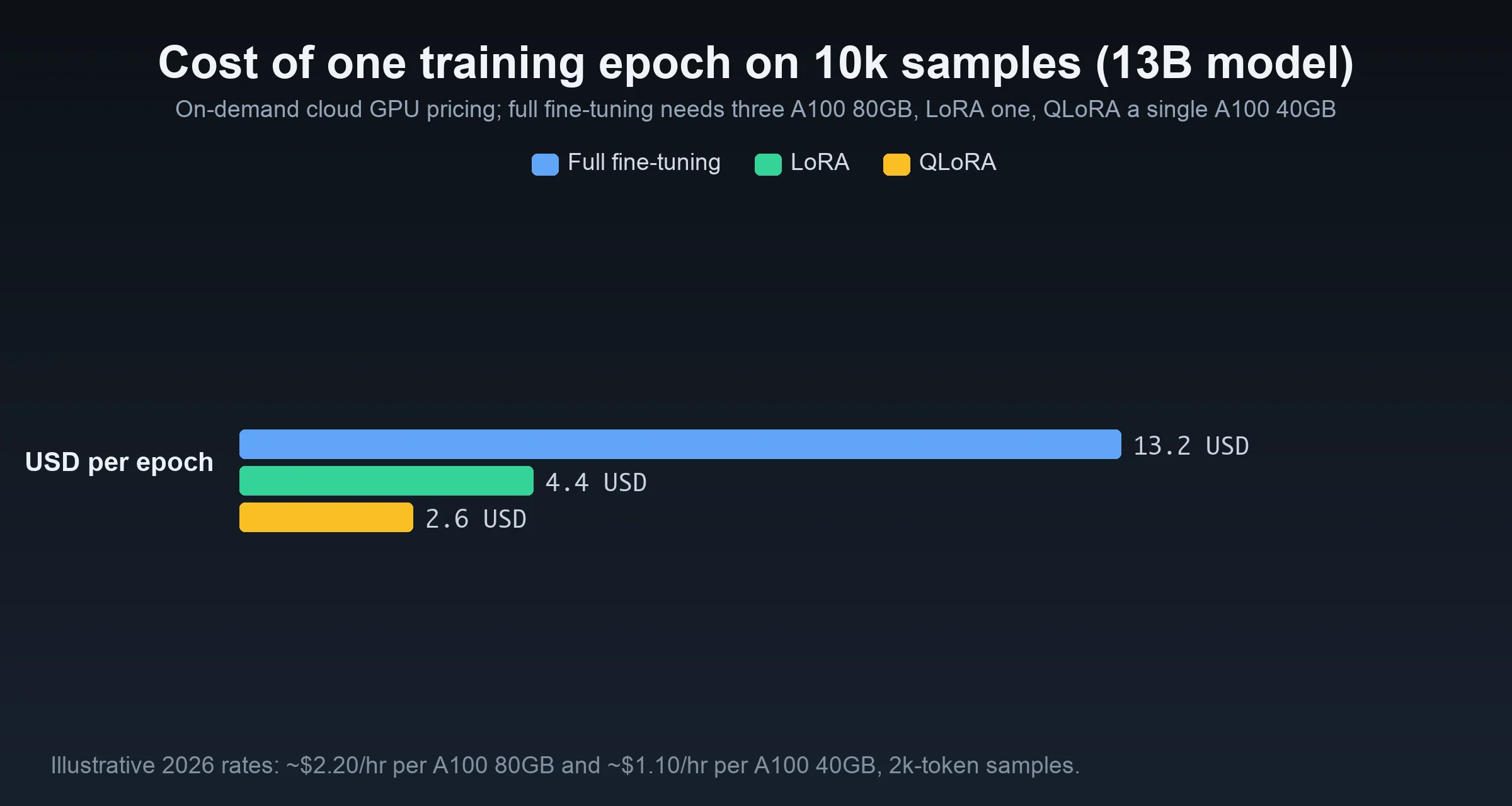
With on-demand 2026 cloud pricing (~$2.20/hr per A100 80GB, ~$1.10/hr per A100 40GB), one epoch over 10k samples of 2k tokens costs roughly:
- Full fine-tuning: 3 x A100 80GB for ~2 hours = ~$13
- LoRA: 1 x A100 80GB for ~2 hours = ~$4.40
- QLoRA: 1 x A100 40GB for ~2.4 hours (4-bit dequantization adds ~15-25% step time) = ~$2.60
The interesting consequence is not the single-run saving - it is what it does to your experiment budget. At full fine-tuning prices, most teams can afford a handful of data-recipe or hyperparameter trials per month. At QLoRA prices, the same budget buys 5x as many runs, and in practice the extra experiments move quality more than the choice of method does. Cap the sweep, keep the runner-up checkpoint as a rollback candidate, and let the gate suite pick the winner.
Two caveats keep the comparison honest. First, QLoRA’s 4-bit base is slightly slower per step, so at very large token counts the gap narrows. Second, full fine-tuning parallelizes better: if your deadline is hours, not dollars, three GPUs finishing in one hour can be worth the 3x price.
Eval-score quality: where adapters match and where they lose
Cost only matters if the model still passes your gates. The consistent pattern across the LoRA and QLoRA papers and subsequent reproductions: adapters match full fine-tuning on narrow, format-heavy tasks and trail it on tasks that need new knowledge or a global shift in the model’s behavior.
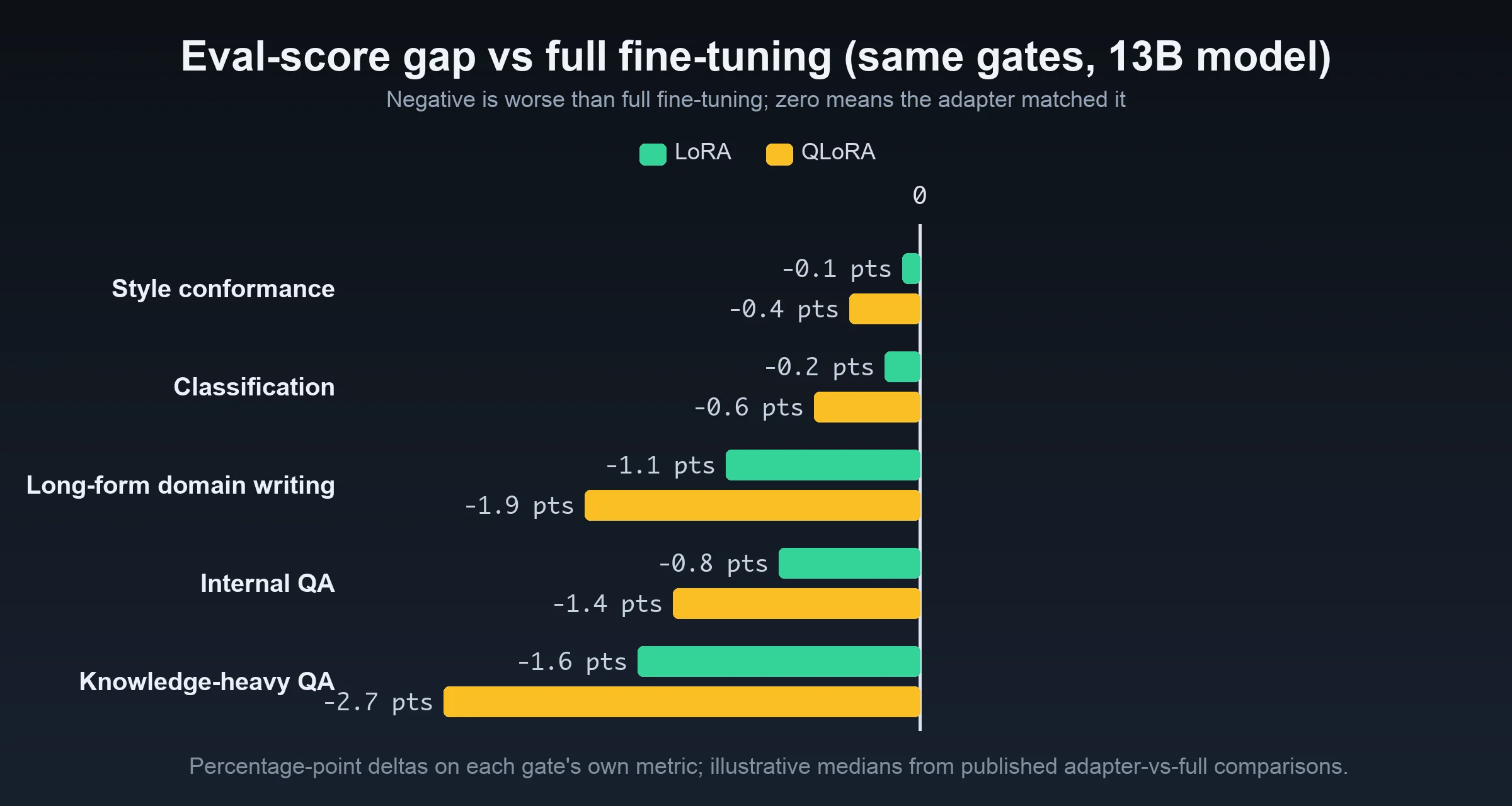
Reading the deltas:
- Style, tone, and output format: adapters are effectively at parity. Conformance lives in a small subspace; rank 16-32 captures it.
- Classification and extraction: within a few tenths of a point - inside the noise of a re-run for most gate suites.
- Knowledge-heavy QA: the biggest gap. Teaching the model facts it did not already have means moving the same weights adapters deliberately freeze; full fine-tuning leads by 1.5-3 points here.
- QLoRA vs LoRA: expect a further 0.3-1 point drop from 4-bit quantization of the base. On format tasks it rarely matters; on the knowledge-heavy tail it compounds.
Whatever the deltas, the gate suite is the referee: run every candidate through the same regression gates so an adapter that drifts on one slice fails loudly instead of shipping quietly.
A decision rule that survives contact with procurement
- Start with QLoRA for any task that is about format, style, routing, or extraction. It is the cheapest way to get a gated baseline, and it runs on hardware you already have.
- Promote to LoRA (bf16 base) when the QLoRA candidate fails a gate by less than ~1 point and the task is not knowledge-heavy - the quantization is the likely culprit.
- Reserve full fine-tuning for knowledge injection, large domain shifts (new language, new modality of jargon), or when adapters plateau 2+ points behind on your gate metric after rank and data tuning. Budget the multi-GPU run and the hyperparameter sweep around it accordingly.
- Keep adapters as the default serving artifact when you can: dozens of task-specific LoRA adapters can share one deployed base model and hot-swap, which no fleet of fully fine-tuned checkpoints can match operationally.
One more operational note: many “fine-tune or not” debates are really RAG vs fine-tuning debates. If the gap is missing facts, retrieval usually beats both full fine-tuning and adapters on cost and freshness; fine-tune for behavior, retrieve for knowledge.