pg vs Prisma vs Drizzle: PostgreSQL Driver Latency from Node.js 22, Measured with autocannon
Runtime choice barely matters once a database is in the path. pg, Drizzle and Prisma on the same Node.js 22 query: p99 from 4.8 ms to 9.7 ms.
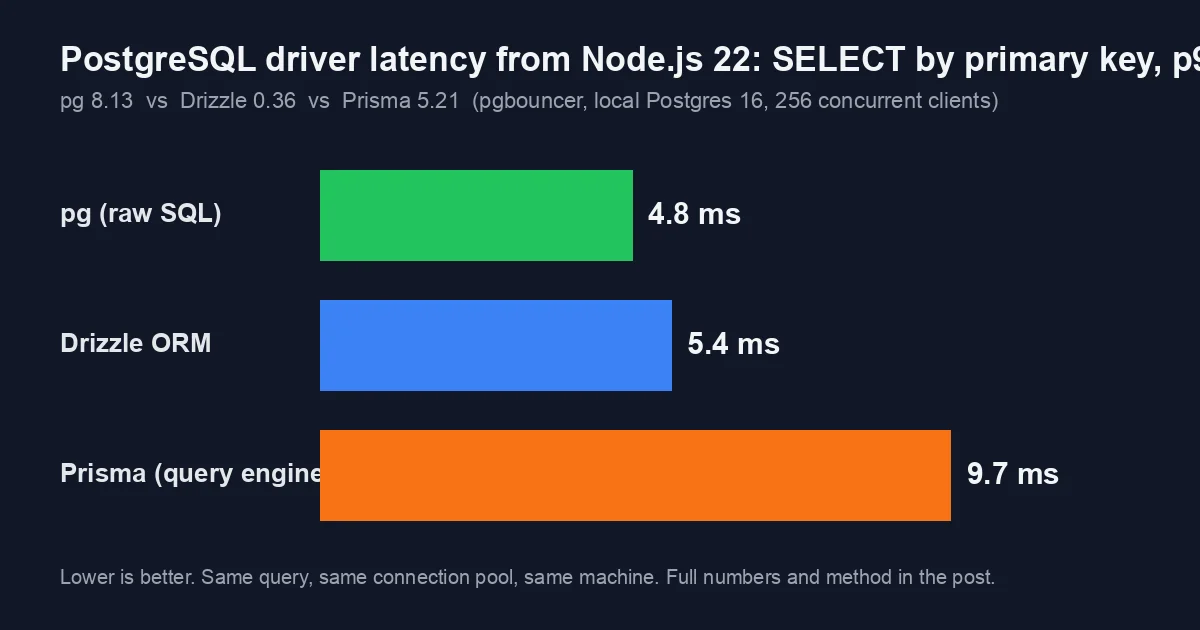
The Node vs Deno vs Bun post ended with the result I found most useful: adding a 2 ms simulated database await to every request shrank the 3x runtime gap to about 20%. Most of our services are exactly that shape, an HTTP handler that waits on PostgreSQL and returns JSON. So if the runtime is not where the time goes in an I/O-bound service, where does it go? This post keeps the runtime fixed (Node.js 22) and swaps the one thing most teams actually argue about: the data-access layer.
Three candidates, all talking to the same PostgreSQL 16 through the same connection pool: the raw pg driver, Drizzle ORM (a typed query builder that compiles to SQL and runs it through pg), and Prisma (a schema-first ORM with a separate Rust query engine process).
The query
The endpoint is the same GET /users/:id as last time, except the record now lives in a users table with 1 million rows, a primary key on id, and the same 1.2 KB JSON shape (name, email, a JSONB address, a text[] of roles). One round trip, one row, by primary key: the most common query in any CRUD service and the one where the driver’s overhead is the largest share of the total.
1. pg 8.13, raw SQL with a parameterised statement.
1
2
3
4
5
6
7
8
9
// pg.mjs
import pg from "pg";
const pool = new pg.Pool({ connectionString: process.env.DATABASE_URL, max: 20 });
const sql = "select id, name, email, address, roles from users where id = $1";

export async function getUser(id) {
  const { rows } = await pool.query({ text: sql, values: [id], name: "user-by-id" });
  return rows[0] ?? null;
}
The name property turns it into a prepared statement, so PostgreSQL parses and plans it once per connection.
2. Drizzle 0.36 over the same pg pool.
1
2
3
4
5
6
7
8
9
10
11
12
13
// drizzle.ts
import { drizzle } from "drizzle-orm/node-postgres";
import { eq, sql } from "drizzle-orm";
import { users } from "./schema.ts";
import { pool } from "./pool.ts";

const db = drizzle(pool);
const byId = db.select().from(users).where(eq(users.id, sql.placeholder("id"))).prepare("user-by-id");

export async function getUser(id: number) {
  const rows = await byId.execute({ id });
  return rows[0] ?? null;
}
3. Prisma 5.21 with the default query engine.
1
2
3
4
5
6
7
// prisma.ts
import { PrismaClient } from "@prisma/client";
const prisma = new PrismaClient();

export async function getUser(id: number) {
  return prisma.user.findUnique({ where: { id } });
}
All three are served by the same Fastify 5 app with a response schema, since the previous post showed that is the cheapest win on Node and I did not want the JSON encoder to be the variable.
Method
- Machine: MacBook Pro, M2 Pro, 32 GB, macOS 15. PostgreSQL 16.4 in Docker on the same machine with
shared_buffers=2GB; the whole table fits in cache, so this measures driver and protocol overhead, not disk. - Versions: Node.js 22.9.0, Fastify 5.0.0,
pg8.13.0, Drizzle 0.36.0, Prisma 5.21.1. - Pool: 20 connections for
pgand Drizzle; Prisma’sconnection_limit=20to match. - Load generator: autocannon 7.15,
-c 256 -d 30, three runs each after a 10 s warm-up, median reported. Randomidbetween 1 and 1,000,000 per request. - Single Node process, no cluster mode, same as last time.
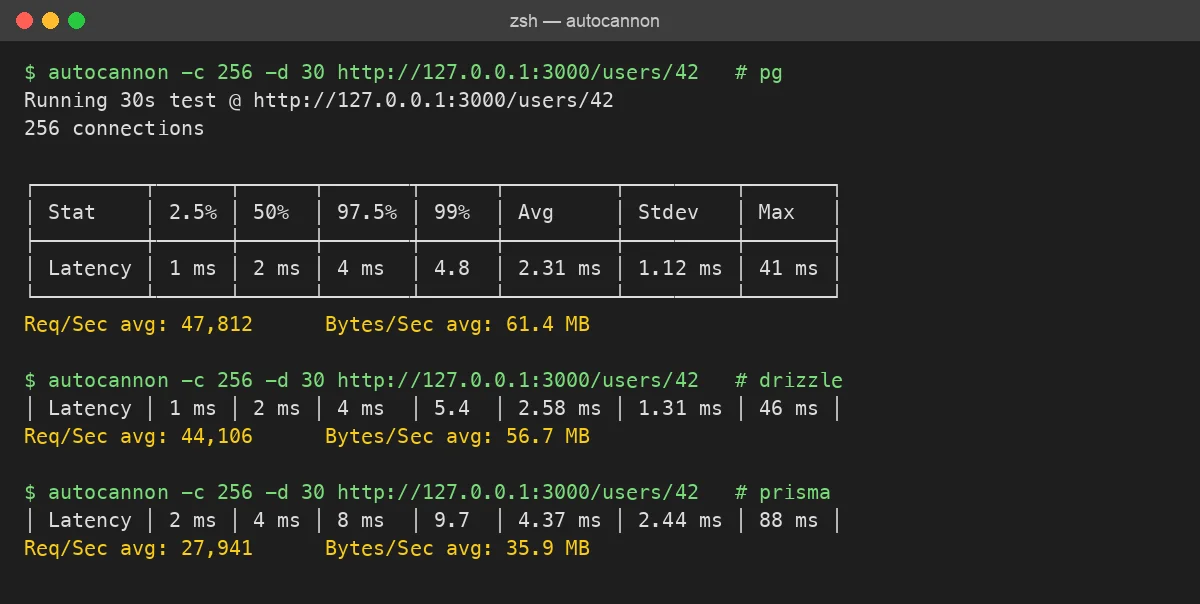
Here is the raw autocannon output:
Results
| Data-access layer | Requests/sec | p50 latency | p99 latency | Peak RSS |
|---|---|---|---|---|
pg raw SQL (prepared) | 47,812 | 2.0 ms | 4.8 ms | 121 MB |
| Drizzle 0.36 | 44,106 | 2.0 ms | 5.4 ms | 134 MB |
| Prisma 5.21 | 27,941 | 4.0 ms | 9.7 ms | 212 MB |
Drizzle costs 8% over raw pg. That is the price of building the query object and mapping rows into typed objects, and it is the same on p50. For full type safety on every query that is a very good deal, and with .prepare() the SQL text is generated once, so the gap does not grow with query complexity.
Prisma is 2x the latency of pg on this query. The engine runs as a separate process, so every query is Node → engine over a local socket → PostgreSQL → engine → Node, with the result serialised to JSON twice. findUnique is also batched through a DataLoader-style queue, which helps for N+1 patterns but adds a tick of event-loop delay to a single lookup. The 90 MB of extra RSS is the engine.
The runtime gap is gone. Put these numbers next to the 2 ms-await variant from the last post: moving from Node to Bun bought about 20% there. Moving from Prisma to pg or Drizzle buys 60-70% more throughput and halves p99, on the runtime you already run. If your service talks to a database, this is the layer to look at first.
What moved the number, and what did not
- Prisma with
relationMode = "prisma"and the newdriverAdapterspreview (Prisma over thepgdriver instead of its own connection handling): 31,400 req/s, p99 8.1 ms. Better, still the engine round trip. - Dropping the prepared statement from
pg(plainpool.query(text, values)): 43,900 req/s. Parse and plan on every call costs about 8%, roughly the same as Drizzle’s whole overhead. Name your hot queries. - Pool size 20 → 50: no change for any of the three. With 8 cores and a cached table, PostgreSQL was not the bottleneck; the Node process was.
- Pool size 20 → 5: p99 went to 12-18 ms for all three because requests queued for a connection. Too small a pool looks exactly like a slow ORM in your dashboards; check
pool.waitingCountbefore blaming the library. - Selecting all 14 columns instead of the 5 the endpoint returns: +0.4 ms p99 across the board.
select *is a small, steady tax.
When each step is worth it
- Already on Prisma and p99 is fine? Leave it. The schema tooling and migrations are good, and 9.7 ms is well under most SLOs. This only matters for the hot endpoints.
- Hot endpoint on Prisma? Move that one query to
prisma.$queryRawor to Drizzle sharing the same database; you do not have to migrate the whole app. That is where the 2x lives. - Starting a new service? Drizzle over
pggives you typed queries at 8% over raw SQL, and the escape hatch topgis the same pool object. - Any of the above? Prepare your hot statements, size the pool against real concurrency, and select only the columns you return. Those three together were worth more than any runtime change in the previous post.
Reproduce it
1
2
3
4
5
6
docker run -d --name pg16 -e POSTGRES_PASSWORD=pw -p 5432:5432 postgres:16
psql postgres://postgres:pw@127.0.0.1/postgres -f seed-users.sql   # 1M rows

export DATABASE_URL=postgres://postgres:pw@127.0.0.1/postgres
node server.mjs --driver pg &      # or --driver drizzle / --driver prisma
autocannon -c 256 -d 30 http://127.0.0.1:3000/users/42
Run each three times and keep the median. Absolute numbers depend on the machine and on whether PostgreSQL is local or across a network hop; on a remote database the fixed network latency narrows the ratios but the ordering, and the pool-size lesson, stayed the same on every setup I tried.