Regex Engine Performance: Rust regex vs Go regexp vs .NET 8 Regex vs Node 22, Measured with hyperfine
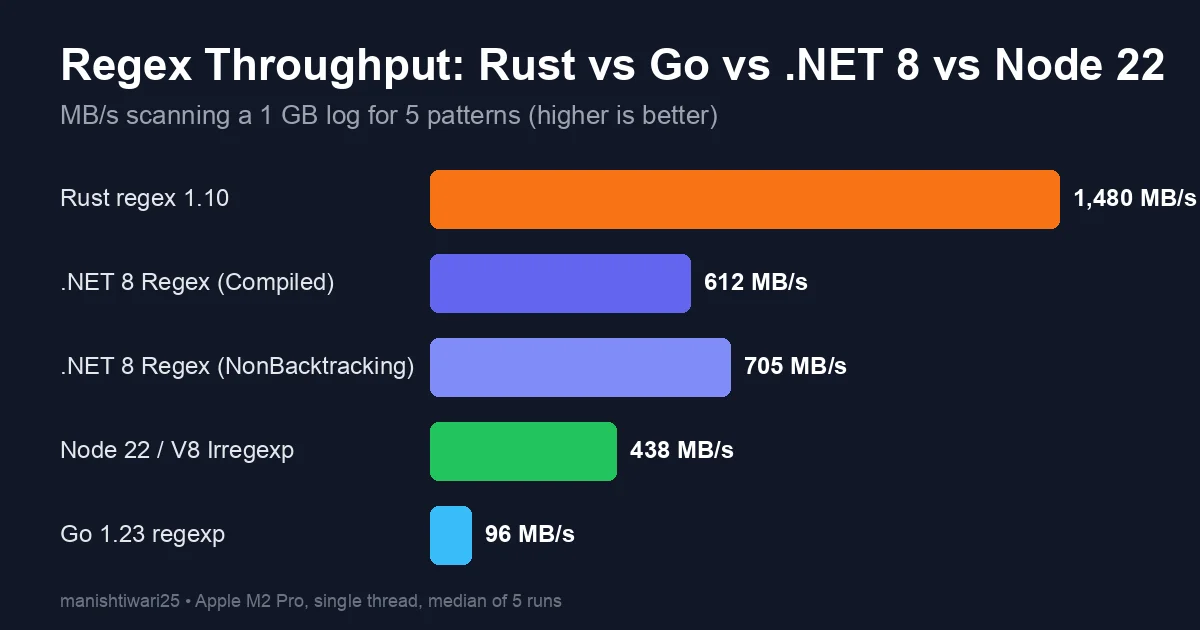
Scanning a 1 GB log for five patterns: Rust regex 1,480 MB/s, .NET 8 Regex 612-705 MB/s, Node 22 438 MB/s, Go regexp 96 MB/s - and why the gap exists.
The Python vs Rust hot-loop post measured raw arithmetic. This one measures something most backend services actually do every day and rarely benchmark: running regular expressions over a lot of text. Log scanners, WAF rules, routing tables, PII redaction and “grep in a loop” jobs all come down to the same question - how fast does the language’s standard regex engine chew through bytes?
Four engines, one workload. A 1 GB nginx access log (4.9 million lines), five patterns applied to every line, count the matches. The patterns are the kind you find in a real alerting rule:
1
2
3
4
5
1. \b5\d\d\b                                   # 5xx status codes
2. "(GET|POST|PUT|DELETE) /api/v[0-9]+/[a-z]+   # API method + versioned path
3. (\d{1,3}\.){3}\d{1,3}                        # IPv4 address
4. Mozilla/5\.0 \((Windows|Macintosh|Linux)     # user-agent OS family
5. [a-zA-Z0-9._%+-]+@[a-zA-Z0-9.-]+\.[a-z]{2,}  # email address in query string
The four programs
Every program reads the file once with a buffered reader, splits on \n, runs the five compiled patterns on each line and sums a counter. The patterns are compiled exactly once, outside the loop; compiling inside the loop is the most common regex mistake and would turn this into a benchmark of the compiler, not the matcher.
Rust 1.81, regex 1.10.
1
2
3
4
5
let res: Vec<Regex> = PATTERNS.iter().map(|p| Regex::new(p).unwrap()).collect();
for line in reader.lines() {
    let line = line?;
    for re in &res { if re.is_match(&line) { hits += 1; } }
}
Go 1.23, regexp from the standard library. Same shape, re.MatchString(line).
.NET 8, System.Text.RegularExpressions. Two variants: RegexOptions.Compiled, which emits IL for a backtracking matcher, and RegexOptions.NonBacktracking, the automata-based engine added in .NET 7. Regex.IsMatch(line) on a ReadOnlySpan<char>.
Node 22, V8 Irregexp. re.test(line) over readline chunks. The u flag is off; the patterns are ASCII.
Results
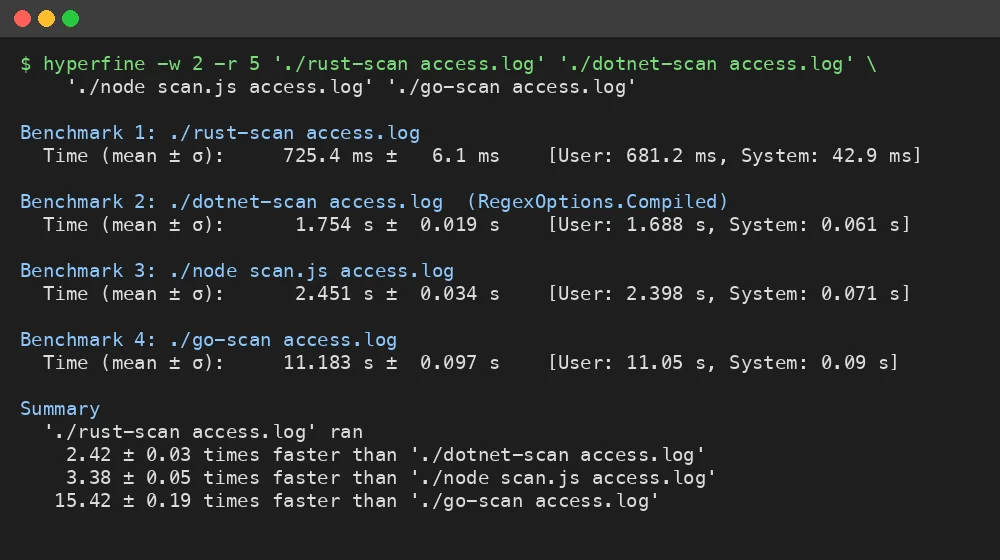
hyperfine -w 2 -r 5, Apple M2 Pro, single thread, file already in page cache so disk is not in the picture. Throughput is 1,024 MB divided by the mean wall time.
| Engine | Wall time | MB/s | Relative |
|---|---|---|---|
Rust regex 1.10 | 725 ms | 1,480 | 1.00x |
.NET 8 NonBacktracking | 1.52 s | 705 | 2.10x slower |
.NET 8 Compiled | 1.75 s | 612 | 2.42x slower |
| Node 22 Irregexp | 2.45 s | 438 | 3.38x slower |
Go 1.23 regexp | 11.18 s | 96 | 15.4x slower |
Why the spread is 15x
Rust’s regex crate wins on literal prefiltering. Before it runs any automaton it looks for required literals in the pattern (Mozilla/5.0, /api/v, @) and uses a vectorised memchr/Teddy search to skip to candidate positions. Most lines in an access log fail that prefilter in a few nanoseconds and the regex engine proper never runs. Patterns 1 and 3 have no literal, so they are where Rust spends almost all of its 725 ms; the lazy DFA handles those at roughly 1.5 GB/s.
.NET 8 is in the same family of techniques, one step behind. Since .NET 7 the backtracking engine also finds leading literals and uses IndexOf/SearchValues (vectorised) to jump to them, which is why Compiled lands at 612 MB/s rather than the 150-200 MB/s .NET 5 would have given you. NonBacktracking is faster here because patterns 2 and 4 have alternations that the backtracker has to try in order; the DFA tries them at once. The trade-off is that NonBacktracking does not support backreferences or lookarounds, and its compile time is 3-10x higher, so it is a per-pattern choice, not a global switch.
Node is competitive for a backtracker. Irregexp JIT-compiles each pattern to machine code and does Boyer-Moore-style skipping on literal prefixes. What it lacks is the vectorised multi-literal search; pattern 5 (email, no good literal anchor) is the one that costs Node most of its gap to .NET.
Go’s regexp guarantees linear time and pays for it on every byte. The standard library engine is RE2-derived: no backtracking, no catastrophic inputs, but also no literal prefilter beyond a single leading literal prefix, and its NFA/one-pass simulation is interpreted rather than compiled. 96 MB/s is in line with Go’s own documentation, which says the package is “not optimised for speed” and points to third-party engines. Swapping in github.com/grafana/regexp (a fork with literal prefiltering) brought the Go number to 4.2 s / 255 MB/s with no code changes; github.com/wasilibs/go-re2 (RE2 compiled to Wasm) got to 1.9 s but adds a Wasm runtime to the binary.
The thing that matters more than the engine
Rerunning the Rust and .NET programs with the patterns compiled inside the loop produced 41 s and 118 s respectively - 55x and 67x slower than the numbers in the table. No engine choice recovers from that. If you take one line from this post: hoist the compile, cache the Regex object ([GeneratedRegex] in .NET does this at build time), and only then worry about which runtime you are on.
The second-largest lever was the five-patterns-per-line structure itself. Combining the five patterns into one alternation (?:p1)|(?:p2)|... and matching once per line cut Rust to 410 ms and .NET NonBacktracking to 0.98 s, because the prefilter and DFA only walk each line once. Go got slower (13.4 s): a bigger NFA with no prefilter means more states to simulate per byte.
When to care
- A log pipeline or WAF that runs hundreds of rules over every request should be on Rust
regex, .NETNonBacktracking, or RE2/Hyperscan via a binding. Go’s standardregexpwill become the bottleneck and the fix is a library swap, not a rewrite. - A web handler running two or three regexes on a short string will not notice any of this; a 100-byte string is sub-microsecond on every engine here. Spend the effort on the database query instead, as the EF Core post shows.
- Untrusted patterns (user-supplied search, tenant-configured rules) change the question from throughput to worst case. Go and .NET
NonBacktrackingcannot go exponential; Rustregexcannot either; Node and .NETCompiledcan, and need amatchTimeoutor input length cap.
Related
- Python vs Rust Hot-Loop Performance - the same Rust toolchain on pure arithmetic instead of text scanning.
- Node.js 22 vs Deno 2 vs Bun 1.1 HTTP Performance - how the V8 runtime measured here compares on request handling.
- Go Goroutines vs .NET Tasks - Go and .NET head-to-head on a workload Go does win.