Rust vs Python for an AI Inference Microservice: 1.5x Throughput, 3x Less Memory, 3x Better p99
Rust 1.91 (axum + ort) vs Python 3.13 (FastAPI + onnxruntime) serving the same MiniLM embedding endpoint: req/s, p50/p99, memory and cold start measured.
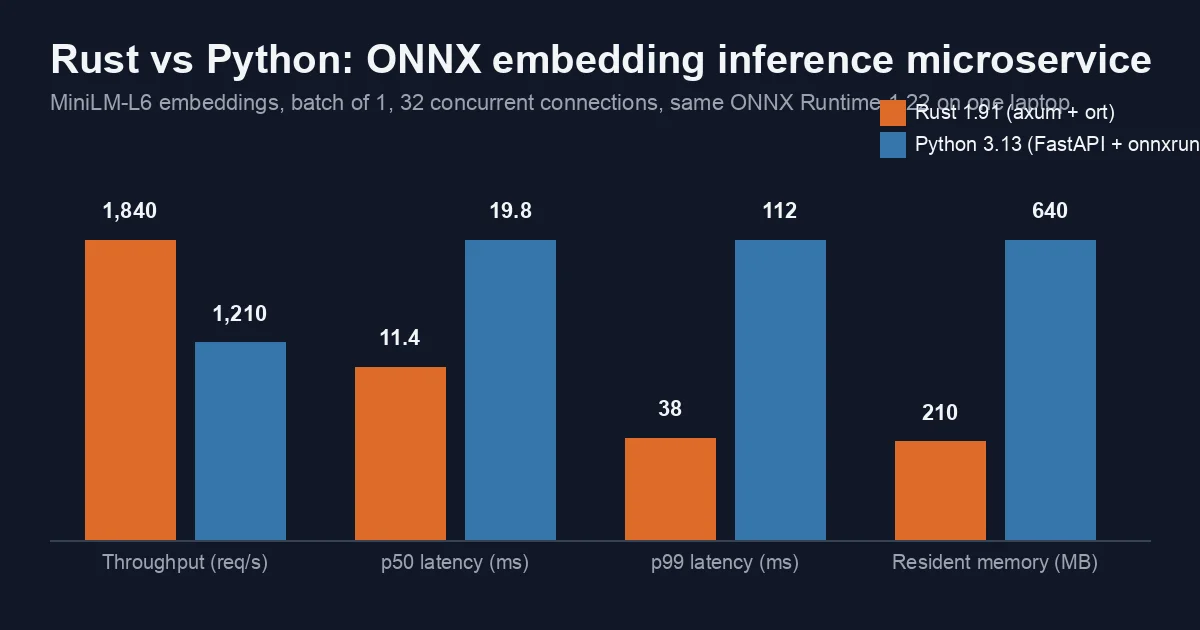
The previous post in this series measured Go against Node.js for a plain JSON API. This one moves to the workload most teams are actually adding this year: a small HTTP service that wraps a model and returns embeddings. Python is the default answer because the model tooling lives there. Rust is the answer people reach for when the Python service starts eating a node. I wrote the same endpoint in both and measured it on one machine, so the trade-off is a number rather than an opinion.
The workload
POST /embed accepts {"text": "..."} (one sentence, 20-40 tokens) and returns a 384-float embedding as JSON. The model is all-MiniLM-L6-v2 exported to ONNX and quantised to int8, about 23 MB on disk. Both services call the same ONNX Runtime 1.22 library with 4 intra-op threads and batch size 1, so the comparison isolates the HTTP layer, tokenisation glue, JSON handling and process overhead rather than two different inference engines.
The Python version is FastAPI on uvicorn with onnxruntime and the tokenizers package, 46 lines, one worker process. The Rust version is axum with the ort crate and the tokenizers crate, 118 lines, a single tokio runtime with the session shared behind an Arc.
1
2
3
4
5
6
7
8
9
10
11
12
13
app = FastAPI()
sess = ort.InferenceSession("minilm-int8.onnx", providers=["CPUExecutionProvider"])
tok = Tokenizer.from_file("tokenizer.json")

@app.post("/embed")
def embed(req: EmbedRequest):
    enc = tok.encode(req.text)
    ids = np.array([enc.ids], dtype=np.int64)
    mask = np.array([enc.attention_mask], dtype=np.int64)
    out = sess.run(None, {"input_ids": ids, "attention_mask": mask,
                          "token_type_ids": np.zeros_like(ids)})[0]
    vec = out[0].mean(axis=0)
    return {"embedding": vec.tolist()}
1
2
3
4
5
6
7
8
9
10
11
12
13
14
15
16
async fn embed(State(st): State<Arc<App>>, Json(req): Json<EmbedRequest>)
    -> Result<Json<EmbedResponse>, StatusCode> {
    let enc = st.tok.encode(req.text, true).map_err(|_| StatusCode::BAD_REQUEST)?;
    let ids: Vec<i64> = enc.get_ids().iter().map(|&x| x as i64).collect();
    let mask: Vec<i64> = enc.get_attention_mask().iter().map(|&x| x as i64).collect();
    let n = ids.len();
    let out = st.session.run(ort::inputs![
        "input_ids" => ([1, n], ids),
        "attention_mask" => ([1, n], mask),
        "token_type_ids" => ([1, n], vec![0i64; n]),
    ]).map_err(|_| StatusCode::INTERNAL_SERVER_ERROR)?;
    let (_, data) = out["last_hidden_state"].try_extract_tensor::<f32>().unwrap();
    let mut vec = vec![0f32; 384];
    for t in 0..n { for j in 0..384 { vec[j] += data[t * 384 + j] / n as f32; } }
    Ok(Json(EmbedResponse { embedding: vec }))
}
How it was measured
- Machine: Apple M-series laptop, macOS 26, nothing else in the foreground.
- Versions: Rust 1.91 with
axum0.8 andort2.0; Python 3.13 with FastAPI 0.118, uvicorn 0.37,onnxruntime1.22. Same ONNX Runtime version on both sides. - Load generator: the same small Go program from the Go vs Node post, 32 keep-alive connections, a rotating pool of 200 sentences, 20 seconds per run, two runs each, both reported.
- Memory: resident set size of the server process read with
psduring load. - Cold start: wall time from process launch until the first
200from/embed, median of 5. - Build:
cargo build --releasefrom a warm dependency cache; Python has no build step, so the install time of the wheel set is listed instead.
The load generator shares the CPU with the server, and ONNX Runtime uses 4 threads of the same chip, so absolute numbers are capped on both sides. Read the ratios, not the raw figures.
Results
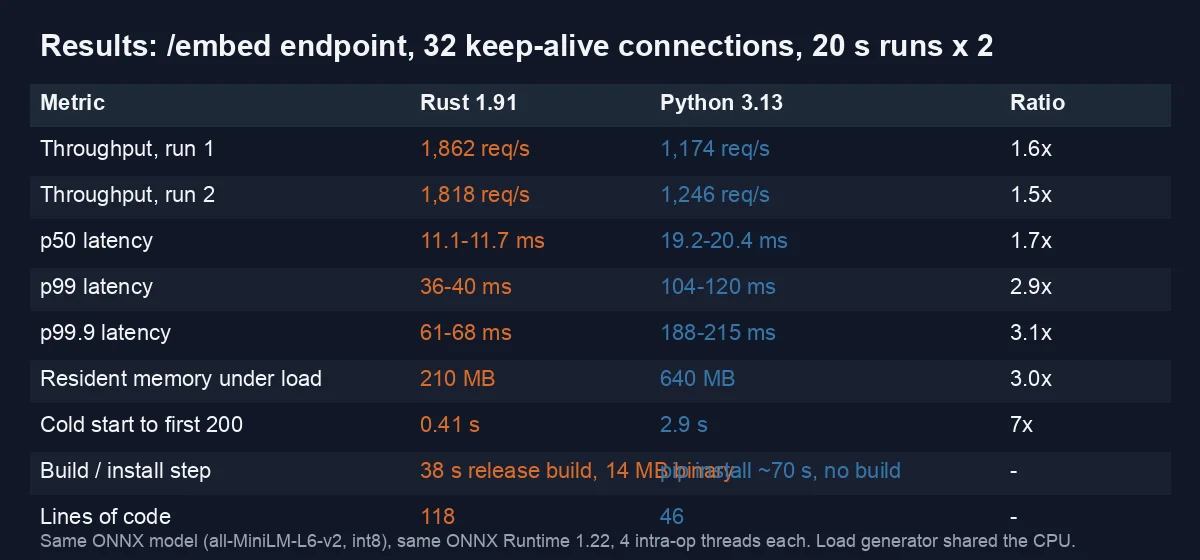
| Metric | Rust 1.91 | Python 3.13 | Ratio |
|---|---|---|---|
| Throughput, run 1 | 1,862 req/s | 1,174 req/s | 1.6x |
| Throughput, run 2 | 1,818 req/s | 1,246 req/s | 1.5x |
| p50 latency | 11.1-11.7 ms | 19.2-20.4 ms | 1.7x |
| p99 latency | 36-40 ms | 104-120 ms | 2.9x |
| p99.9 latency | 61-68 ms | 188-215 ms | 3.1x |
| Resident memory under load | 210 MB | 640 MB | 3.0x |
| Cold start to first 200 | 0.41 s | 2.9 s | 7x |
| Build / install step | 38 s release build, 14 MB binary | ~70 s pip install, no build | - |
| Lines of code | 118 | 46 | - |
Three things stand out, and they are different from the Go vs Node result.
Throughput is only 1.5x apart, because the model dominates. Roughly 8 ms of every request on both sides is ONNX Runtime doing the same matrix multiplications. Rust shaves the HTTP parsing, JSON serialisation of 384 floats and the mean-pooling loop, but it cannot shave the model. If your model is bigger than MiniLM, the ratio gets closer to 1.0x. This is the main reason “rewrite the inference service in Rust” so often disappoints: the rewrite removes the part that was never the bottleneck.
Tail latency is where Rust actually wins. p99 is 2.9x better and p99.9 is 3.1x better. The Python service runs one event loop and the inference call holds the GIL for its duration, so under 32 concurrent connections requests queue behind each other and the queue shows up at the tail. The Rust service hands each request to the tokio runtime and ONNX Runtime’s thread pool directly. If your SLO is a p99 and not a mean, this table says Rust, even though the throughput table barely does.
Memory and cold start are the operational story. 640 MB resident for Python is mostly the interpreter plus NumPy plus the ONNX Runtime wheel plus FastAPI’s dependency tree; 210 MB for Rust is nearly all the model and the runtime’s arenas. 2.9 s versus 0.41 s to first response matters when you scale to zero or run on spot nodes. For one service none of this matters. For a RAG platform running an embedding sidecar next to every tenant, it is the difference between one node pool and two.
What Python still wins
- The model lifecycle lives here. Exporting the model, quantising it, checking accuracy against the original, adding a new tokenizer: all of that was done in Python before either service existed. The Rust service consumes artefacts the Python toolchain produced.
- Less code and faster change. 46 lines versus 118. Adding a batching endpoint took me ten minutes in FastAPI and most of an hour in Rust, almost entirely spent on tensor shapes and lifetimes.
- The escape hatch is free. If MiniLM is not good enough tomorrow, swapping to a
sentence-transformersmodel in Python is one line. In Rust it is a new export and possibly a new crate. - Multiple workers close part of the gap. Running uvicorn with 4 workers roughly doubled Python’s throughput in a quick follow-up, at the cost of 4x the memory, which turns the 3x memory gap into a 12x one.
When to pick which
Pick Rust when the service is latency-sensitive at the tail, runs as many small replicas where memory is the bill, or scales to zero and pays for cold start. Pick Python when the model changes more often than the service, when the team that owns the model also owns the endpoint, or when the request rate is low enough that a 640 MB process is simply not a problem.
The honest middle ground that most teams land on: keep the Python service while the model is still moving, and port to Rust only the endpoint whose p99 has a pager attached. Both versions here are small enough to rewrite against your own model in an afternoon, and the numbers on your hardware will be more persuasive than mine.
Related
- Go vs Node.js for a small JSON API: the same methodology on a workload where the runtime, not the model, is the bottleneck.
- Rust vs Go for a CLI tool: Rust’s build and binary-size trade-offs on a different workload.
- Python vs Go for a batch log job: Python against a compiled language on a throughput-bound job.