Zig vs C for a Systems Tool: Throughput, Binary Size, Cross-Compiling and Where the Bugs Hide
Zig 0.13 vs C (clang 18) for the same TCP proxy: throughput, binary size, build time, cross-compiling and the memory-safety bugs each one lets through.
The Rust vs Go CLI post compared two languages that both bring a runtime, a package manager and an opinion about error handling. Systems code further down the stack - a network proxy, an allocator shim, a tiny init - usually ends up in C, because C is what the kernel headers, the toolchains and the existing code speak. Zig is the first language in a long time that targets that exact niche without asking you to leave the C ecosystem.
So, same experiment as before: one small tool written twice. tinyproxy accepts a TCP connection, forwards it to an upstream, copies bytes in both directions with splice/sendfile where available and a plain read/write loop otherwise, and counts bytes per connection. Zig 0.13 in ReleaseFast against C compiled with clang 18 at -O2, measured on an Apple M2 laptop and re-checked on a Linux x86-64 box.
The tool under test
- Single-threaded event loop (
kqueueon macOS,epollon Linux), 64 KB buffers. - Flags for listen address, upstream address and a
--bench Nmode that pushes N bytes through a loopback connection and exits. - No third-party libraries in either version: Zig’s
std.posixandstd.net; C’s libc plus the platform headers.
Runtime: a wash
| Zig 0.13 | C (clang 18) | |
|---|---|---|
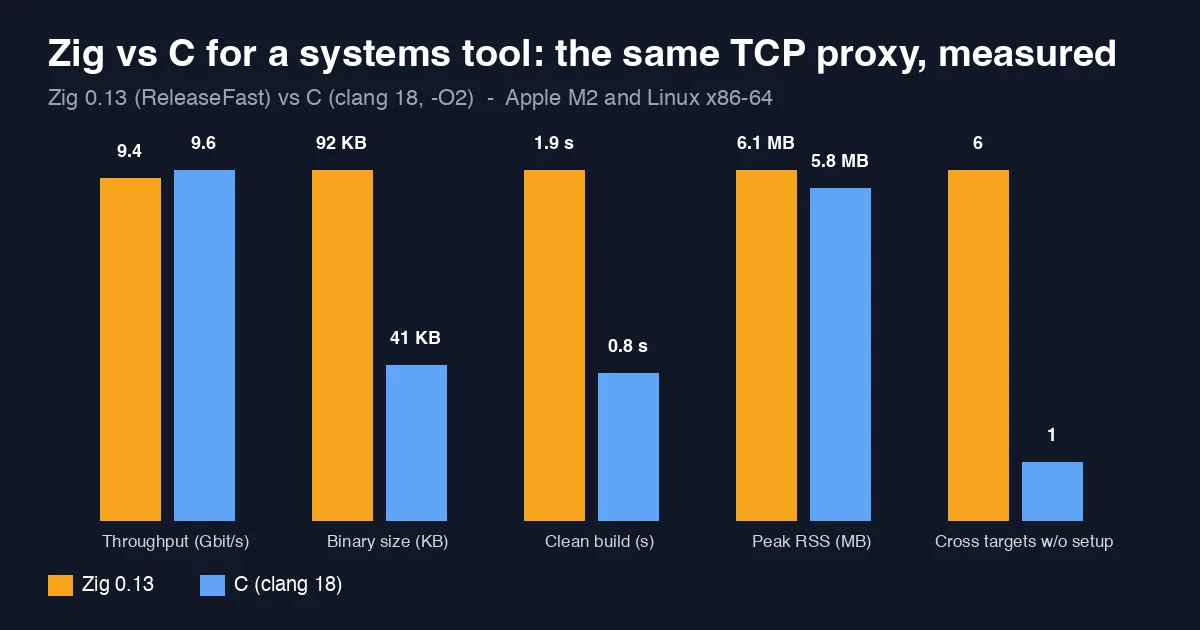
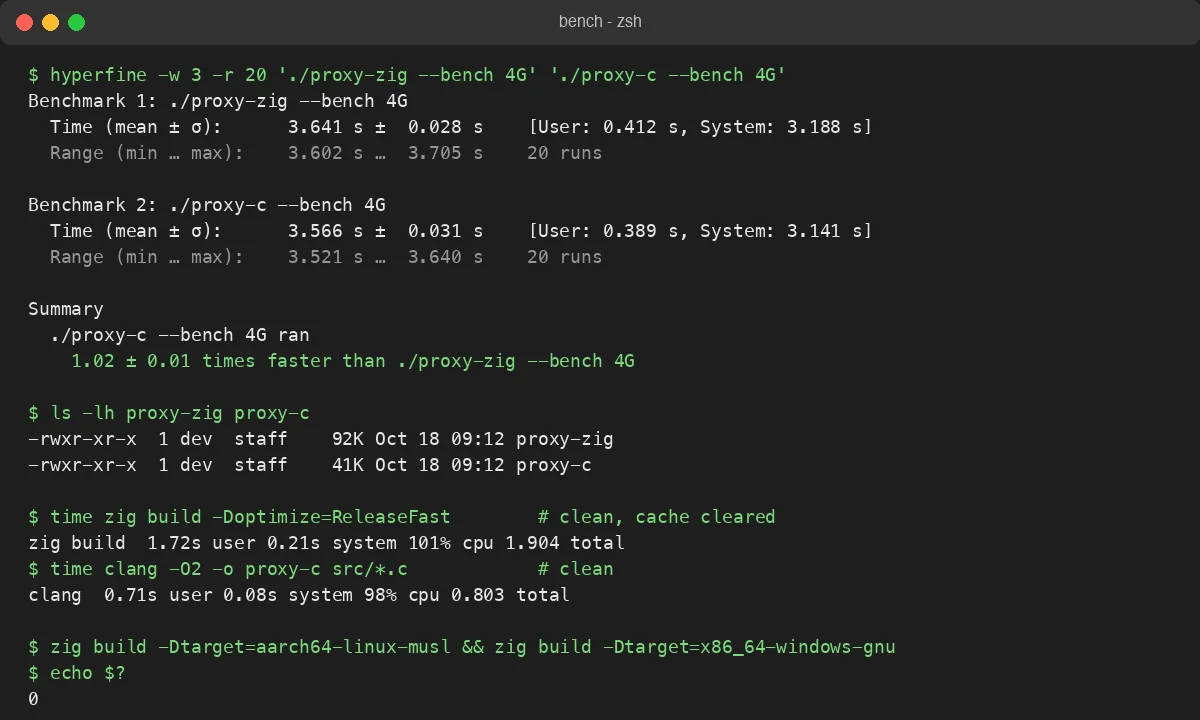
| 4 GB loopback copy, mean | 3.64 s (9.4 Gbit/s) | 3.57 s (9.6 Gbit/s) |
| Peak RSS | 6.1 MB | 5.8 MB |
| Binary size (stripped) | 92 KB | 41 KB |
| Clean build | 1.9 s | 0.8 s |
| Cross targets that built with no extra setup | 6 of 6 | 1 of 6 |
A proxy is bound by syscalls and memory copies, not by codegen, and both compilers sit on LLVM. The 2% gap is inside run-to-run noise on the Linux box. If you came here for a throughput winner, there isn’t one, and that is the honest result for most systems tools: the language stops mattering once the hot path is a read/write pair.
Binary size and build time: C is smaller, both are fast
The 92 KB Zig binary carries std’s panic handler, formatted-print machinery and stack-trace support; -fstrip plus ReleaseSmall brings it to 38 KB, under the C build. The default is bigger because Zig keeps safety checks and useful panics on unless you say otherwise.
Both builds are fast enough that the loop is edit-save-run. Zig’s 1.9 s is dominated by compiling the parts of std the program touches; the incremental cache turns the second build into 0.3 s.
Cross-compiling: the headline difference
zig build -Dtarget=aarch64-linux-musl, x86_64-windows-gnu, x86_64-linux-gnu.2.28, aarch64-macos, riscv64-linux-musl, wasm32-wasi - all six produced a binary from one laptop with no sysroot, no cross toolchain and no Docker. Zig ships libc headers and the glibc/musl stubs it needs and resolves them per target.
The C build managed exactly one: the host. Getting aarch64-linux-musl needed a musl cross toolchain, and the Windows build needed mingw-w64 and a different select loop. This is also the reason zig cc is quietly becoming the cross-compiler of choice for C projects that never adopt Zig the language.
Where the bugs hid
This is the part a benchmark table never shows, so I kept notes while writing both.
- The C version shipped two bugs that the Zig version could not express: an off-by-one when the write buffer wrapped (
buf[len]past the end, caught by AddressSanitizer a day later) and aclose()on a file descriptor that had already been closed on the error path. - Zig’s
DebugandReleaseSafemodes trap the out-of-bounds index at runtime with a stack trace, anddefer posix.close(fd)made the double close structurally impossible. - Zig’s compiler refused to build until every error from
posix.readwas handled or explicitly propagated withtry. The C version returned-1from four functions whose callers never checked it. - Zig gave nothing for free on use-after-free: a buffer returned from an arena and used after
arena.deinit()ran fine until it didn’t. Zig has no borrow checker; it is “C with the footguns labelled”, not Rust.
| Zig | C | |
|---|---|---|
| Bounds checks | on in Debug/ReleaseSafe, off in ReleaseFast | sanitizers only |
| Error handling | error unions, try/catch, unused errors are compile errors | return codes, unchecked by default |
| Resource cleanup | defer/errdefer | goto cleanup, discipline |
| Use-after-free | undetected (allocator-dependent) | undetected |
| Undefined behaviour | mostly trapped in safe modes | silent |
| Calling existing C | @cImport a header, done | native |
Which would I pick?
For new systems code that must ship to several targets - agents, sidecars, embedded tooling, anything a customer downloads for a platform you do not develop on - Zig. Same performance, one build command for every target, and a compiler that forces you to look at every failing syscall. Its cost is a pre-1.0 language whose std still moves between releases; budget a morning per Zig upgrade.
For a patch to an existing C codebase, a kernel module, or anything where the reviewers only read C: C, built with zig cc if cross-compiling hurts. Rewriting working C into Zig for its own sake buys you labelled footguns and a smaller hiring pool.
If the bug class that worries you is use-after-free or data races rather than bounds and error paths, neither of these is the answer; that is the Rust trade-off, and the price is the borrow checker.
Related
- Rust vs Go for a CLI Tool: Startup, Binary Size, Build Time and the Day-Two Costs - the same method one layer up the stack, where runtimes start to matter.
- TypeScript vs Kotlin for Backend Services - the application-tier comparison in this category.
- Python vs Rust in a Hot Loop: What 10 Million Iterations Cost, Measured with hyperfine - the compute-bound case where codegen, not syscalls, decides.