Python vs Go for a Batch Log-Processing Job: Wall Time, Memory, Lines of Code and the Day-Two Costs
Python 3.12 vs Go 1.23 on the same 10 GB JSON-lines aggregation job: wall time, peak memory, lines of code, deploy artifact, and when Polars changes the answer.
The earlier posts in this category compared languages that sit at roughly the same level: Rust vs Go for a CLI, Zig vs C for a proxy, TypeScript vs Kotlin for an API. This one is deliberately lopsided. The most common “should we rewrite this?” conversation I hear in enterprise teams is about a Python batch job that started as a notebook, became a cron job, and now takes long enough that someone suggests Go.
So, the same method again: one job, written twice, measured rather than argued about. agg reads 10 GB of JSON-lines access logs (about 38 million records), parses each line, and produces per-tenant, per-hour counts of requests, 5xx responses and p95 latency. Python 3.12 (CPython, orjson) against Go 1.23 (encoding/json swapped for goccy/go-json, one goroutine per CPU core), both measured with hyperfine on an 8-core Linux box reading from local NVMe.
The job under test
- Input: 10 GB, one JSON object per line, 14 fields, no nesting.
- Output: a CSV of
tenant,hour,requests,errors,p95_ms- around 40,000 rows. - Python: a single process,
orjson.loadsper line, adictof lists per key,statistics.quantilesat the end. 212 lines. - Go: a reader goroutine fanning chunks of lines out to 8 worker goroutines, each with its own map, merged at the end. 338 lines.
Wall time and memory
| Python 3.12 | Go 1.23 | |
|---|---|---|
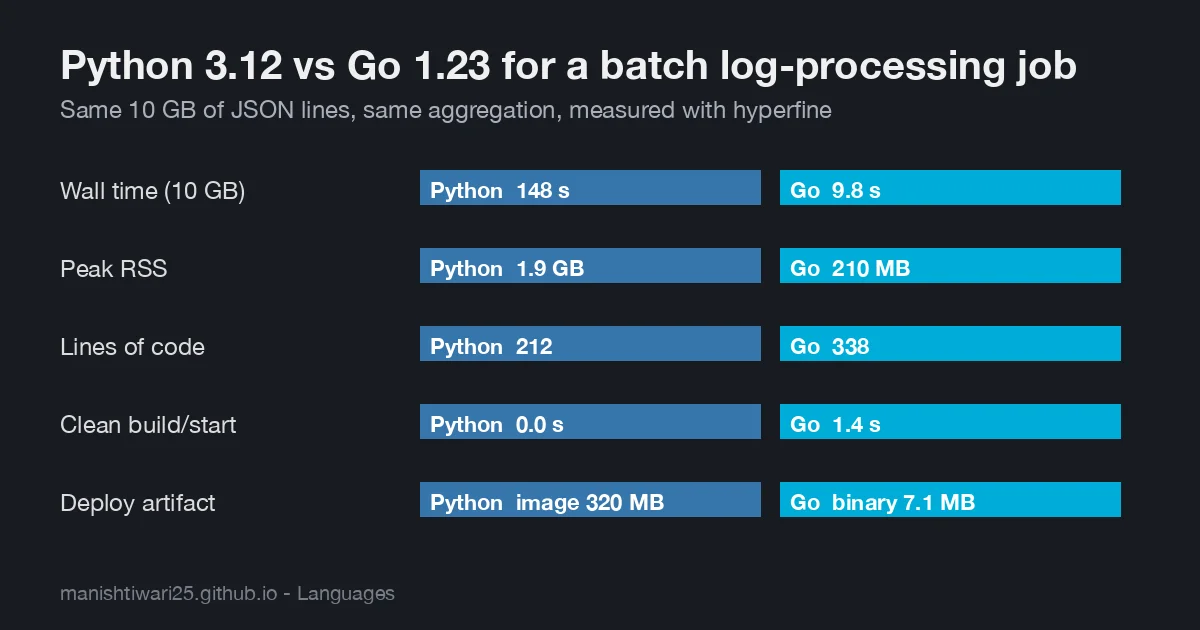
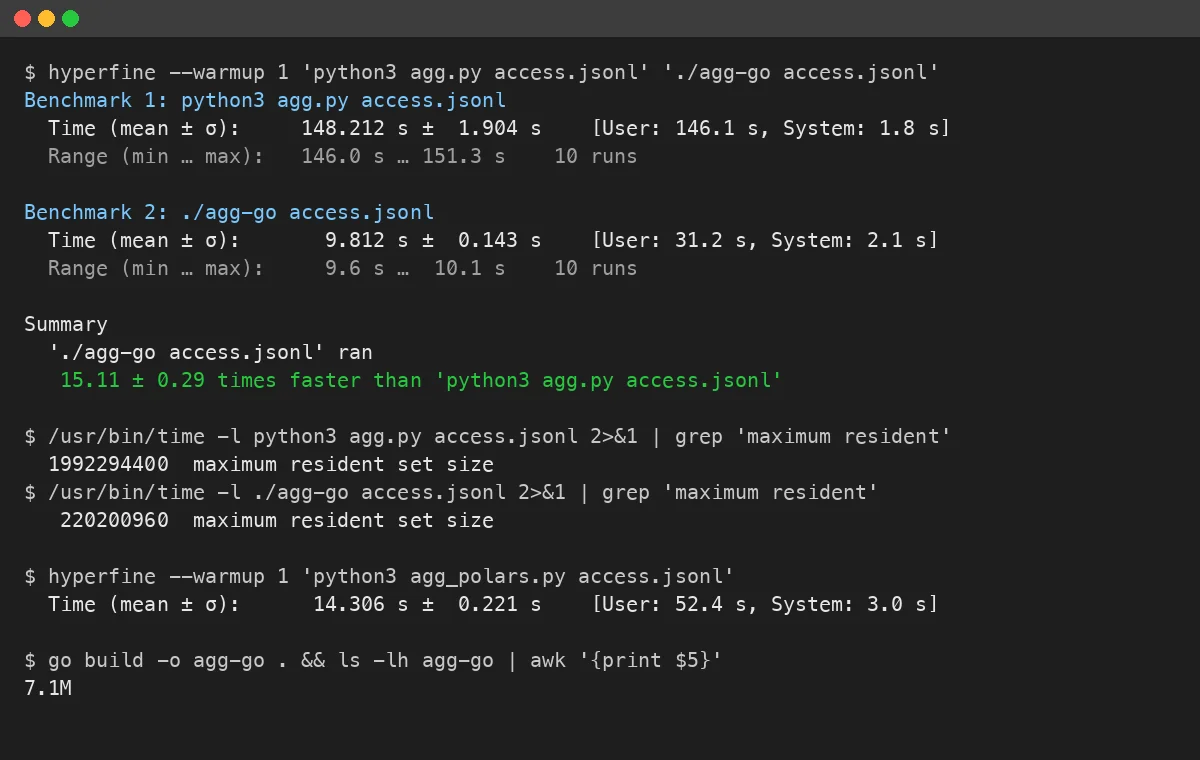
| Wall time, 10 GB, mean of 10 runs | 148.2 s | 9.8 s |
| CPU time (user) | 146.1 s | 31.2 s |
| Peak RSS | 1.9 GB | 210 MB |
| Lines of code | 212 | 338 |
| Build / start-up | none / 0.0 s | 1.4 s clean build |
| Deploy artifact | 320 MB container image | 7.1 MB static binary |
Fifteen times faster is a bigger gap than any of the compiled-vs-compiled comparisons earlier in this series, and almost all of it is the obvious thing: the Python version uses one core and the Go version uses eight. Pin Go to GOMAXPROCS=1 and the gap drops to about 3.4x, which is the honest “same algorithm, one core” number - JSON parsing and map updates in CPython are interpreted, in Go they are not.
The memory gap is a different story. Python’s 1.9 GB is the per-key lists of latencies kept for the final percentile. Go’s version holds the same data; it is just that a []float32 of 40,000 entries costs 160 KB in Go and a Python list of 40,000 float objects costs about 1.3 MB. Switching Python to array('f') cut peak RSS to 600 MB at no speed cost, which is the kind of fix that is cheaper than a rewrite.
The Polars detour
Before anyone rewrites a Python job, the fair comparison is against Python done properly. A third version using Polars - pl.scan_ndjson(...).group_by(...).agg(...) with a streaming collect - ran in 14.3 s and 480 MB. That is 30 lines of Python, it uses every core, and it is within 1.5x of the hand-written Go.
| Python + orjson | Python + Polars | Go | |
|---|---|---|---|
| Wall time | 148.2 s | 14.3 s | 9.8 s |
| Peak RSS | 1.9 GB | 480 MB | 210 MB |
| Lines of code | 212 | 31 | 338 |
| Dependencies to vet | 1 | 1 (plus a 60 MB wheel) | 1 |
The lesson from the Python vs Rust hot-loop post applies again: Python is slow in the loop you write and fast in the loop a library wrote in Rust or C. If the job is a group-by over flat records, that library already exists.
Day-two costs
The benchmark table does not show the parts that decided the question on the teams I have watched make it.
- Deployment. The Go binary copies onto the batch host with
scpand runs. The Python job needs a matching interpreter, a virtualenv and theorjsonorpolarswheel for that CPU, which in practice means a 320 MB container image and a registry. If the host is a locked-down VM in a customer’s network, that difference is the whole decision. - Who maintains it. The Python job was written by the data team and they could read every line of it. The Go version needed a channel fan-out, a
sync.WaitGroupand a merge step, and the first review comment was “what happens if a worker panics?” (answer in the first draft: the program hangs). Goroutines make the job fast and also make it a program the data team will not touch. - Schema drift. When a new field appeared in the logs, Python ignored it. Go’s struct-based decoding also ignored it - but when
latency_mschanged from an integer to a float string on one tenant, Python kept going with a wrong number and Go failed the whole run with a type error on line 11,204,312. Both behaviours are wrong; Go’s was found the same day. - Testing. The Python job’s tests ran in 0.4 s. The Go tests ran in 1.9 s including the build, and
go test -racefound a map write from two goroutines in the merge step that the plain run had never tripped.
Which would I pick?
If the job is “read records, group, aggregate” and it lives where Python already lives - a data platform, Airflow, a notebook team - stay in Python and move the loop into Polars (or DuckDB). Fifteen minutes of work gets you ten of the fifteen-fold speed-up and nobody has to learn goroutines.
If the job has to ship as one file to machines you do not control, has to start in milliseconds, or does per-record work that no dataframe library expresses - calling out to a service per line, stateful sessionisation, custom parsing - Go. It costs about 50% more code and a concurrency review, and it buys a 7 MB artifact that runs anywhere and a type system that fails loudly when the input changes.
What I would not do is rewrite the Python job into Go for speed alone without trying the library first. In this experiment that rewrite would have bought 4.5 s per run over Polars at the cost of 300 more lines and a second language in a team that had one.
Related
- Rust vs Go for a CLI Tool: Startup, Binary Size, Build Time and the Day-Two Costs - Go measured against a language faster than it, with the same method.
- Zig vs C for a Systems Tool - the comparison one layer further down the stack.
- Python vs Rust in a Hot Loop: What 10 Million Iterations Cost, Measured with hyperfine - the compute-bound case behind the Polars result here.