Variables, Values and References: How a Name Finds Its Data
A beginner-friendly explanation of variables, values and references, and why copying a list behaves differently from copying a number across languages.
TL;DR
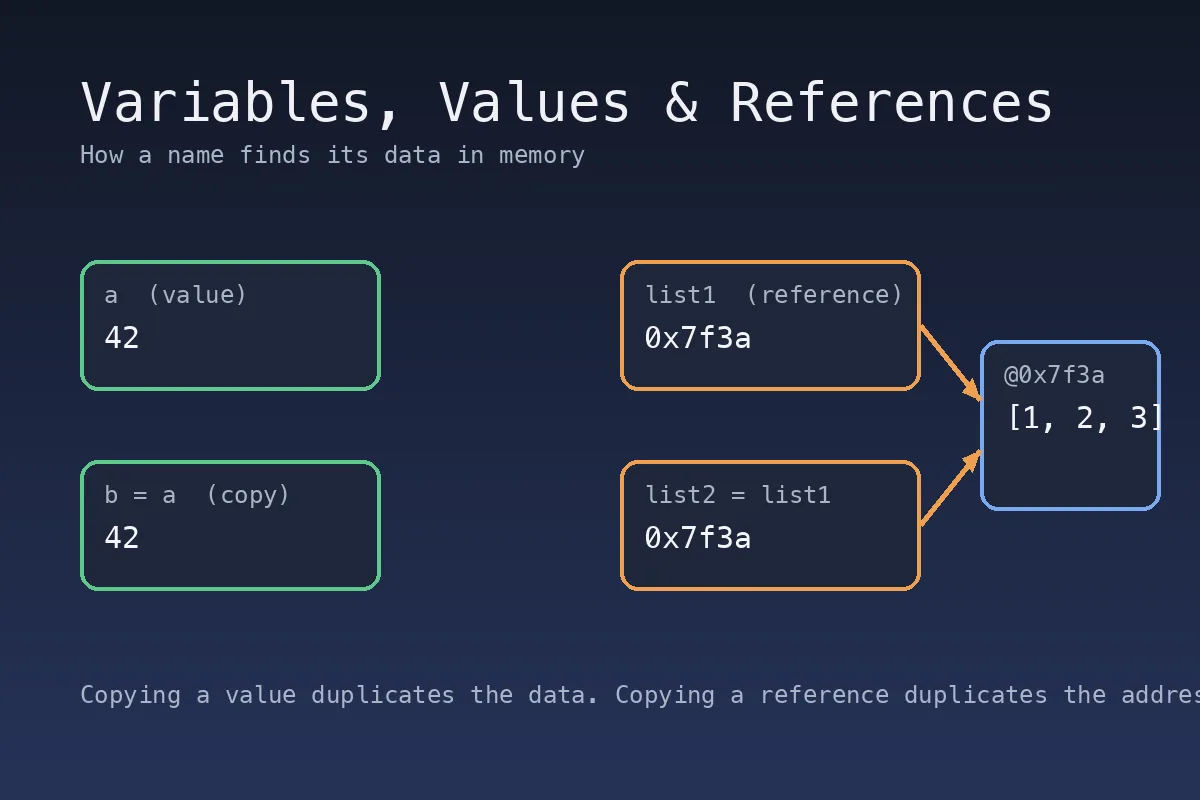
A variable is a name for a place that holds data. Some variables hold the data itself (a value); others hold the address where the data lives (a reference). Copying a value duplicates the data. Copying a reference duplicates only the address, so two names end up looking at the same thing. Almost every “why did my other variable change?!” bug in a beginner’s first year comes from this single idea.
This is the third article in the beginner series. If you missed the earlier ones, start with How to Become a Software Engineer and The Language of Computers.
A variable is a label on a box
Think of your computer’s memory as a very long row of numbered boxes. When you write age = 42, the language picks a box, writes 42 into it, and attaches the label age to that box. The label is for you; the computer only cares about the box number (the address).
1
2
3
4
5
6
age = 42
copy_of_age = age
copy_of_age = copy_of_age + 1

print(age)          # 42
print(copy_of_age)  # 43
Here copy_of_age = age created a second box with its own 42. Changing one does not touch the other. Numbers, booleans and (in most languages) single characters behave like this. They are value types.
Big things are not copied, they are pointed at
Now try the same experiment with a list:
1
2
3
4
5
6
scores = [1, 2, 3]
other = scores
other.append(4)

print(scores)  # [1, 2, 3, 4]  <- surprise!
print(other)   # [1, 2, 3, 4]
Why did scores change when we only touched other? Because the box labelled scores does not hold the list. It holds the address of the list, which lives somewhere else in memory. other = scores copied the address, not the list. Both labels now point at one list, so changing it through either name changes “both”.
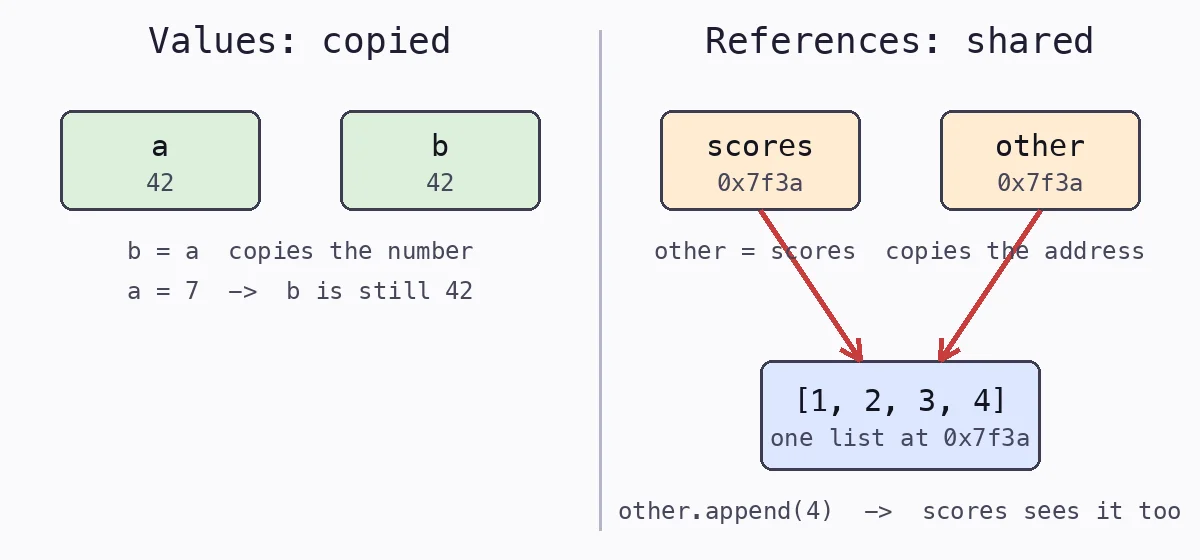
That address-in-a-box is a reference (some languages say pointer). Lists, dictionaries, objects, arrays, strings in many languages - anything that can be large or grow - is usually handled by reference. Copying a small address is cheap; copying a million-element list every time you pass it to a function would be ruinously slow.
The same idea in four languages
The vocabulary differs, but the picture is identical.
JavaScript - primitives are values, objects and arrays are references:
1
2
3
4
5
6
7
8
let a = 10;
let b = a;
b++;              // a is still 10

const user = { name: "Ada" };
const alias = user;
alias.name = "Grace";
console.log(user.name); // "Grace"
C# - int, double, bool and struct are value types; class instances are reference types:
1
2
3
4
5
6
7
8
int x = 5;
int y = x;        // separate copy
y++;              // x == 5

var list1 = new List<int> { 1, 2, 3 };
var list2 = list1;        // same list, two names
list2.Add(4);
Console.WriteLine(list1.Count); // 4
Rust makes the choice explicit. Assigning a Vec moves it, so the old name is no longer usable, and borrowing with & hands out a reference the compiler tracks:
1
2
3
4
let v1 = vec![1, 2, 3];
let v2 = v1;          // v1 moved into v2; using v1 now is a compile error
let r = &v2;          // r is a reference (borrow) to v2's data
println!("{}", r.len());
Python has only references under the hood, but numbers and strings are immutable, so you can never observe sharing: b = b + 1 builds a brand-new number instead of changing the shared one. Lists and dicts are mutable, which is exactly why the surprise above happens.
When you really want a copy
If you need an independent list, say so:
1
2
3
other = scores.copy()          # shallow copy: new list, same inner items
import copy
deep  = copy.deepcopy(scores)  # deep copy: new list AND new inner items
1
2
const alias = [...items];              // shallow
const deep  = structuredClone(items);  // deep
1
var list2 = new List<int>(list1);      // shallow copy
Shallow copies the outer container only; if the items inside are themselves references (a list of lists), they are still shared. Deep copies recursively. Most of the time shallow is what you want and is much cheaper.
Passing variables to functions
The same rule explains function arguments. The function receives a copy of whatever is in the box. For a number, that is a copy of the number, so the caller cannot see changes. For a list, it is a copy of the address, so the function can change the caller’s list:
1
2
3
4
5
6
7
8
9
10
11
def add_one(n):
    n += 1          # local copy only

def add_item(items):
    items.append("x")  # caller's list is changed

count = 1
names = []
add_one(count)
add_item(names)
print(count, names)  # 1 ['x']
Reassigning the parameter (items = []) inside the function only relabels the local box; it does not affect the caller. Mutating the object it points to does.
Why this matters
- Hidden bugs: a “helper” function quietly modifies the list it was given, and a totally unrelated part of the program breaks.
- Performance: understanding that large structures are passed by reference tells you when copying is free and when it is expensive. Our Performance posts build directly on this.
- Reading other languages: once you can spot “value or reference?” you can pick up C, Go, Java or Rust far faster, because they are all answering the same question with different syntax.
Try it yourself
- In any language you have installed, create a list, assign it to a second name, change one, and print both.
- Repeat with a number.
- Make a real copy and confirm the two names are now independent.
Ten minutes with this exercise will save you hours of debugging later.