AI API Format Converter: One Chat Request, Four Provider Payloads
How the Lamplit Labs AI API Format Converter rewrites a chat request between OpenAI, Anthropic, Gemini and Ollama, and what it drops.
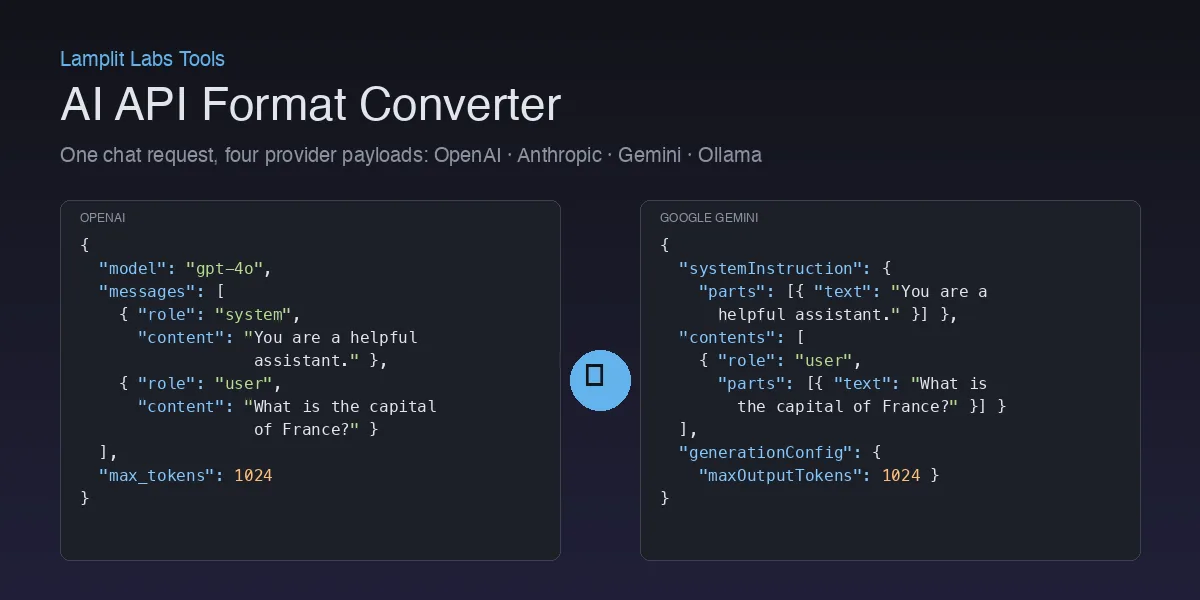
Every team that has swapped LLM providers has written the same twenty lines of glue: pull the system message out of messages because Anthropic wants it as a top-level system string, rename assistant to model because Gemini insists, move max_tokens into generationConfig.maxOutputTokens, and then discover that Ollama calls the same thing options.num_predict. The AI API Format Converter on the Lamplit Labs tools site does that translation in the browser so you can see the target payload before you write the adapter. Like the Token Counter and the Prompt Template Editor, nothing you paste leaves the page.
What the page looks like
The tool opens with a standard OpenAI chat completion request as the input:
1
2
3
4
5
6
7
8
9
{
  "model": "gpt-4o",
  "messages": [
    { "role": "system", "content": "You are a helpful assistant." },
    { "role": "user", "content": "What is the capital of France?" }
  ],
  "temperature": 0.7,
  "max_tokens": 1024
}
Above the editors is a bar with two tab rows, From and To, each offering OpenAI, Anthropic, Google Gemini and Ollama, and a swap button between them. The left pane is an editable JSON editor labelled with the source provider; the right pane is read-only, labelled with the target, with a copy button in its header. Conversion is live: every keystroke re-parses the input and re-renders the output, and a parse error or shape error appears as a red chip above the editors instead of a stale result.
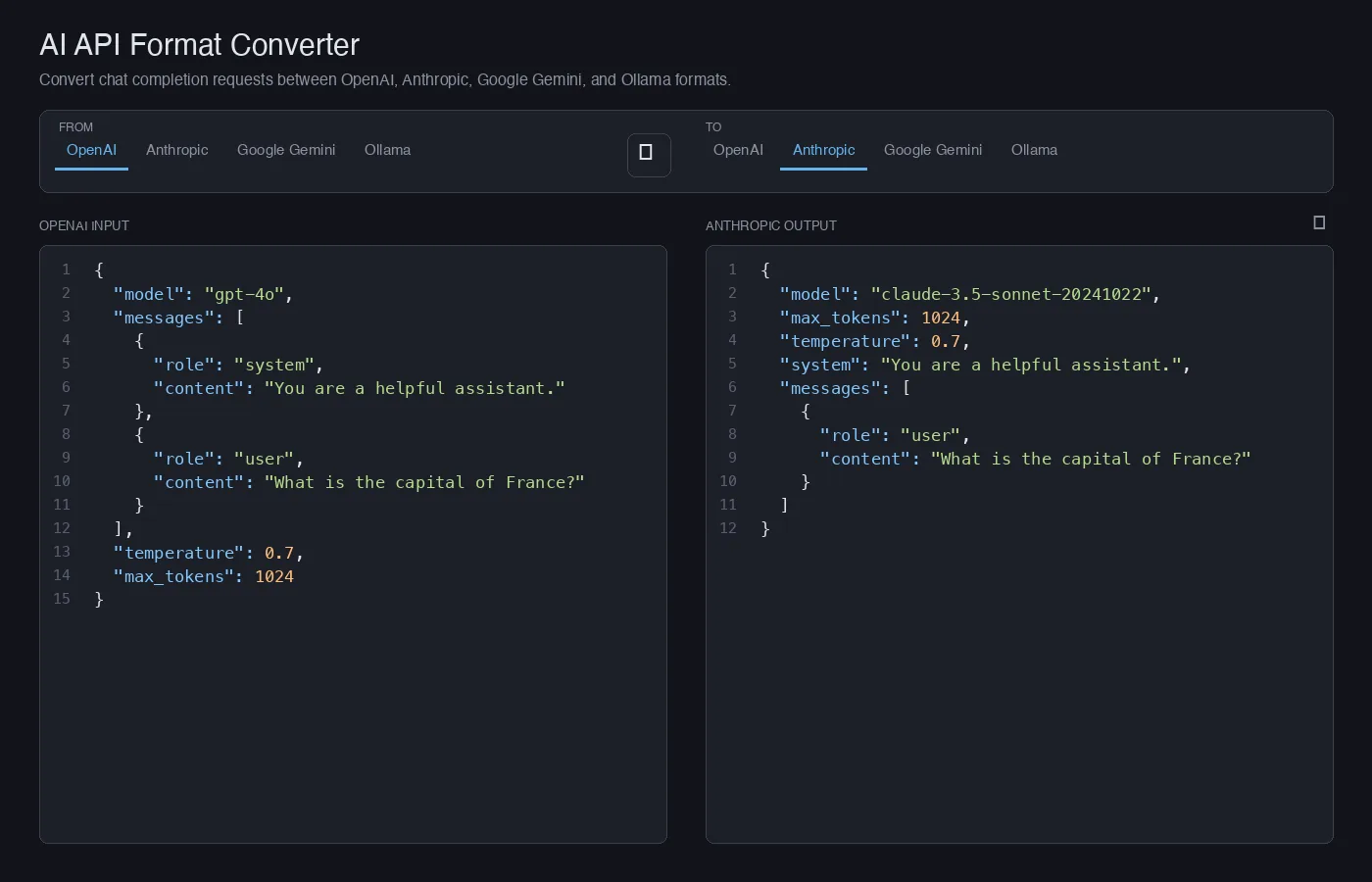
With From = OpenAI and To = Anthropic, the sample above becomes:
1
2
3
4
5
6
7
8
9
{
  "model": "claude-3.5-sonnet-20241022",
  "max_tokens": 1024,
  "temperature": 0.7,
  "system": "You are a helpful assistant.",
  "messages": [
    { "role": "user", "content": "What is the capital of France?" }
  ]
}
The system message has moved out of the array, max_tokens has become required-and-first (Anthropic rejects a request without it), and the model name has been replaced because gpt-4o is meaningless to the Anthropic endpoint.
How the conversion works
The converter does not keep a four-by-four matrix of provider pairs. Each source format is parsed into one small canonical shape, and each target format is rendered from that shape:
1
2
3
4
messages:    [{ role, content: string }]
model:       string
temperature: number   (default 0.7)
maxTokens:   number   (default 1024)
That design is why the Swap button is cheap: it copies the current output into the input editor and flips the two tabs, so you can round-trip a request and see what survives. The per-provider rules are the part worth knowing when you read the output.
Parsing in
- OpenAI reads
messages,model,temperature,max_tokens. - Anthropic reads the same, then prepends the top-level
systemstring as asystemmessage so it is not lost. - Google Gemini requires a
contentsarray (anything else is an error chip); each item’spartsare flattened to text,role: "model"is mapped back toassistant,systemInstruction.partsbecomes a leading system message, andgenerationConfig.temperature/maxOutputTokensfill the two numbers. - Ollama reads
messagesandmodel, and takestemperatureandnum_predictfromoptions.
Rendering out
- OpenAI emits
model,messages,temperature,max_tokens. - Anthropic hoists the first system message into
system, keeps the model only if its name containsclaude(otherwiseclaude-3.5-sonnet-20241022), and forces every non-assistant role touser. - Google Gemini emits
systemInstruction.parts[].text, acontentsarray withassistantrenamed tomodeland every content wrapped inparts: [{ text }], and agenerationConfigblock. Note that it emits nomodelfield at all, because Gemini takes the model from the URL. - Ollama keeps the model only if its name contains
llamaormistral(otherwisellama3.1), addsstream: false, and neststemperatureandnum_predictunderoptions.
What it deliberately drops
Because the canonical shape is role + text, the converter is lossy by design, and the losses are the exact places where provider adapters bite in production:
- Multimodal and structured content is flattened. An OpenAI
contentarray of{ type: "text" }and{ type: "image_url" }parts becomes the text parts joined with newlines; the image reference is gone. GeminiinlineDataparts are serialised as JSON strings rather than carried across. - Tool and function calling is not translated.
tools,tool_choice,tool_callsand Anthropictool_useblocks are ignored; if you need that mapping, build the schema once with the Function Call Schema Builder and wire it per provider. - Sampling parameters other than temperature and max tokens are dropped.
top_p,stop,seed,response_format,presence_penaltyand friends do not appear in the output. - Model names are substituted, not mapped. The tool does not know that
gpt-4ois “roughly” any particular Claude or Gemini model; it falls back to a sensible default and leaves the choice to you.
None of these are bugs to work around; they are the boundary of what a shape converter can do honestly. The value is that the output is a correct minimal request for the target API, which is the thing you want to diff your adapter’s output against.
Where it fits in an AI SDLC
Three uses have come up repeatedly:
- Provider evaluation. When comparing answer quality across vendors, paste the request you already send to one provider and copy the converted payload into
curlfor the other. The comparison is then about the model, not about whether you remembered Gemini’spartswrapper. - Adapter tests. Convert a handful of representative requests and commit the outputs as fixtures. Your own adapter code should produce the same shape, and when it does not, the diff tells you which rule you missed.
- Local fallback. Teams running Ollama as an offline or cost-control fallback can see at a glance that the Ollama body is close to OpenAI’s except for
optionsandstream, which usually settles the “do we need a second client library” question quickly.
If you use the AI Pricing Calculator to decide which provider to try next, this is the tool that gets the first request onto the wire without reading four sets of docs.