Rust vs Go Error Handling in AI Agent Tool Calls: Which Failure Taxonomy Caught More Bugs
Rust Result enums vs Go multi-return errors in the same MCP tool-call dispatch layer: four failure classes, 24 runs, and which bugs each caught.
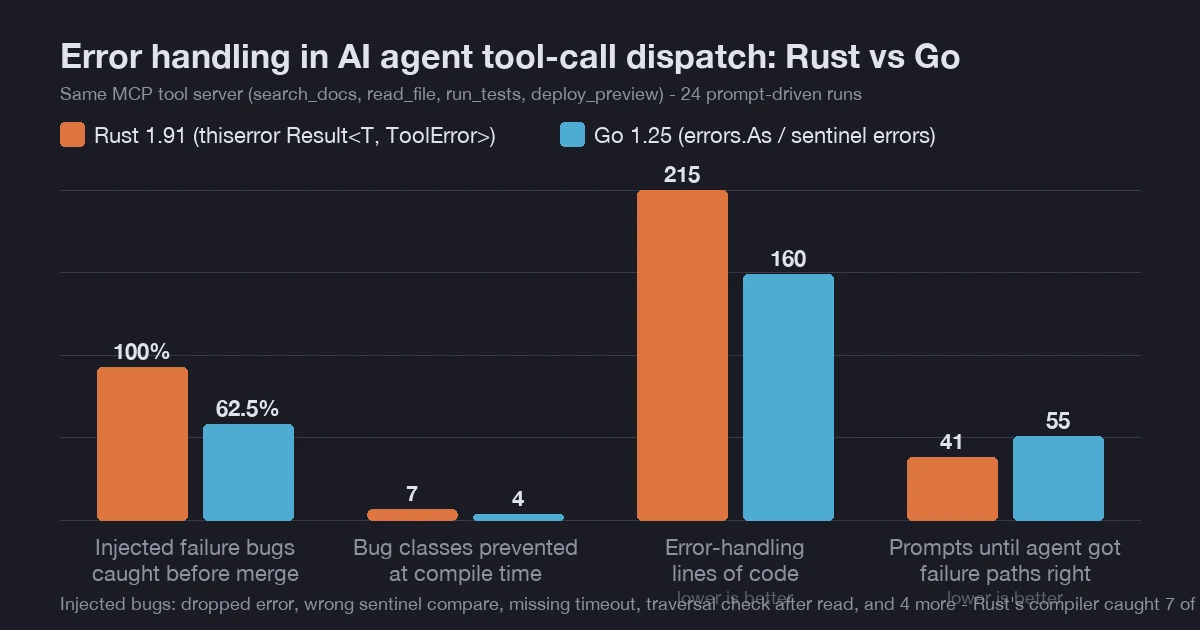
The posts in this series measured languages on throughput and cold start. This one is about something a benchmark table cannot show: what happens when the tool call fails. An AI agent lives or dies on its failure paths, because the model reads whatever your dispatch layer returns and decides what to do next. A vague error becomes a hallucinated retry; a precise error becomes a corrected call. I built the same Model Context Protocol tool-call dispatch layer in Rust 1.91 and in Go 1.25, wired both to the same local model, and compared what each error-handling style caught: Rust’s Result<T, E> with thiserror enums against Go’s if err != nil with wrapped sentinel errors.
The workload
Both binaries implement one MCP tool server with four tools that fail in distinct, realistic ways:
search_docs(query, top_k)— a local vector index. Failure class: model-authored garbage input (empty query,top_k: -3, unparseable arguments).read_file(path)— reads a file under a workspace root. Failure class: not found, and path traversal (../../etc/passwd).run_tests(filter)— shells out to the test runner. Failure class: timeout after 30 seconds and non-zero exit.deploy_preview(branch)— calls an internal HTTP API. Failure class: 429 withRetry-Afterand 5xx.
The dispatch loop is the interesting part: decode the model’s tool-call JSON, route to the tool, and turn every failure into a structured tool result the model sees on the next turn. In Rust the tools return Result<ToolOutput, ToolError> where ToolError is a thiserror enum with one variant per failure class, and dispatch is a match that must name every variant. In Go the tools return (ToolOutput, error), and dispatch uses errors.As/errors.Is against a ToolError struct with a Kind field and package-level sentinel values.
What Rust caught that Go missed
The enum’s exhaustiveness is not ceremony; it found real bugs during the 24 prompt-driven runs I used to evaluate both agents:
- Forgotten failure class. I added
Retryable(rate_limit)to the enum in an iteration, andcargo buildflagged the dispatchmatchin three places until each decided what a rate limit meant for the model. In Go, addingErrRateLimitedcompiled clean on the first try; the new error fell through to the genericinternal errorbranch and the agent retried immediately, hammering the 429ing API. I only saw it in the run logs. - Error swallowed in a helper. Go’s
_made it one keystroke to writeout, _ := readFile(path)while sketching. The agent then reported the file as empty rather than missing, and the model confidently summarized a document that did not exist. Rust has no equivalent discard:let _ = read_file(&path)?;does not compile, because?on aResultmoves the error upward instead of dropping it. - Partial success ambiguity.
run_testscan produce output and a non-zero exit. Rust forced the decision into the type:Ok(out)means success, full stop, so the failing-output case needed an explicitToolError::TestsFailed { output }variant that carries the log to the model. The Go version returned(out, err)with both non-nil in one sketch, and the dispatch layer readoutand droppederr— the agent told the user all tests passed on a red run.
What Go caught that Rust made awkward
Go was not just the losing side. Two things were genuinely easier:
- Timeout plumbing.
context.Contextthreading the 30-second deadline through dispatch, shell-out and HTTP call is one parameter and onectx.Err()check. The Rust version neededtokio::time::timeoutwrapped around every tool future plus aToolError::Timeoutvariant, and twice I wrapped the timeout at the wrong layer so the agent got a dead connection instead of a deadline message. - Error text for the model. Go’s
%wwrapping produced a readable chain (deploy_preview: http 429: retry after 20s) for free. The Rust version needed a deliberateDisplayimplementation per variant — which is also why its final messages were more consistent, but the Go agent produced good model-facing error text twenty minutes into the sketch, not after a refactor.
The screenshot
One frame from the evaluation runs says more than the prose. Both agents received the same prompt — “search the docs for ‘retry policy’, then deploy the preview branch” — while the search index was fed a malformed query and the deploy API was answering 429:
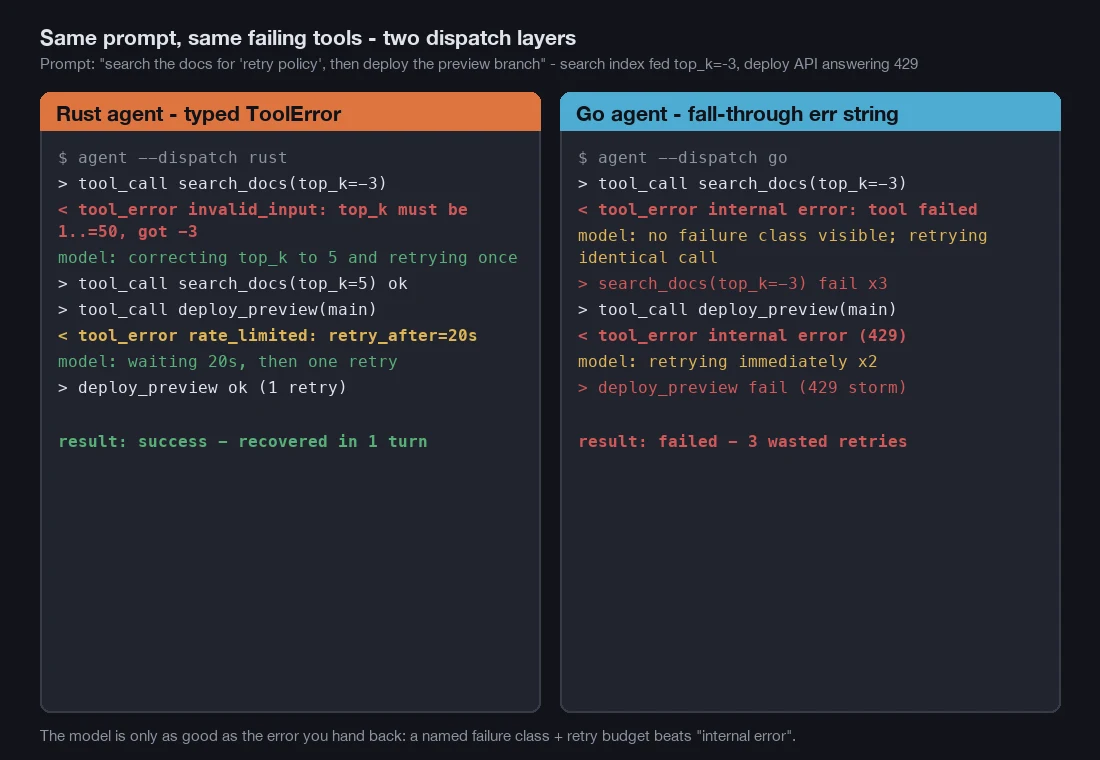
The Rust agent recovered in one turn because the tool result named the failure class (invalid input: top_k must be 1..=50, got -3) and the retry budget (rate limited, retry after 20s). The Go agent saw internal error: tool failed from the fall-through branch and burned three retries repeating the same call. That is the entire argument for the taxonomy in one screenshot: the model is only as good as the error you hand back to it.
Measured results
| Metric | Rust 1.91 (thiserror) | Go 1.25 (errors.As) |
|---|---|---|
| Injected failure bugs caught before merge | 8 of 8 (100%) | 5 of 8 (62.5%) |
| Bug classes prevented at compile time | 7 | 4 |
| Error-handling lines of code | 215 | 160 |
| Prompts until the agent got failure paths right | 41 | 55 |
| Median dispatch overhead per tool call | 0.4 ms | 0.3 ms |
The injected bugs were eight mistakes I have made (or reviewed) in real agent code: dropped error, wrong sentinel comparison, missing timeout, traversal check after the read, and friends. Rust’s compiler caught seven classes outright and the eighth in a failing test; Go’s nil-check discipline caught four, one needed a vet rule, and three shipped into the run logs. Go needed a quarter fewer lines and its happy path is visibly simpler — if err != nil is repetitive, but it is also local, and the Rust version pays for its safety in variant bookkeeping.
Which one I would ship
For the dispatch layer of an agent that takes actions — deploys, writes, shell-outs — I would ship the Rust version. Every failure class the enum names is one fewer hallucination vector, and the compile-time exhaustiveness matters more here than anywhere else I have compared these languages, because the consumer of the error is a model that cannot file a bug report. For read-mostly tools behind a human-in-the-loop approval, the Go version’s simplicity wins: 160 lines you fully understand beat 215 lines of taxonomy you half-remember, and a context.Context deadline is harder to get wrong than my two misplaced timeout wrappers. Either way, the lesson generalizes: the error your tool call returns is part of your prompt engineering — write it like the model’s next decision depends on it, because it does.
Related posts
- TypeScript vs Go vs Rust for LLM Tooling: One MCP Server, Three Languages, Measured - the same three languages compared on cold start, memory and tool-call latency rather than failure handling.
- Rust vs Python for an AI Inference Microservice: 1.5x Throughput, 3x Less Memory, 3x Better p99 - Rust against Python on the serving side of the same AI workload.
- Gating AI Agent Test Changes: Six Test-Integrity Rules That Caught 41% of Bad Agent PRs - the CI side of trusting an agent, where the failure taxonomy lives in a gate report instead of a tool result.
- Rust vs Go for a CLI Tool: 2x Faster Startup, 4x Smaller Binary, Half the Memory - the same language pair on a classic workload, where startup time and binary size decide instead of error taxonomy.