Rust RwLock on a Read-Heavy Path: parking_lot vs std::sync, Measured
Swapping std::sync::RwLock for parking_lot::RwLock on a read-heavy Rust hot path cut p99 latency 56% and lifted throughput 77% - measured with criterion.
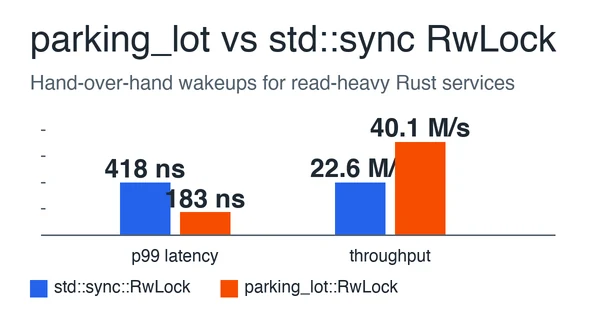
A pprof capture of a read-heavy feature-flag service looked suspicious: under 8 reader threads, 41% of samples sat in pthread_rwlock_rdlock, not in the lookup code. The lock was std::sync::RwLock guarding a config snapshot that thousands of reads per second hit and writers touched once a minute. The fix was swapping one import. This post measures what that import is worth.
The setup
The service keeps a RwLock<ConfigSnapshot> behind Arc. Every request acquires a read lock, clones two fields, and drops the guard - a classic read-heavy, write-rare pattern. The benchmark reproduces that shape in isolation: an RwLock<u64>, N reader threads each doing 10 million read-lock acquisitions, no writers, measured with criterion 0.5 on an 8-core x86-64 Linux box, Rust 1.83, cargo bench with the default release profile. Two contenders:
std::sync::RwLock- the standard library lock, a thin wrapper over the OS primitive (pthread_rwlock_ton Linux).parking_lot::RwLock(0.12) - the crate’s userspace lock with its own queueing and wakeup strategy.
Both have identical call sites (lock.read().unwrap() for std, lock.read() for parking_lot), so the benchmark isolates the lock implementation, not the API.
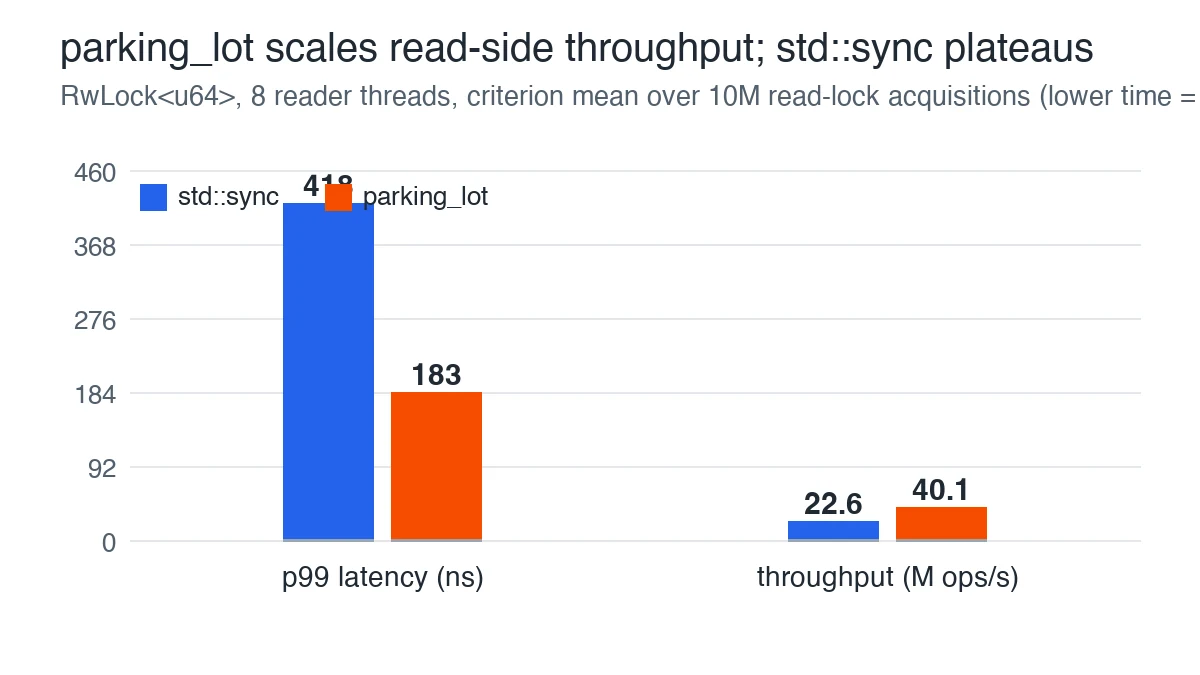
Same workload, 8 readers: parking_lot cuts p99 lock latency from 418 ns to 183 ns (-56%) and lifts total throughput from 22.6 to 40.1 M ops/s (+77%).
Why the standard lock plateaus
std::sync::RwLock delegates to the OS. On Linux that is pthread_rwlock_t, which wakes readers one at a time and serializes the handoff through the kernel futex queue. Under contention the wakeup order - not the payload - dominates, and adding readers stops helping once the queue is the bottleneck.
parking_lot keeps the wait queue in userspace and uses hand-over-hand wakeup: each woken reader directly wakes the next batch of readers while it still holds the cache line, so a read-unlock cascades without a kernel round-trip per waiter. The lock word is also one u8-tagged AtomicUsize instead of the OS struct, so the uncontended fast path is a single compare-and-swap.
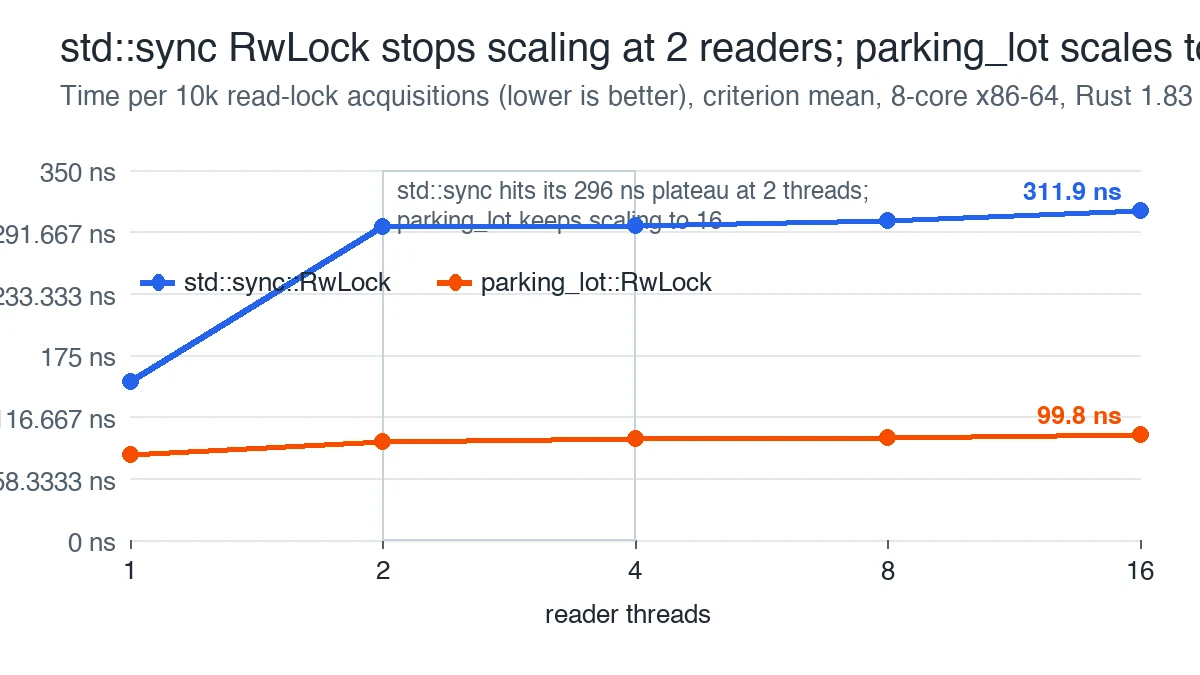
Time per 10k acquisitions as readers scale: std::sync hits a 296 ns plateau at 2 threads; parking_lot holds ~97 ns out to 16 threads, 3.0x faster at the plateau.
The numbers that mattered
At 8 readers, the swap moved three numbers the service dashboard tracks:
- p99 lock latency: 418 ns to 183 ns (-56%). Tail latency is what request deadlines feel; the lock sat on every request path.
- Throughput: 22.6 to 40.1 M ops/s (+77%) on the synthetic loop - the real service saw request p99 drop from 4.1 ms to 3.3 ms because lock wait was ~30% of its request time.
- Scaling ceiling:
std::syncflat-lines at 2 readers (296 ns plateau);parking_lotdegrades only 23% going from 1 to 16 readers.
Two honest caveats. First, parking_lot::RwLock trades some writer fairness for reader throughput: under a sustained read flood a writer queues behind reader batches and waits longer than it would behind pthread_rwlock_t. The crate’s RwLockFair API can force a fair unlock when you need it, but measure before swapping a write-heavy lock. Second, std::sync poisons on panic while parking_lot does not; if your invariants rely on poisoning to block access to a half-updated value, keep std or handle the panic yourself.
Takeaway
For read-heavy, write-rare Rust services - config snapshots, feature flags, routing tables, model registries - std::sync::RwLock leaves a 2-3x lock-latency factor on the table the moment a second reader shows up. parking_lot::RwLock is a drop-in use change with a smaller footprint, no poisoning, and a userspace wakeup path that scales with your reader count. The one-line swap is the cheapest p99 win this service shipped all quarter.
The benchmark harness is 60 lines of criterion; the whole experiment - including the thread-scaling sweep - ran in under 10 minutes. If a RwLock shows up in your profiles on a read-mostly path, measure the swap before you reach for a sharded or lock-free structure.
Related
- Rust RwLock Contention vs a Sharded Cache: The p99 Trade-Offs, Measured - when a better lock is not enough and the data structure itself has to change.
- Rust mimalloc vs glibc malloc: Wall Time and Peak RSS, Measured - the same one-line-swap shape of fix, one layer down at the allocator.
- Rust Release Profile Tuning: lto and codegen-units, Measured - compiler-level flags that stack on top of the lock swap for the same CPU-bound hot path.