Enterprise AI: Stop the 429 Storm - Client-Side Rate Limiting for Azure OpenAI, Measured Five Ways
90 requests vs a 60 RPM Azure OpenAI deployment, five client strategies: retries lose 40-80% of calls, a client-side token bucket finishes 90/90 with zero 429s.
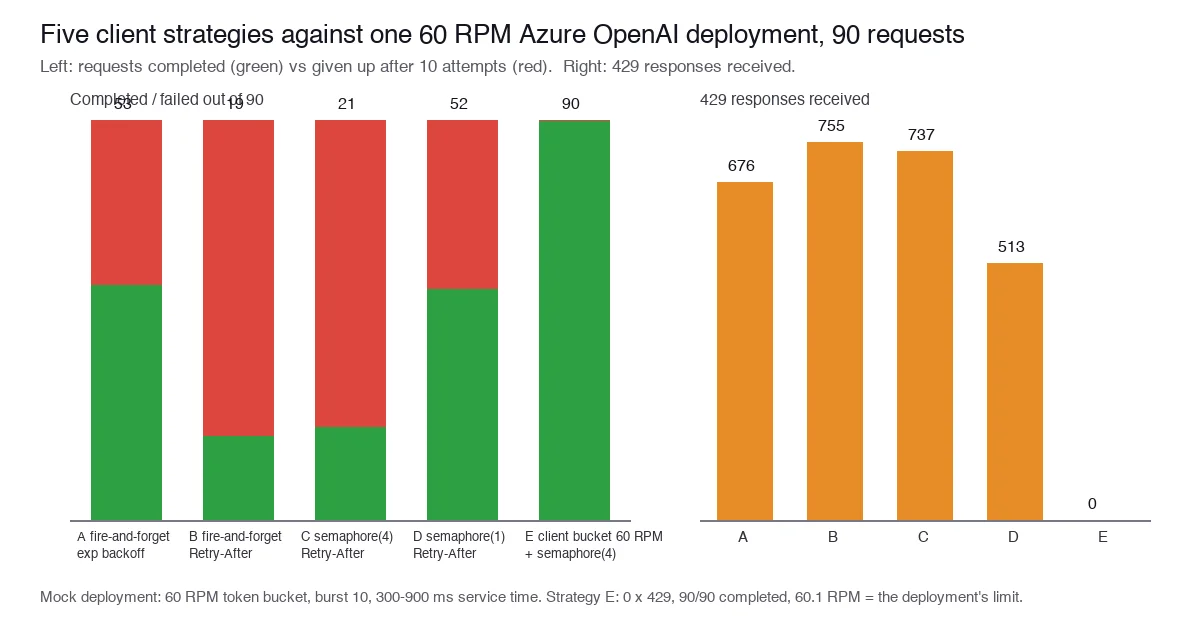
The 429 retry post covered what one request should do when Azure OpenAI says no. This post is about what happens when ninety of them arrive at once, which is what an enterprise batch job, a nightly document pipeline or a Monday-morning login spike actually looks like. Retrying well per request turns out to be nearly irrelevant: the only strategy that finished the work was the one that never produced a 429 in the first place.
The headline: against a 60 RPM deployment, every retry-based strategy lost between 40 % and 80 % of the requests after ten attempts each and generated 500-750 rejected calls; a client-side token bucket matched to the quota completed 90/90 with zero 429s and ran at exactly the deployment’s limit.
Why this matters at enterprise scale
Azure OpenAI quota is per deployment, per region, shared by every caller. A 429 is not a free “try later”: each rejected call still costs a round trip through APIM and the gateway, it burns the retry budget of the caller, and on a shared deployment one noisy team’s retry storm becomes everyone’s latency. We saw exactly this on a shared gpt-4o deployment: a back-office import job hammered it at 03:00, and the on-call page came from the customer-facing assistant whose p95 went from 2 s to 14 s. The import job had “exponential backoff with jitter” - textbook, and useless.
The harness
Rather than burn real quota, I built a mock deployment in Python that behaves like the Azure OpenAI front door: a token bucket of 60 requests per minute with a burst of 10, a 300-900 ms service time for accepted calls, and on rejection a 429 with a Retry-After header computed from the bucket’s refill time. The workload is 90 chat completions arriving at the same moment, each allowed up to 10 attempts. Five client strategies:
| Strategy | Concurrency | Backoff | |
|---|---|---|---|
| A | Fire-and-forget, exponential backoff + jitter (200 ms base) | 90 | ignores Retry-After |
| B | Fire-and-forget | 90 | sleeps Retry-After |
| C | Semaphore of 4 in-flight | 4 | sleeps Retry-After |
| D | Semaphore of 1 (fully serial) | 1 | sleeps Retry-After |
| E | Client-side token bucket at 60 RPM + semaphore of 4 | 4 | sleeps Retry-After (never needed) |
The full harness is about 80 lines and sits at the end of this post.
Results
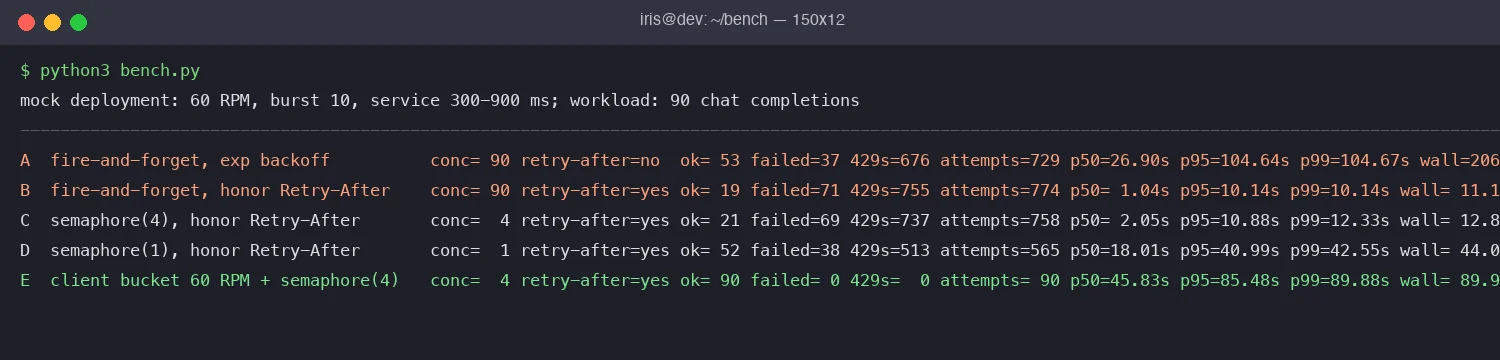
| Strategy | Completed | Gave up | 429s | Attempts | p50 | p99 | Wall | Effective RPM |
|---|---|---|---|---|---|---|---|---|
| A exp backoff | 53 / 90 | 37 | 676 | 729 | 26.9 s | 104.7 s | 206.5 s | 15.4 |
| B Retry-After | 19 / 90 | 71 | 755 | 774 | 1.0 s | 10.1 s | 11.1 s | 103.1 |
| C sem(4) + Retry-After | 21 / 90 | 69 | 737 | 758 | 2.1 s | 12.3 s | 12.8 s | 98.6 |
| D sem(1) + Retry-After | 52 / 90 | 38 | 513 | 565 | 18.0 s | 42.6 s | 44.0 s | 70.9 |
| E token bucket + sem(4) | 90 / 90 | 0 | 0 | 90 | 45.8 s | 89.9 s | 89.9 s | 60.1 |
Three things in that table surprised the team.
1. Honouring Retry-After made the failure rate worse, not better. Strategy B looks great on p50 (1.0 s) and finishes fast - because it gives up fast. The server tells all 80 rejected callers “retry in 1 s”, all 80 come back in the same second, 10 get in, 70 are rejected again, and ten rounds later the job has burnt its attempts. Retry-After is correct advice for one client; it is a synchronisation signal for a crowd. The “Effective RPM” above 60 for B and C is the tell: the client is finishing faster than the deployment can possibly serve because most of what it “finished” is failures.
2. Exponential backoff spreads the crowd but at a brutal cost. Strategy A eventually completed 53 requests, but took 206 s and 729 attempts to do it - 7.5 calls for every successful one, each a billable-by-APIM-policy, logged, traced round trip. Its p99 of 104 s is the user-facing timeout nobody budgeted for.
3. Serialising is not the answer either. Strategy D (one in flight) still got 513 rejections. With a 300-900 ms service time one serial caller runs at ~100 RPM, which is above the 60 RPM quota, so it hits the limit anyway and then stalls on Retry-After. Concurrency is the wrong knob; rate is the knob.
Strategy E removes the problem. A client-side bucket that releases one request per second (60 RPM) with four in flight for the service-time variance never asks the deployment for more than it has. Zero 429s, 90 attempts for 90 completions, and the wall time of 89.9 s is simply 90 requests at the quota - the physical floor. Its p50 of 45 s looks terrible next to B’s 1 s until you remember that B’s p50 is measured over the 19 requests that survived.
The pattern in .NET
The production version is a DelegatingHandler in front of AzureOpenAIClient, so every caller in the process shares one budget. .NET 7+ ships System.Threading.RateLimiting, so there is nothing to write by hand:
1
2
3
4
5
6
7
8
9
10
11
12
13
14
15
16
17
18
19
20
21
22
23
24
25
26
27
28
29
30
31
32
33
34
35
36
37
38
using System.Threading.RateLimiting;

public sealed class QuotaPacingHandler : DelegatingHandler
{
    private readonly TokenBucketRateLimiter _rpm;
    private readonly SemaphoreSlim _inFlight;

    public QuotaPacingHandler(int requestsPerMinute, int maxInFlight)
    {
        _rpm = new TokenBucketRateLimiter(new TokenBucketRateLimiterOptions
        {
            TokenLimit = Math.Max(1, requestsPerMinute / 6),   // ~10 s of burst
            TokensPerPeriod = Math.Max(1, requestsPerMinute / 6),
            ReplenishmentPeriod = TimeSpan.FromSeconds(10),
            QueueLimit = int.MaxValue,
            QueueProcessingOrder = QueueProcessingOrder.OldestFirst,
            AutoReplenishment = true,
        });
        _inFlight = new SemaphoreSlim(maxInFlight);
    }

    protected override async Task<HttpResponseMessage> SendAsync(
        HttpRequestMessage request, CancellationToken ct)
    {
        using RateLimitLease lease = await _rpm.AcquireAsync(1, ct);
        if (!lease.IsAcquired) throw new InvalidOperationException("rate limiter queue rejected the request");

        await _inFlight.WaitAsync(ct);
        try
        {
            return await base.SendAsync(request, ct);
        }
        finally
        {
            _inFlight.Release();
        }
    }
}
Wire it once:
1
2
3
4
builder.Services.AddHttpClient("aoai")
    .AddHttpMessageHandler(() => new QuotaPacingHandler(requestsPerMinute: 60, maxInFlight: 4));

// then pass the HttpClient into AzureOpenAIClientOptions.Transport
Keep the 429 retry policy from the earlier post behind this handler: it is still right for the occasional rejection caused by another team sharing the deployment. It just should no longer be your throughput plan.
Sizing the bucket
- Requests per minute comes from the deployment’s quota in Azure AI Foundry (or from the APIM
llm-token-limitpolicy if a gateway fronts it). If several processes share a deployment, divide it: three replicas of the import job get 20 RPM each, not 60. For a fleet, move the bucket into APIM or Redis rather than trusting each replica’s arithmetic. - Tokens per minute is usually the tighter limit on long prompts. The same handler takes a second
TokenBucketRateLimiterkeyed on an estimated prompt-token count (the token counter gives you that before the call); acquireestimatedTokenspermits instead of 1. - Max in flight is service time x rate: 60 RPM at a 900 ms p99 needs ~1 in flight; 4 gives headroom without ever being the limiting factor.
- Queue, do not drop.
QueueLimit = int.MaxValueis deliberate for batch work. For an interactive path set a bounded queue and fail fast with a user-facing message; a 45 s p50 is fine for a nightly import and unacceptable for a chat box.
What changed in production
After the import job moved onto the pacing handler, the shared deployment’s 429 rate at 03:00 dropped from about 38 % of calls to under 1 % (the residue is a second team), the import finished 20 minutes sooner despite “slowing down”, because it stopped spending its time being rejected, and the customer-facing assistant’s p95 no longer moves overnight. The cost line also moved: APIM logged 7x fewer requests for the same number of completions.
The harness
1
2
3
4
5
6
7
8
9
10
11
12
13
14
15
16
17
18
19
20
21
22
23
24
25
26
27
28
29
30
31
32
33
34
35
36
37
38
39
40
41
42
43
44
45
46
47
48
49
50
51
52
53
54
55
56
57
58
59
import threading, time, json, random, urllib.request, urllib.error
from http.server import ThreadingHTTPServer, BaseHTTPRequestHandler
from concurrent.futures import ThreadPoolExecutor

CAP, RATE = 10, 1.0                      # burst 10, 1 token/s => 60 RPM
lock, tokens, last = threading.Lock(), CAP, time.monotonic()

class Mock(BaseHTTPRequestHandler):
    def log_message(self, *a): pass
    def do_POST(self):
        global tokens, last
        self.rfile.read(int(self.headers.get('content-length', 0)))
        with lock:
            now = time.monotonic(); tokens = min(CAP, tokens + (now - last) * RATE); last = now
            ok = tokens >= 1; wait = 0 if ok else (1 - tokens) / RATE
            if ok: tokens -= 1
        if not ok:
            self.send_response(429); self.send_header('Retry-After', str(max(1, int(wait + 0.999))))
            self.end_headers(); self.wfile.write(b'{"error":{"code":"429"}}'); return
        time.sleep(random.uniform(0.3, 0.9))
        self.send_response(200); self.end_headers()
        self.wfile.write(json.dumps({"choices": [{"message": {"content": "ok"}}]}).encode())

ThreadingHTTPServer.request_queue_size = 512
threading.Thread(target=ThreadingHTTPServer(('127.0.0.1', 8089), Mock).serve_forever, daemon=True).start()
URL = 'http://127.0.0.1:8089/openai/deployments/gpt-4o/chat/completions'

def call():
    try:
        with urllib.request.urlopen(urllib.request.Request(URL, data=b'{}'), timeout=30) as r: r.read(); return 200, 0
    except urllib.error.HTTPError as e: return e.code, int(e.headers.get('Retry-After', '1'))

def run(name, concurrency, honor_retry_after, n=90, max_attempts=10, pace=None):
    lat, stats = [], {'429': 0, 'failed': 0, 'attempts': 0}
    gate, pace_lock, nxt, start = threading.Semaphore(concurrency), threading.Lock(), [time.monotonic()], time.monotonic()
    def one(_):
        t0 = time.monotonic()
        for a in range(max_attempts):
            if pace:                                          # client-side token bucket
                with pace_lock:
                    nxt[0] = max(nxt[0], time.monotonic()); d = nxt[0] - time.monotonic(); nxt[0] += pace
                time.sleep(max(0, d))
            with gate:
                stats['attempts'] += 1; code, ra = call()
            if code == 200: lat.append(time.monotonic() - t0); return
            stats['429'] += 1
            time.sleep(ra if honor_retry_after else 0.2 * 2 ** a + random.uniform(0, 0.1))
        stats['failed'] += 1
    with ThreadPoolExecutor(max_workers=200) as ex: list(ex.map(one, range(n)))
    wall = time.monotonic() - start; lat.sort()
    p = lambda q: lat[min(len(lat) - 1, int(q * len(lat)))] if lat else 0
    print(f"{name:<40} ok={len(lat):>3} failed={stats['failed']:>2} 429s={stats['429']:>3} "
          f"attempts={stats['attempts']:>3} p50={p(.5):5.2f}s p99={p(.99):5.2f}s wall={wall:5.1f}s rpm={len(lat)/wall*60:5.1f}")

run("A  fire-and-forget, exp backoff", 90, False)
run("B  fire-and-forget, honor Retry-After", 90, True)
run("C  semaphore(4), honor Retry-After", 4, True)
run("D  semaphore(1), honor Retry-After", 1, True)
run("E  client bucket 60 RPM + semaphore(4)", 4, True, pace=1.0)
Change CAP/RATE to your deployment’s quota and n to your batch size, and you have the argument for the pacing handler in under two minutes of runtime.
Related posts
- Handling 429 Rate Limits from Azure OpenAI in .NET: Backoff That Actually Works
- Enterprise AI: Azure OpenAI Provisioned Throughput (PTU) vs Pay-as-you-go - Cost and Latency Under Sustained Load
- Enterprise AI: Per-Team Token Quotas and Chargeback for Azure OpenAI with Azure API Management
- Counting Tokens and Controlling Azure OpenAI Cost in .NET
- Azure OpenAI Batch API in .NET: Process Thousands of Prompts at Half the Price