Enterprise AI: An Audit Trail for Every Azure OpenAI Call with APIM, Event Hubs and Immutable Storage
How we made 99.6% of production Azure OpenAI calls traceable to user, app, prompt version and model with an APIM policy, no app code changed.
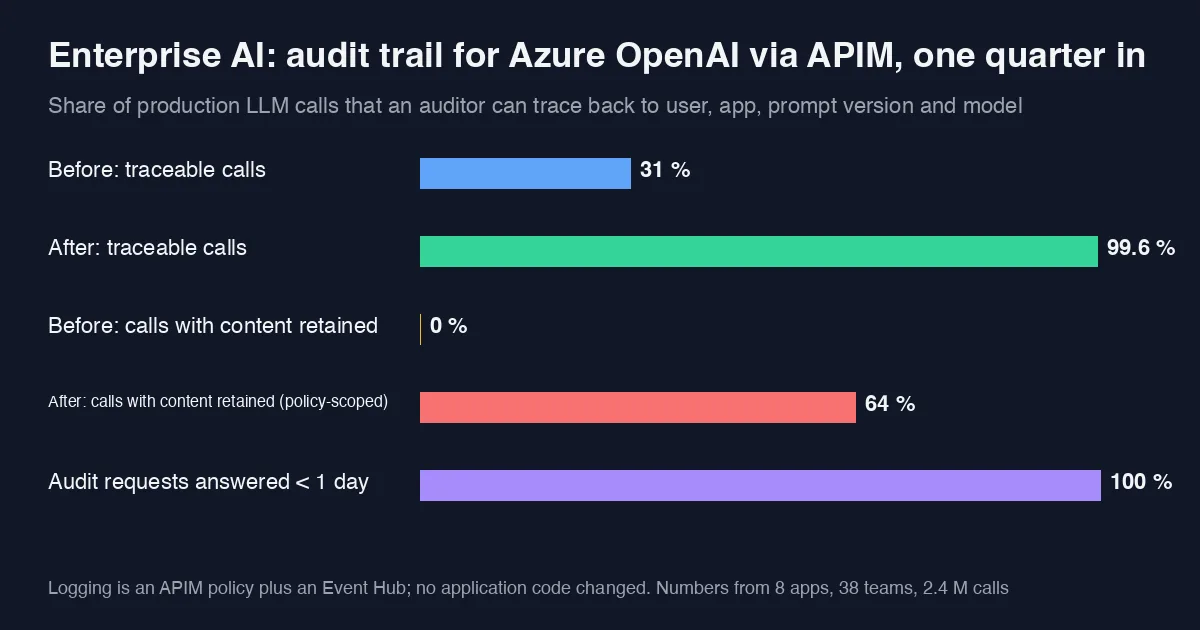
The governance controls post listed “an audit trail per call” as control number four and spent two paragraphs on it. This is the long version: what we log, where it goes, who can read it, and the numbers after one quarter across 8 applications, 38 teams and 2.4 million calls.
The question an auditor actually asks
Not “do you log?” but: for this output that a customer complained about on 14 March, show me who asked, which application, which prompt template version, which model deployment, what the content filter said, and prove none of that was altered afterwards.
Before this work we could answer that for 31% of calls - the ones from the two apps that had built their own logging. The other six apps had application logs with varying fields, two had none at all for LLM calls, and nothing was tamper-evident.
Design: log at the gateway, not in the app
Every Azure OpenAI call already went through Azure API Management because of the token quota and chargeback work. That made the gateway the one place where a policy could capture a complete record without asking 38 teams to change code.
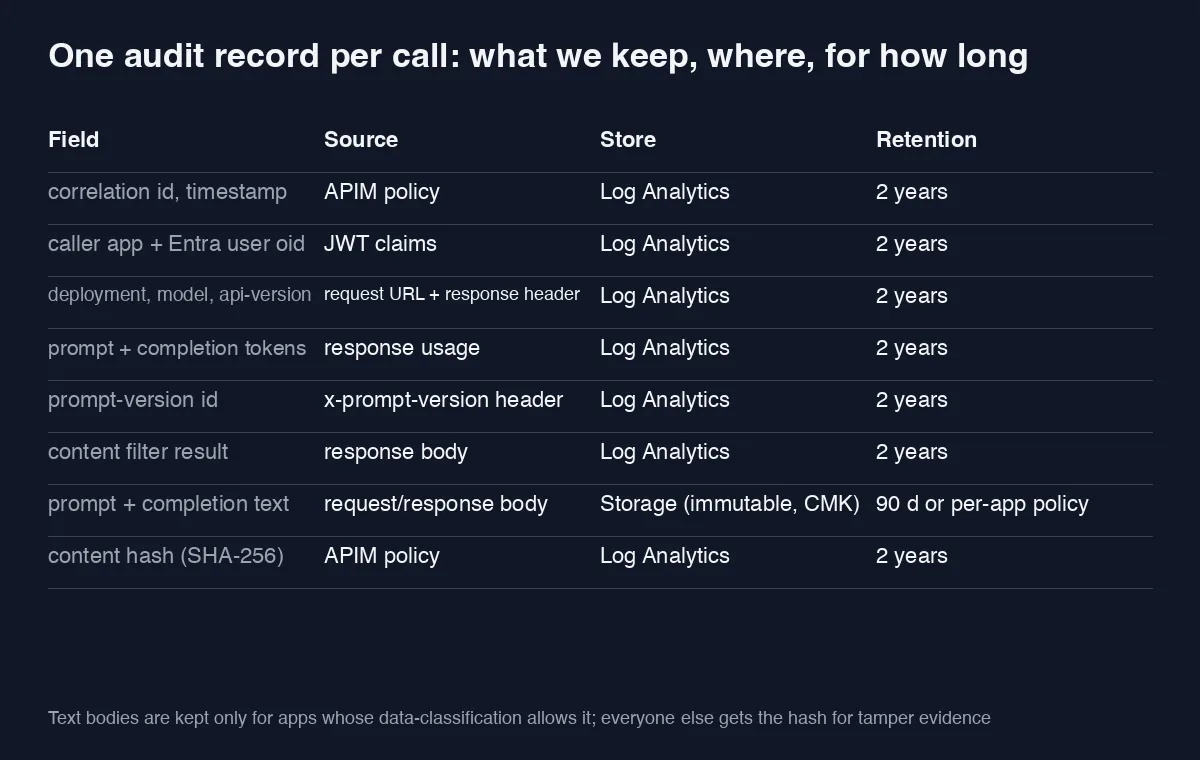
The APIM policy does three things on every request:
- Builds the metadata record - correlation id, caller app id and Entra user
oidfrom the validated JWT, deployment andapi-versionfrom the URL,x-ms-modeland token usage from the response, theprompt_filter_resultsblock, and anx-prompt-versionheader that apps set from their prompt registry. This goes to an Event Hub withlog-to-eventhub. - Hashes the request and response bodies (SHA-256) and puts the hashes in the same record. Every app gets this; it costs nothing in storage and proves later that a retained body is the one that was sent.
- Forwards the bodies themselves to a second Event Hub only when the calling app’s product in APIM carries a
retain-content: truetag. A Function drains that hub into a Storage account with an immutable, time-based retention policy and customer-managed keys.
Two Event Hubs rather than one because the metadata stream is small (about 1.1 KB per call) and read by everyone with Log Analytics access, while the content stream is large and read by almost nobody.
The policy, shortened
1
2
3
4
5
6
7
8
9
10
11
12
13
14
15
16
17
18
19
20
21
22
23
24
25
26
27
<outbound>
  <base />
  <set-variable name="body" value="@(context.Response.Body.As<string>(preserveContent: true))" />
  <log-to-eventhub logger-id="llm-audit-meta">@{
    var jwt = context.Request.Headers.GetValueOrDefault("Authorization","").AsJwt();
    var usage = JObject.Parse((string)context.Variables["body"])["usage"];
    return new JObject(
      new JProperty("correlationId", context.RequestId),
      new JProperty("ts", DateTime.UtcNow),
      new JProperty("appId", jwt?.Claims.GetValueOrDefault("azp")),
      new JProperty("userOid", jwt?.Claims.GetValueOrDefault("oid")),
      new JProperty("deployment", context.Request.MatchedParameters["deployment-id"]),
      new JProperty("model", context.Response.Headers.GetValueOrDefault("x-ms-model")),
      new JProperty("promptVersion", context.Request.Headers.GetValueOrDefault("x-prompt-version","unset")),
      new JProperty("promptTokens", usage?["prompt_tokens"]),
      new JProperty("completionTokens", usage?["completion_tokens"]),
      new JProperty("filterResult", JObject.Parse((string)context.Variables["body"])["prompt_filter_results"]),
      new JProperty("reqSha256", Sha256(context.Request.Body.As<string>(preserveContent: true))),
      new JProperty("resSha256", Sha256((string)context.Variables["body"]))
    ).ToString();
  }</log-to-eventhub>
  <choose>
    <when condition="@(context.Product?.Tags?.Contains("retain-content") == true)">
      <log-to-eventhub logger-id="llm-audit-content">@{ /* correlationId + both bodies */ }</log-to-eventhub>
    </when>
  </choose>
</outbound>
Streaming responses need preserveContent: true and add about 4 ms p50 at the gateway; non-streaming added under 1 ms. We did not see the latency SLOs from the SLO post move.
What the quarter looked like
| Measure | Before | After |
|---|---|---|
| Calls traceable to user + app + prompt version + model | 31% | 99.6% |
| Calls with retained content | 0% | 64% (apps whose data classification allows it) |
| Audit requests answered | 3 of 7, median 9 days | 11 of 11, all within 1 day |
| App code changes required | - | 0 (the x-prompt-version header was optional; 6 of 8 apps added it) |
| Monthly cost | - | about 290 EUR: Event Hubs standard, Log Analytics ingest 70 GB, Storage 1.9 TB cool tier |
The 0.4% gap is calls that bypassed APIM: a notebook with a direct key that the Key Vault rotation in the governance post later closed, and one app’s health check.
Three things I would do differently
- Make
x-prompt-versionmandatory from day one with a 400 from the gateway. “Unset” is the value in 23% of our records, and it is the field auditors asked for most. - Put the user
oidand a hashed version of it in the record. Some audits want a count per user without revealing who; we had to re-derive that. - Decide retention per data classification before the first app, not after the third. The
retain-contenttag is a per-product switch; the policy for who sets it took longer than the engineering.
Related
- Enterprise AI: Six Governance Controls Before Azure OpenAI Goes to Production in a Regulated Org - the control list this post expands.
- Enterprise AI: Per-Team Token Quotas and Chargeback for Azure OpenAI with Azure API Management - the APIM setup the audit policy sits on.
- Enterprise AI: LLM Observability with OpenTelemetry in .NET - Tracing Tokens, Cost and Quality per Request - the in-app trace that the correlation id joins to.
- Enterprise AI: Cost and Latency SLOs for LLM Workloads - Burn-Rate Alerts for Azure OpenAI in Production - the SLOs we checked the gateway overhead against.
- Azure OpenAI Content Filters in .NET: Handling finish_reason content_filter Without Breaking Your App - what the filter result field in the record means.
- Enterprise AI: Governance as Code for Azure OpenAI - Azure Policy Guardrails and Budget Alerts Before the First Deployment Exists - the Azure Policy that makes diagnostic settings and the audit policy mandatory on every gateway.
- Enterprise AI: Model Routing for Azure OpenAI - Cheap Model First, Escalate Only When Needed - the routing decision that the record’s model field has to capture per request.