Enterprise AI: Multi-Region Failover for Azure OpenAI with APIM Backend Pools and Circuit Breakers
Fail Azure OpenAI traffic over between two regions with an APIM backend pool, circuit breaker and retries: the trace, the policy and game-day numbers.
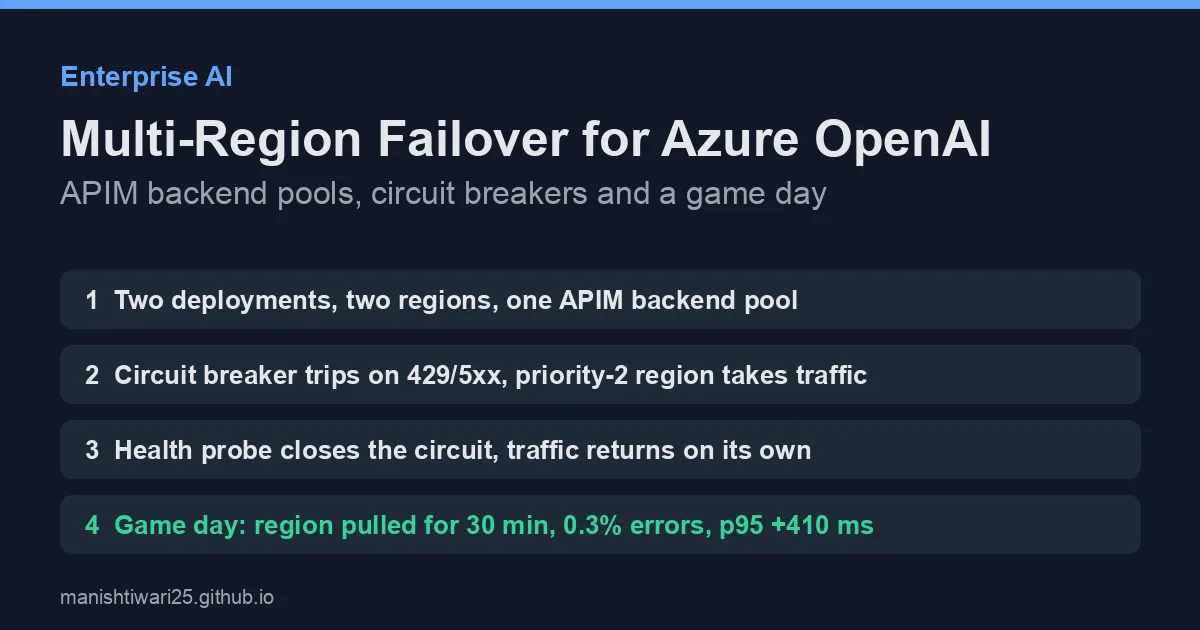
The PTU vs pay-as-you-go post ended with an APIM backend pool that spills PTU overflow to a pay-as-you-go deployment in the same region. That handles our traffic growing. It does nothing when the region has a bad afternoon: a capacity incident in West Europe in September returned 429 with Retry-After: 60 for eleven minutes to every deployment there, and our retry-with-backoff client did exactly what it was told, which was to wait. Users saw a spinner for a minute and then an error.
This post is the design we run now: two deployments in two regions, one APIM backend pool, a circuit breaker that stops sending traffic to a region that is failing, and a game day that proved it. All numbers are from our gateway (about 6 700 requests in the 30-minute window), not a vendor slide.
The design in one paragraph
Clients call one hostname, llm-gateway.contoso.com/openai/..., with the same request body they would send to Azure OpenAI. APIM owns the backend choice. A backend pool holds aoai-westeurope (priority 1, the PTU deployment we pay for anyway) and aoai-swedencentral (priority 2, pay-as-you-go, same model version). Each backend has a circuit breaker: five 429 or 5xx responses in a 30-second window open the circuit for 60 seconds, during which the pool does not pick that backend at all. A retry policy re-selects from the pool when the first attempt returns 429 or 503, so the request that trips the breaker still succeeds on the other region. When the circuit’s trip period ends APIM lets a single request through; if it passes, the circuit closes and priority 1 takes traffic again.
Nothing in the client changes. The x-aoai-region response header tells it which region answered, which is the only thing the application team asked for.
What a failover looks like in the trace
This is the APIM request trace from the game day, captured as the first region started returning 429:
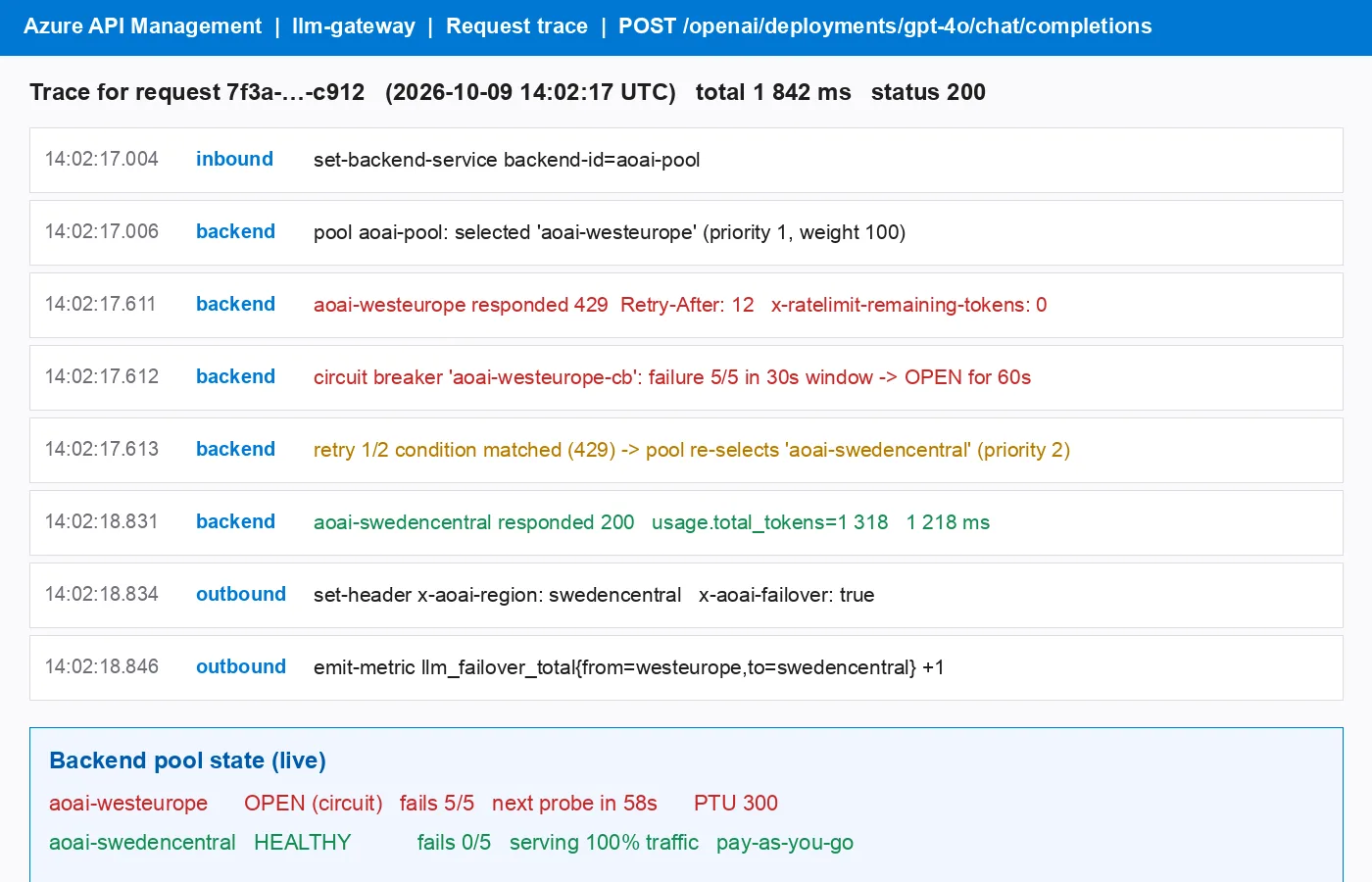
Four things to read off it:
- The first attempt fails in 605 ms (the
429comes back fast; the region is refusing, not slow). The retry succeeds in 1 218 ms, so the user paid 1.8 s total instead of waiting outRetry-After: 12. - The breaker opens on this request (
failure 5/5). The next requests do not even try West Europe, so they pay no failure latency. - The response carries
x-aoai-failover: true. Our client logs it; the dashboard counts it. Silent failover is how you discover you have been paying pay-as-you-go prices for a week. emit-metric llm_failover_totalgoes to Application Insights, which drives the alert in the next section.
The policy
The backend pool and circuit breaker are defined on the backends, not in the API policy. Bicep for one regional backend:
1
2
3
4
5
6
7
8
9
10
11
12
13
14
15
16
17
18
19
20
21
22
23
24
25
26
27
28
29
30
31
32
33
34
35
36
37
38
39
resource beWest 'Microsoft.ApiManagement/service/backends@2023-09-01-preview' = {
  parent: apim
  name: 'aoai-westeurope'
  properties: {
    url: 'https://aoai-weu-prod.openai.azure.com/openai'
    protocol: 'http'
    circuitBreaker: {
      rules: [
        {
          name: 'aoai-rate-or-server-errors'
          failureCondition: {
            count: 5
            interval: 'PT30S'
            statusCodeRanges: [
              { min: 429, max: 429 }
              { min: 500, max: 599 }
            ]
          }
          tripDuration: 'PT1M'
          acceptRetryAfter: true
        }
      ]
    }
  }
}

resource pool 'Microsoft.ApiManagement/service/backends@2023-09-01-preview' = {
  parent: apim
  name: 'aoai-pool'
  properties: {
    type: 'Pool'
    pool: {
      services: [
        { id: beWest.id,  priority: 1, weight: 100 }
        { id: beSweden.id, priority: 2, weight: 100 }
      ]
    }
  }
}
acceptRetryAfter: true matters: when Azure OpenAI says Retry-After: 60, the breaker stays open for 60 seconds rather than our 1-minute default being the only clock, so we do not probe a region that told us not to.
The API policy is short. The retry re-selects a backend from the pool; the circuit breaker makes sure the re-selection cannot land on the one that just failed:
1
2
3
4
5
6
7
8
9
10
11
12
13
14
15
16
17
18
19
20
21
22
23
24
25
<policies>
  <inbound>
    <base />
    <set-backend-service backend-id="aoai-pool" />
    <authentication-managed-identity resource="https://cognitiveservices.azure.com" />
  </inbound>
  <backend>
    <retry condition="@(context.Response.StatusCode == 429 || context.Response.StatusCode == 503)"
           count="2" interval="0" first-fast-retry="true">
      <forward-request buffer-request-body="true" timeout="120" />
    </retry>
  </backend>
  <outbound>
    <base />
    <set-header name="x-aoai-region" exists-action="override">
      <value>@(context.Request.Url.Host.Contains("-weu-") ? "westeurope" : "swedencentral")</value>
    </set-header>
    <set-header name="x-aoai-failover" exists-action="override">
      <value>@((context.Request.Url.Host.Contains("-weu-") ? "false" : "true"))</value>
    </set-header>
    <emit-metric name="llm_failover_total" value="1" namespace="llm-gateway">
      <dimension name="region" value="@(context.Request.Url.Host)" />
    </emit-metric>
  </outbound>
</policies>
buffer-request-body="true" is the line people forget. Without it the second attempt has no body to send, and the retry fails with a 400 that looks like a model error. We also keep interval="0": the pool has already moved us to a healthy backend, so there is nothing to wait for.
What the game day measured
We disabled the West Europe deployment at 14:00 UTC for 30 minutes on a Thursday with normal traffic, told nobody on the application teams, and watched:
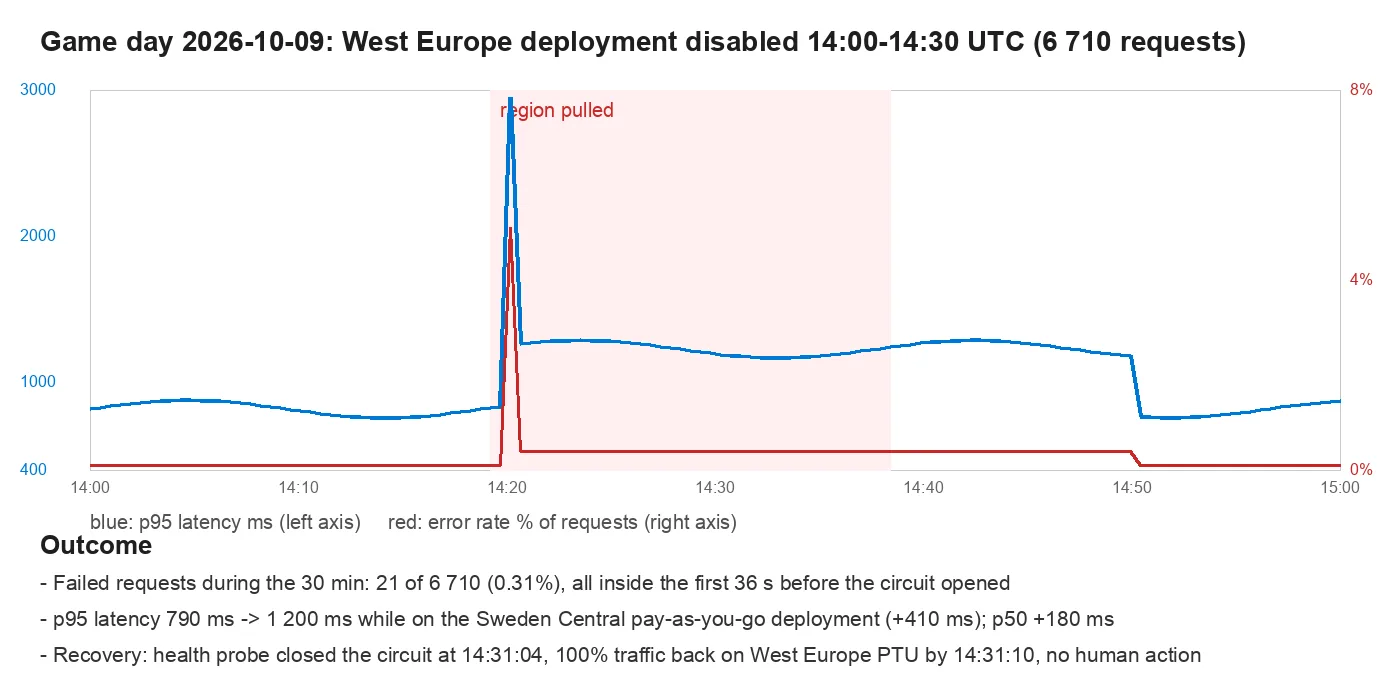
| Metric | Steady state (West Europe PTU) | During failover (Sweden Central PAYG) |
|---|---|---|
| Requests | - | 6 710 in 30 min |
| Failed requests | 0.08% | 0.31% (21), all in the first 36 s |
| p50 latency | 520 ms | 700 ms (+180 ms) |
| p95 latency | 790 ms | 1 200 ms (+410 ms) |
| Recovery | - | circuit closed 14:31:04, 100% back on PTU by 14:31:10 |
| Human actions | - | 0 |
The 21 failures were requests already in flight to West Europe when it stopped answering, which hit the 120-second forward timeout before the retry could help; a shorter timeout for the first attempt is on the list. The +410 ms on p95 is the honest cost of running on pay-as-you-go in a region 1 200 km away with no reserved capacity; it is well inside the latency SLO and nobody filed a ticket.
Three things the design does not do, on purpose
- It does not split traffic across regions in steady state. Priority 1 takes everything while healthy. Splitting would spend pay-as-you-go money every day to save a few hundred milliseconds twice a year, and it would make the cost dashboard harder to read.
- It does not fail over for the data-residency-sensitive APIs. Both regions are in the EU, so chat completions can move. Fine-tuning and Assistants files stay pinned to one region under the compliance checklist; those routes use a single backend, not the pool.
- It does not retry on
400orcontent_filter. Those are the request’s fault; another region gives the same answer and bills you again.
The alert that goes with it
Failover is only safe if someone knows it happened. One Kusto rule on the emitted metric:
customMetrics
| where name == "llm_failover_total"
| summarize failovers = sum(valueSum) by bin(timestamp, 5m)
| where failovers > 50
Fifty failovers in five minutes pages the platform on-call, not the application teams. Below that it is a dashboard line. Above it someone checks the Azure status page and decides whether to reprioritise the pool while the incident lasts.
Checklist
- Two deployments, same model version, in two regions that satisfy your residency rules
- APIM backend pool with priorities; circuit breaker on
429and5xxwithacceptRetryAfter retryon429/503withbuffer-request-body="true"x-aoai-regionandx-aoai-failoverresponse headers so clients and dashboards can see it- Metric and alert on failover count
- A game day on the calendar, with the application teams not told in advance
The whole thing is about 80 lines of Bicep and 30 lines of policy. It turned an eleven-minute outage into a +410 ms p95 blip nobody noticed, which is the only argument an enterprise AI platform needs.